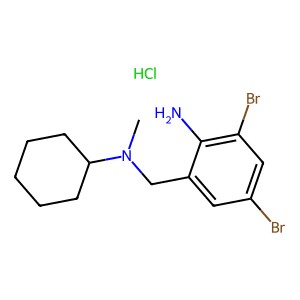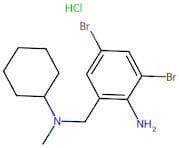
CAS 611-75-6
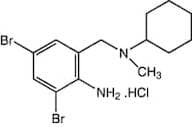
:Cloridrato de bromexina
Descrição:
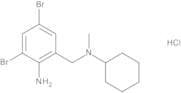
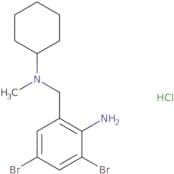
Cloridrato de bromexina é um agente mucolítico sintético usado principalmente no tratamento de condições respiratórias associadas à produção excessiva de muco, como bronquite crônica e asma. Funciona quebrando a estrutura do muco, tornando-o menos viscoso e mais fácil de expelir. Este composto é um pó cristalino branco a off-white que é solúvel em água e tem um sabor ligeiramente amargo. Sua fórmula química é C14H21Br2N·HCl, e tem um peso molecular de aproximadamente 377,65 g/mol. Cloridrato de bromexina é tipicamente administrado por via oral e está disponível em várias formulações, incluindo comprimidos, xaropes e soluções para inalação. O medicamento geralmente é bem tolerado, mas os efeitos colaterais potenciais podem incluir distúrbios gastrointestinais, reações alérgicas e tontura. É importante notar que, embora a bromexina possa ajudar na eliminação do muco, deve ser usada como parte de um plano de tratamento abrangente sob supervisão médica.
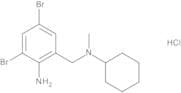
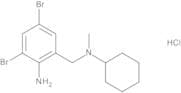
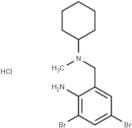
Fórmula:C14H20Br2N2·ClH
InChI:InChI=1S/C14H20Br2N2.ClH/c1-18(12-5-3-2-4-6-12)9-10-7-11(15)8-13(16)14(10)17;/h7-8,12H,2-6,9,17H2,1H3;1H
Chave InChI:InChIKey=UCDKONUHZNTQPY-UHFFFAOYSA-N
SMILES:C(N(C)C1CCCCC1)C2=C(N)C(Br)=CC(Br)=C2.Cl
Sinónimos:- 2,4-Dibromo-6-[(cyclohexyl-methyl-amino)-methyl]-phenylamine; hydrochloride
- 2,4-Dibromo-6-{[Cyclohexyl(Methyl)Amino]Methyl}Aniline Hydrochloride
- 2-Amino-3,5-dibromo-N-cyclohexyl-N-methylbenzylamine hydrochloride
- 2-Amino-3,5-dibromo-N-cyclohexyl-N-methylbenzylamine monohydrochloride
- Auxit
- Benzenemethanamine, 2-amino-3,5-dibromo-N-cyclohexyl-N-methyl-, hydrochloride (1:1)
- Benzenemethanamine, 2-amino-3,5-dibromo-N-cyclohexyl-N-methyl-, monohydrochloride
- Bisolvon
- Bisolvon hydrochloride
- Bromhexine Hcl
- Bromhexine Hydrochloride
- Bromhexine chloride
- Bromhexine monohydrochloride
- Cyclohexylmethyl(2-amino-3,5-dibromobenzyl)ammonium chloride
- N-(2-Amino-3,5-dibromobenzyl)-N-methylcyclohexylamine hydrochloride
- N-Cyclohexyl-N-methyl-(2-amino-3,5-dibromobenzyl)ammonium chloride
- N-Cyclohexyl-N-methyl-N-(2-amino-3,5-dibromobenzyl)ammonium chloride
- N<sup>α</sup>-Cyclohexyl-N<sup>α</sup>-methyl-3,5-dibromotoluene-α,2-diamine hydrochloride
- Ophtosol
- Quentan
- Toluene-α,2-diamine, 3,5-dibromo-N<sup>α</sup>-cyclohexyl-N<sup>α</sup>-methyl-, monohydrochloride
- Ver mais sinónimos
Ordenar por
Pureza (%)
0
100
|
0
|
50
|
90
|
95
|
100
Bromhexine Hydrochloride
CAS:Fórmula:C14H20Br2N2·HClPureza:>98.0%(HPLC)(N)Cor e Forma:White to Almost white powder to crystalPeso molecular:412.59Bromhexine hydrochloride, 98+%
CAS:A mucolytic agentFórmula:C14H21Br2ClN2Pureza:98+%Peso molecular:412.59BROMHEXINE HYDROCHLORIDE CRS
CAS:BROMHEXINE HYDROCHLORIDE CRSFórmula:C14H21Br2ClN2Peso molecular:412.5909BROMHEXINE FOR SYSTEM SUITABILITY CRS
CAS:BROMHEXINE FOR SYSTEM SUITABILITY CRSFórmula:C14H21Br2ClN2Peso molecular:412.5909Bromhexine hydrochloride
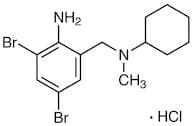
CAS:Bromhexine hydrochloride (Bisolvon) is a mucolytic agent used in the treatment of respiratory disorders associated with viscid or excessive mucus.Fórmula:C14H21Br2ClN2Pureza:99.98%Cor e Forma:White SolidPeso molecular:412.592,4-Dibromo-6-[(cyclohexyl-methyl-amino)-methyl]-phenylamine
CAS:Fórmula:C14H21Br2ClN2Pureza:98%Cor e Forma:SolidPeso molecular:412.5909Bromhexine hydrochloride
CAS:Fórmula:C14H20Br2N2·HClPureza:98.0 - 102.0 % (dried basis)Cor e Forma:White or almost white crystalline powderPeso molecular:412.60Bromhexine HCl
CAS:Fórmula:C14H20Br2N2·HClCor e Forma:White To Off-White SolidPeso molecular:376.14 36.46Bromhexine-d3 HCl
CAS:Fórmula:C14H17D3Br2N2·HClCor e Forma:White To Off-White SolidPeso molecular:379.15 36.46Bromhexine Hydrochloride
CAS:Applications Expectorant; mucolytic.
References Goicoechea, H., et al.: Talanta, 49, 793 (1999), Ribone, M., et al.: J. Pharm. Biomed. Anal., 23, 591 (2000),Fórmula:C14H20Br2N2·ClHCor e Forma:White To Light BeigePeso molecular:412.59Bromhexine HCl
CAS:Bromhexine HCl is a bronchodilator that belongs to the group of drugs called expectorants. It is used to treat bronchitis, chronic obstructive pulmonary disease, and asthma. Bromhexine HCl has a synergistic effect with other drugs such as hydroxyl groups, hydrochloric acid, and other expectorants. Bromhexine HCl also has a high detection sensitivity for infectious diseases. The most common symptoms of these infections are fever and cough. Bromhexine HCl can be used to reduce pain in patients with inflammatory conditions such as arthritis or fibromyalgia. This drug also reduces the production of prostaglandins and leukotrienes by inhibiting cyclooxygenase-1 (COX-1) and cyclooxygenase-2 (COX-2).Fórmula:C14H20Br2N2·HClPureza:Min. 98 Area-%Cor e Forma:White Off-White PowderPeso molecular:412.59 g/mol






![2,4-Dibromo-6-[(cyclohexyl-methyl-amino)-methyl]-phenylamine](/_next/image/?url=https%3A%2Fstatic.cymitquimica.com%2Fproducts%2FIN%2Fthumb%2FDA003OJX.jpg&w=3840&q=75)