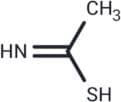
CAS 62-55-5
:Tioacetamida
Descrição:
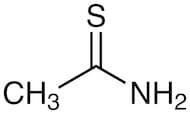
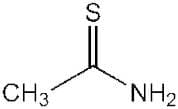
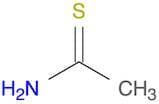
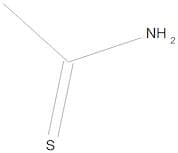
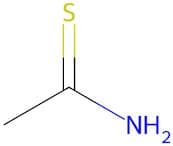
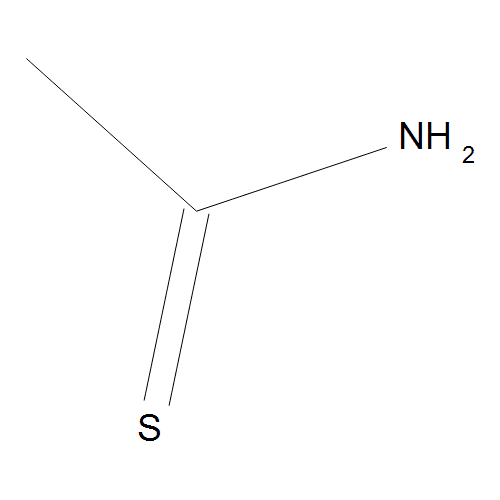
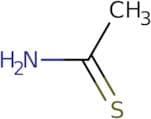
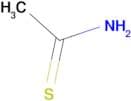
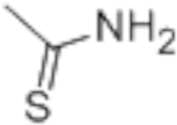
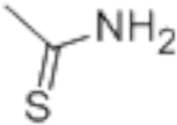
Tioacetamida é um composto orgânico com a fórmula química C2H5NS, caracterizado pela presença de um grupo funcional tioamida. Aparece como um sólido cristalino branco com um leve odor de enxofre e é solúvel em água, álcool e éter. Tioacetamida é conhecido por seu papel na síntese orgânica, particularmente como um reagente na preparação de tioamidas e outros compostos que contêm enxofre. Também é utilizado em várias aplicações, incluindo a produção de produtos farmacêuticos e agroquímicos. O composto tem um perfil de toxicidade relativamente baixo, mas pode ser perigoso quando ingerido ou inalado, necessitando de precauções de segurança adequadas durante o manuseio. Tioacetamida pode sofrer hidrólise para formar ácido acético e sulfeto de hidrogênio, e também é conhecido por participar de várias reações químicas, como substituições nucleofílicas. Devido à sua reatividade, é importante armazenar Tioacetamida em um local fresco e seco, longe de agentes oxidantes fortes.
Fórmula:C2H5NS
InChI:InChI=1S/C2H5NS/c1-2(3)4/h1H3,(H2,3,4)
Chave InChI:InChIKey=YUKQRDCYNOVPGJ-UHFFFAOYSA-N
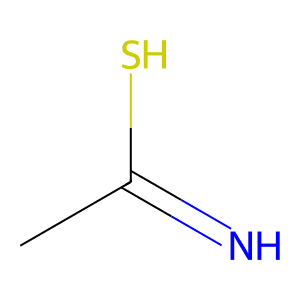
SMILES:C(C)(N)=S
Sinónimos:- Acetamide, thio-
- Acetimidic acid, thio-
- Acetothioamide
- Nsc 2120
- TAA
- Thiacetamide
- Thioacetamid
- Thioacetamide
- Tioacetamida
- Ethanethioamide
Ordenar por
Pureza (%)
0
100
|
0
|
50
|
90
|
95
|
100
15 produtos.
Thioacetamide
CAS:Fórmula:C2H5NSPureza:>98.0%(GC)(T)Cor e Forma:White to Light yellow to Light orange powder to crystalPeso molecular:75.13Thioacetamide, ACS, 99% min
CAS:Thioacetamide is used in qualitative inorganic analysis as an in-situ source for sulfide ions. It is used in analytical chemistry as a source of hydrogen sulfide. It is an additive in enantioselective reduction of beta-keto esters with immobilized bakers yeast. It is also used as a vulcanizing agentFórmula:C2H5NSPureza:99%Peso molecular:75.13Thioacetamide, 98%
CAS:Thioacetamide is used in qualitative inorganic analysis as an in-situ source for sulfide ions. It is used in analytical chemistry as a source of hydrogen sulfide. It is an additive in enantioselective reduction of beta-keto esters with immobilized bakers yeast. It is also used as a vulcanizing agentFórmula:C2H5NSPureza:98%Cor e Forma:White to cream to pale yellow, Crystals or powder or crystalline powderPeso molecular:75.13Thioacetamide
CAS:Fórmula:C2H5NSPureza:≥ 99.0%Cor e Forma:White, off-white or faint yellow or beige crystalline powder or crystalsPeso molecular:75.13Thioacetamide
CAS:ThioacetamideFórmula:C2H5NSPureza:99%Cor e Forma: colorless/white to off-white/yellow solidPeso molecular:75.1328g/molThioacetamide
CAS:Produto ControladoApplications Thioacetamide is a carcinogen, a hepatotoxicant. Thioacetamide induces acute chronic liver injury through the activation of protein synthesis of RNA, DNA, and gamma-glutamyl transpeptitase. Thioacetamide has been used in the synthesis of [email protected] nano-array core-shell structure.
References Akhtar, T., Sheikh, N.: Toxin Reviews, 32, 43 (2013); Yuan, A., et. al.: Adv. Mater. Res., 652, 683 (2013)Fórmula:C2H5NSCor e Forma:NeatPeso molecular:75.13Thioacetamide
CAS:Produto ControladoThioacetamide is a chemical compound that has been used as a model system to study apoptosis. It is also known to cause injury and biochemical changes in cells. Thioacetamide is metabolized by cytochrome P450 enzymes and conjugated with glucuronic acid, which prevents it from binding to DNA or protein. The oxidation of thioacetamide by cytochrome P450 enzymes leads to the formation of reactive oxygen species that may cause DNA damage. Apoptosis induced by thioacetamide has been shown to be mediated through the mitochondrial pathway, which involves the release of cytochrome C, activation of caspase-9, and cleavage of poly (ADP-ribose) polymerase (PARP). Thioacetamide also inhibits sorbitol dehydrogenase activity, which leads to an accumulation of sorbitol in cells. This accumulation can activate transcriptional factors such as nuclear factor kappa B (NF-κB), leading toFórmula:C2H5NSPureza:Min. 98 Area-%Cor e Forma:PowderPeso molecular:75.13 g/molThioacetamide extrapure AR, ACS, ExiPlus, Multi-Compendial, 99%
CAS:Fórmula:C2H5NSPureza:min. 99.0%Cor e Forma:White, Crystalline powder, Clear, ColourlessPeso molecular:75.13Thioacetamide extrapure AR, 99%
CAS:Fórmula:C2H5NSPureza:min. 99.0%Cor e Forma:White, Crystalline powder, Clear, ColourlessPeso molecular:75.13Thioacetamide
CAS:Thioacetamide, a hepatotoxicant, induces liver lesions and cell necrosis without neutrophil infiltration in rats.Fórmula:C2H5NSPureza:99.48% - 99.6%Cor e Forma:White Solid CrystallinePeso molecular:75.13