CAS 622-60-6
:1-etoxi-4-metilbenzeno
Descrição:
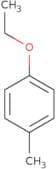
1-etoxi-4-metilbenzeno, também conhecido como p-etoxitolueno, é um composto orgânico caracterizado por sua estrutura aromática, que consiste em um anel de benzeno substituído por um grupo etóxi (-OCH2CH3) e um grupo metila (-CH3) nas posições para. Este composto é um líquido incolor a amarelo pálido com um agradável odor aromático. É moderadamente solúvel em água, mas mais solúvel em solventes orgânicos como etanol e éter. A presença dos grupos etóxi e metila influencia sua reatividade química, tornando-o um intermediário útil na síntese orgânica e em várias reações químicas, incluindo substituição aromática eletrofílica. Além disso, 1-etoxi-4-metilbenzeno exibe propriedades típicas de compostos aromáticos, como estabilidade e ressonância. É importante manusear esta substância com cuidado, pois pode representar riscos à saúde se inalada ou ingerida, e medidas de segurança adequadas devem ser tomadas durante seu uso em ambientes laboratoriais ou industriais.
Fórmula:C9H12O
InChI:InChI=1S/C9H12O/c1-3-10-9-6-4-8(2)5-7-9/h4-7H,3H2,1-2H3
Chave InChI:InChIKey=WSWPHHNIHLTAHB-UHFFFAOYSA-N
SMILES:O(CC)C1=CC=C(C)C=C1
Sinónimos:- Phenetole, p-methyl-
- 1-Ethoxy-4-methylbenzene
- 4-Methylphenetole
- p-Methylphenetole
- Benzene, 1-ethoxy-4-methyl-
Ordenar por
Pureza (%)
0
100
|
0
|
50
|
90
|
95
|
100
1 produtos.
1-Ethoxy-4-methylbenzene
CAS:1-Ethoxy-4-methylbenzene (EMB) is a chemical intermediate that can be used to produce methanesulfonate, an intermediate in the synthesis of pharmaceuticals. It is a colorless liquid with a boiling point of 119 degrees Celsius and a molecular weight of 130.11. The yield of EMB varies depending on the conditions used, but it is typically between 33% and 75%. Kinetics studies have been conducted using termini, which are dyes that react with the carbonyl group on EMB to produce fluorescent products. The kinetics can be seen through microscopy and high-performance liquid chromatography techniques. Nitrate has been shown to be a good catalyst for this reaction mechanism, which involves the formation of an alkyl radical from the splitting of water molecules and the oxidation of metoprolol by nitrate radicals. High concentrations are needed for this reaction to occur because metoprolol is unstable at low concentrations.BR>Fórmula:C9H12OPureza:Min. 95%Peso molecular:136.19 g/mol