CAS 6267-34-1
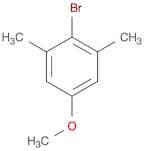
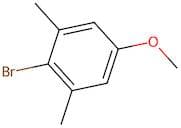
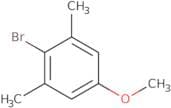
:2-Bromo-5-metoxi-1,3-dimetilbenzeno
Descrição:
2-Bromo-5-metoxi-1,3-dimetilbenzeno, também conhecido pelo seu número CAS 6267-34-1, é um composto orgânico que pertence à classe de hidrocarbonetos aromáticos bromados. Sua estrutura molecular apresenta um anel de benzeno substituído por um átomo de bromo, um grupo metóxi (-OCH3) e dois grupos metila (-CH3) em posições específicas, que contribuem para suas propriedades químicas e reatividade. Este composto é tipicamente caracterizado por sua polaridade moderada devido à presença do grupo metóxi, que pode influenciar sua solubilidade em vários solventes. O substituinte bromo pode aumentar a reatividade do composto em reações de substituição aromática eletrofílica, tornando-o útil na química orgânica sintética. Além disso, a presença de múltiplos substituintes pode afetar as propriedades físicas do composto, como pontos de ebulição e fusão, bem como suas características espectrais em técnicas como espectroscopia de RMN e IR. No geral, 2-Bromo-5-metoxi-1,3-dimetilbenzeno serve como um intermediário valioso na síntese de moléculas orgânicas mais complexas.
Fórmula:C9H11BrO
InChI:InChI=1S/C9H11BrO/c1-6-4-8(11-3)5-7(2)9(6)10/h4-5H,1-3H3
Chave InChI:InChIKey=RAWZVIWEDAGMPW-UHFFFAOYSA-N
SMILES:O(C)C1=CC(C)=C(Br)C(C)=C1
Sinónimos:- 3,5-Dimethyl-4-bromoanisole
- 4-Bromo-1-methoxy-3,5-dimethylbenzene
- 4-Bromo-3,5-Dimethylanisole
- 4-Methoxy-2,6-dimethylbromobenzene
- Anisole, 4-bromo-3,5-dimethyl-
- Benzene, 2-bromo-5-methoxy-1,3-dimethyl-
- NSC 37991
- 2-Bromo-5-methoxy-1,3-dimethylbenzene
Ordenar por
Pureza (%)
0
100
|
0
|
50
|
90
|
95
|
100
4 produtos.
2-Bromo-5-methoxy-1,3-dimethylbenzene
CAS:Fórmula:C9H11BrOPureza:97%Cor e Forma:LiquidPeso molecular:215.08702-Bromo-5-methoxy-1,3-dimethylbenzene
CAS:2-Bromo-5-methoxy-1,3-dimethylbenzenePureza:98%Peso molecular:215.09g/mol4-Bromo-3,5-dimethylbenzyl alcohol
CAS:4-Bromo-3,5-dimethylbenzyl alcohol is a potent anticancer agent that is synthesized from bromoarenes. It has been shown to be effective against cancer cells in the presence of activated carbon, aluminum chloride, and organotellurium. 4-Bromo-3,5-dimethylbenzyl alcohol reacts with peptide hormones and other hormones at the cellular level by inhibiting DNA synthesis. This inhibition prevents the production of proteins that are vital for cell division. The reaction rate is rapid in solvents such as acetonitrile.>>END>>Fórmula:C9H11BrOPureza:Min. 95%Cor e Forma:PowderPeso molecular:215.09 g/mol