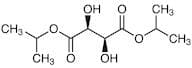
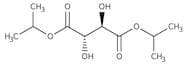
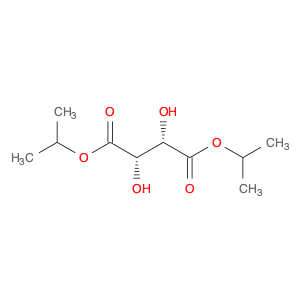
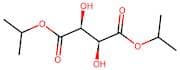
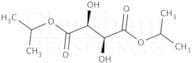
CAS 62961-64-2
:Diisopropil (-)-tartarato
Descrição:
Diisopropil (-)-tartarato, com o número CAS 62961-64-2, é um composto orgânico que pertence à classe dos tartaratos, que são ésteres derivados do ácido tartárico. Esta substância é caracterizada por sua natureza quiral, exibindo atividade óptica devido à presença de múltiplos estereocentros. Normalmente, aparece como um líquido incolorido a amarelo pálido e é conhecida por sua baixa volatilidade e solubilidade moderada em solventes orgânicos. Diisopropil (-)-tartarato é frequentemente utilizado como um auxiliar quiral na síntese assimétrica, facilitando a produção de compostos enantiomericamente puros. Suas aplicações se estendem à indústria farmacêutica, onde desempenha um papel no desenvolvimento de vários medicamentos. O composto é geralmente estável em condições padrão, mas deve ser manuseado com cuidado, assim como muitos produtos químicos orgânicos, para evitar perigos potenciais. No geral, Diisopropil (-)-tartarato é valorizado por sua utilidade em estereoquímica e seu papel em aumentar a eficiência dos processos sintéticos.
Fórmula:C10H18O6
InChI:InChI=1S/C10H18O6/c1-5(2)15-9(13)7(11)8(12)10(14)16-6(3)4/h5-8,11-12H,1-4H3/t7-,8-/m0/s1
Chave InChI:InChIKey=XEBCWEDRGPSHQH-YUMQZZPRSA-N
SMILES:[C@H]([C@@H](C(OC(C)C)=O)O)(C(OC(C)C)=O)O
Sinónimos:- (-)-Dipt
- (2S,3S)-Diisopropyl tartrate
- <span class="text-smallcaps">D</span>-(-)-Diisopropyl tartrate
- <span class="text-smallcaps">D</span>-(-)-Tartaric acid diisopropyl ester
- Butanedioic acid, 2,3-dihydroxy-, 1,4-bis(1-methylethyl) ester, (2S,3S)-
- Butanedioic acid, 2,3-dihydroxy-, bis(1-methylethyl) ester, (2S,3S)-
- Butanedioic acid, 2,3-dihydroxy-, bis(1-methylethyl) ester, [S-(R*,R*)]-
- D-(-)-Tartaric Acid Diisopropyl Ester
- Diisopropyl (-)-<span class="text-smallcaps">D</span>-tartrate
- Diisopropyl (-)-tartrate
- Diisopropyl (S,S)-tartrate
- Diisopropyl D-Tartrate
- bis(1-methylethyl) (2R,3S)-2,3-dihydroxybutanedioate
- dipropan-2-yl (2S,3S)-2,3-dihydroxybutanedioate
- Ver mais sinónimos
Ordenar por
Pureza (%)
0
100
|
0
|
50
|
90
|
95
|
100
8 produtos.
Diisopropyl D-(-)-Tartrate
CAS:Fórmula:C10H18O6Pureza:>98.0%(GC)Cor e Forma:Colorless to Almost colorless clear liquidPeso molecular:234.25(-)-Diisopropyl D-tartrate, 98%
CAS:This Thermo Scientific Chemicals brand product was originally part of the Alfa Aesar product portfolio. Some documentation and label information may refer to the legacy brand. The original Alfa Aesar product / item code or SKU reference has not changed as a part of the brand transition to Thermo Sci
Fórmula:C10H18O6Pureza:98%Cor e Forma:Clear colorless, Liquid or viscous liquidPeso molecular:234.25(2S,3S)-Diisopropyl 2,3-dihydroxysuccinate
CAS:Fórmula:C10H18O6Pureza:98%Cor e Forma:LiquidPeso molecular:234.2463D-(-)-Tartaric acid diisopropyl ester
CAS:D-(-)-Tartaric acid diisopropyl esterPureza:98%Peso molecular:234.25g/mol(2S,3S)-Diisopropyl 2,3-dihydroxysuccinate
CAS:Pureza:95.0%Cor e Forma:Liquid, ClearPeso molecular:234.2480010986328Diisopropyl D-tartrate
CAS:Diisopropyl tartrate is a chemical compound that has been used in the synthesis of antibiotics. It is bifunctional, meaning that it can act as both a nucleophile and a base. The chloride forms a nucleophilic addition with the allyl group, forming an intermediate that is an excellent leaving group for the final product. Diisopropyl tartrate is used to synthesize monomers for polymers, such as chloroprene and styrene, which are used in the manufacture of plastics and rubber. This chemical is also used in catalytic asymmetric reactions, where it acts as a catalyst by stabilizing one enantiomer over another to promote stereoselective reactions.Fórmula:C10H18O6Pureza:Min. 95%Cor e Forma:Colorless Clear LiquidPeso molecular:234.25 g/molD-(-)-Diisopropyl Tartrate
CAS:Produto ControladoApplications D-(-)-Diisopropyl Tartrate is a reagent for kinetic resolution of racemic allylic alcohols and α-furfuryl amides by enantioselective epoxidation.
References Lee, E., et al.: J. Org. Chem., 1994, 59 1444; Jung, M., et al.: J. Am. Chem. Soc., 115, 12208 (1993); Wang, Z., et al.: Tetrahedron, 49, 2641 (1993)Fórmula:C16H17N3O4S2Cor e Forma:NeatPeso molecular:379.454