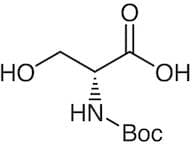
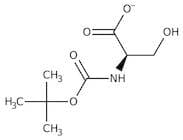
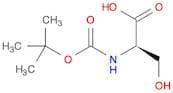
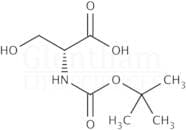
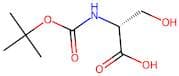
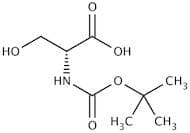
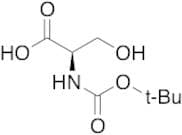
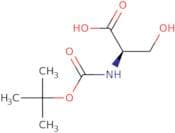
![N-[(1,1-Dimethylethoxy)carbonyl]-D-serine](/_next/image/?url=https%3A%2Fstatic.cymitquimica.com%2Fcas-image%2Fthumb-webp%2F304714-n-11-dimethylethoxy-carbonyl-d-serine.webp&w=3840&q=75)
CAS 6368-20-3
:N-[(1,1-Dimetiletoxicarbonil)-D-serina]
Descrição:
N-[(1,1-Dimetiletoxicarbonil)-D-serina], com o número CAS 6368-20-3, é um derivado de aminoácido caracterizado pela presença de um grupo carbonila ligado ao nitrogênio do grupo amino e um grupo 1,1-dimetiletoxilo volumoso. Esta estrutura confere propriedades estéricas e eletrônicas únicas, tornando-o útil em várias aplicações químicas, particularmente na síntese de peptídeos e como um bloco de construção na química medicinal. O composto é tipicamente um sólido branco a off-white, solúvel em solventes orgânicos polares, e exibe estabilidade sob condições laboratoriais padrão. Seus grupos funcionais permitem uma reatividade potencial em reações de acoplamento, tornando-o valioso na síntese de moléculas mais complexas. Além disso, a presença da porção D-serina sugere uma atividade biológica potencial, uma vez que a D-serina é conhecida por desempenhar um papel na neurotransmissão. No geral, este composto exemplifica a interseção da química orgânica e da bioquímica, com aplicações tanto em metodologias sintéticas quanto em pesquisa biológica.
Fórmula:C8H15NO5
InChI:InChI=1S/C8H15NO5/c1-8(2,3)14-7(13)9-5(4-10)6(11)12/h5,10H,4H2,1-3H3,(H,9,13)(H,11,12)/t5-/m1/s1
Chave InChI:InChIKey=FHOAKXBXYSJBGX-RXMQYKEDSA-N
SMILES:[C@H](NC(OC(C)(C)C)=O)(C(O)=O)CO
Sinónimos:- (2R)-2-[(tert-butoxycarbonyl)amino]-3-hydroxypropanoate
- (2R)-2-[[(tert-Butoxy)carbonyl]amino]-3-hydroxypropanoic acid
- (2R)-3-Hydroxy-2-[(2-methylpropan-2-yl)oxycarbonylamino]propanoic acid
- (R)-2-(tert-Butoxycarbonylamino)-3-hydroxypropanoic acid
- (R)-tert-Butoxycarbonyl-<span class="text-smallcaps">D</span>-serine
- <span class="text-smallcaps">D</span>-Serine, N-[(1,1-dimethylethoxy)carbonyl]-
- BOC-<span class="text-smallcaps">D</span>-Serine
- BOC-D-Serine
- Boc-D-Ser-OH
- N-(tert-Butoxycarbonyl)-D-serine
- N-Boc-<span class="text-smallcaps">D</span>-serine
- N-[(1,1-Dimethylethoxy)carbonyl]-<span class="text-smallcaps">D</span>-serine
- N-tert-Butoxycarbonyl-<span class="text-smallcaps">D</span>-serine
- Serine, N-carboxy-, N-tert-butyl ester, <span class="text-smallcaps">D</span>-
- tert-(Butoxycarbonyl)-<span class="text-smallcaps">D</span>-serine
- D-Serine, N-[(1,1-dimethylethoxy)carbonyl]-
- Serine, N-carboxy-, N-tert-butyl ester, D-
- N-[(1,1-Dimethylethoxy)carbonyl]-D-serine
- Ver mais sinónimos
Ordenar por
Pureza (%)
0
100
|
0
|
50
|
90
|
95
|
100
10 produtos.
N-(tert-Butoxycarbonyl)-D-serine
CAS:Fórmula:C8H15NO5Pureza:>98.0%(T)(HPLC)Cor e Forma:White to Almost white powder to crystalPeso molecular:205.21N-Boc-D-serine, 98+%
CAS:This Thermo Scientific Chemicals brand product was originally part of the Alfa Aesar product portfolio. Some documentation and label information may refer to the legacy brand. The original Alfa Aesar product / item code or SKU reference has not changed as a part of the brand transition to Thermo SciFórmula:C8H14NO5Pureza:98+%Cor e Forma:Crystals or powder or crystalline powder or lumps, WhitePeso molecular:204.20Ref: IN-DA003OGT
1gA consultar25kgA consultar10g20,00€5g21,00€25g25,00€50g33,00€100g49,00€500g122,00€Boc-D-serine
CAS:Produto ControladoApplications Boc-D-serine is D-serine (S270975) with amine protected from eletrophiles by tert-butyloxycarbonyl group in organic synthesis. Boc-D-serine can be used to synthesize acetamido-methoxypropionamides such as Desacetyl Desmethyl Lacosamide (D288325) which is a potent anticonvulsant.
References Letiran, A., et al.: J. Med. Chem., 45, 4762 (2002); Wadavrao, S., et al.: Synthesis, 45, 3383 (2013)Fórmula:C8H15NO5Cor e Forma:NeatPeso molecular:205.21BOC-D-Ser-OH
CAS:BOC-D-Ser-OH is a synthetic amino acid with an acetylated serine side chain. It is used in the synthesis of glycosidic bonds. BOC-D-Ser-OH reacts with sodium hydrogen carbonate to form the sodium salt of D-serine, which can be used to produce glycoconjugates or as a model protein. The reaction yield is low and can be improved by adding acetyl groups to the substrate, such as galactose. Glycosidic bonds are formed by transfer reactions between nucleophilic hydroxyl groups on sugar molecules and electrophilic amino groups on proteins. The glycoconjugates produced by this reaction have been shown to have anticancer activity in animal models.Fórmula:C8H15NO5Pureza:Min. 95%Peso molecular:205.21 g/mol