CAS 642-31-9
:9-Antracenocarboxaldeído
Descrição:
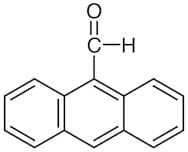
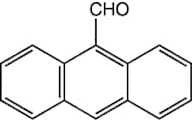
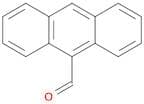
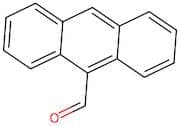
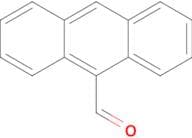
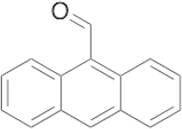
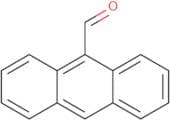
9-Antracenocarboxaldeído, com o número CAS 642-31-9, é um composto orgânico pertencente à classe dos aldeídos. Apresenta uma estrutura de antraceno, que é um hidrocarboneto aromático policíclico, com um grupo formilo (-CHO) ligado na posição 9. Este composto é caracterizado pelo seu estado sólido à temperatura ambiente, aparecendo tipicamente como uma substância cristalina de cor amarela a marrom claro. Tem um ponto de fusão relativamente alto e é pouco solúvel em água, mas mais solúvel em solventes orgânicos como etanol e diclorometano. 9-Antracenocarboxaldeído é conhecido por suas aplicações em síntese orgânica, particularmente na preparação de vários derivados e como um bloco de construção no desenvolvimento de materiais e corantes fluorescentes. Além disso, exibe propriedades fotofísicas interessantes, tornando-o útil em pesquisas relacionadas a dispositivos optoeletrônicos. Assim como muitos aldeídos aromáticos, pode representar riscos à saúde se inalado ou ingerido, exigindo precauções de segurança adequadas durante o manuseio.
Fórmula:C15H10O
InChI:InChI=1S/C15H10O/c16-10-15-13-7-3-1-5-11(13)9-12-6-2-4-8-14(12)15/h1-10H
Chave InChI:InChIKey=YMNKUHIVVMFOFO-UHFFFAOYSA-N
SMILES:C(=O)C=1C2=C(C=C3C1C=CC=C3)C=CC=C2
Sinónimos:- 9-Anthracenaldehyde
- 9-Anthracenealdehyde
- 9-Anthracenecarbaldehyde
- 9-Anthracenecarboxaldehyde
- 9-Anthracenemethanal
- 9-Anthrylaldehyde
- 9-Anthrylcarboxaldehyde
- 9-Formylanthracene
- A-9-A
- Akos B029849
- Akos Bbs-00003154
- Antharacene-1-carboxaldehyde
- Anthracen-9-carbaldehyd
- Anthracene-9-Carbaldehyde
- Anthracene-9-Carboxaldehyde
- Anthraldehyde(9)
- Antraceno-9-Carbaldehido
- Nsc 15
- Ver mais sinónimos
Ordenar por
Pureza (%)
0
100
|
0
|
50
|
90
|
95
|
100
9 produtos.
9-Anthracenecarboxaldehyde
CAS:Fórmula:C15H10OPureza:>99.0%(GC)Cor e Forma:White to Amber powder to crystalPeso molecular:206.249-Anthraldehyde, 98%
CAS:9-Anthraldehyde is used to prepare asymmetrical tridentate Schiff base ligands, 2-(9-anthrylmethyl-ideneamino)-4-methyl-phenol and functionalized ligand like 2-(anthracen-9-ylidene)-4,5-bis(diphenylphosphino)-4-cyclopentene-1,3-dione through Knoevenangel condensation with the diphosphine ligand 4,5-Fórmula:C15H10OPureza:98%Cor e Forma:Yellow to green, PowderPeso molecular:206.249-Anthraldehyde
CAS:9-AnthraldehydeFórmula:C15H10OPureza:98%Cor e Forma: yellow solidPeso molecular:206.24g/mol9-Formylanthracene
CAS:9-Formylanthracene is a hydroxylated derivative of anthracene. This molecule has significant cytotoxicity and shows high resistance to cancer cells. It is also capable of inducing apoptosis in carcinoma cell lines. 9-Formylanthracene binds to DNA polymerase, inhibiting the enzyme activity and blocking synthesis of DNA. It also inhibits other enzymes that are necessary for cellular metabolism, such as the ribonucleotide reductase enzyme. 9-Formylanthracene is a potential anticancer drug candidate due to its ability to inhibit DNA polymerase and induce apoptosis in cancer cells, but it does not show any effect on normal liver cells.
Pureza:Min. 95%