CAS 64790-15-4
:Glucagon (19-29) (humano, bovino, suíno)
Descrição:
O glucagon (19-29) é um fragmento peptídico derivado da molécula maior de glucagon, que desempenha um papel crucial no metabolismo e regulação da glicose. Este fragmento específico consiste nos aminoácidos 19 a 29 da sequência de glucagon e é conhecido por sua atividade biológica em estimular a glicogenólise e a gluconeogênese no fígado, aumentando assim os níveis de glicose no sangue. O número CAS 64790-15-4 identifica este peptídeo particular, que é relevante tanto na fisiologia humana quanto animal, incluindo espécies bovinas e suínas. Caracteristicamente, o glucagon (19-29) é uma molécula hidrofílica, exibindo tipicamente um alto grau de solubilidade em soluções aquosas, o que é essencial para sua função biológica. É frequentemente utilizado em pesquisas e ambientes clínicos para estudar processos metabólicos e potenciais aplicações terapêuticas em condições como hipoglicemia e diabetes. A estabilidade e atividade deste peptídeo podem ser influenciadas por fatores como pH, temperatura e a presença de outros íons ou moléculas na solução.
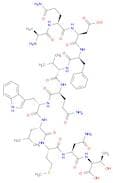
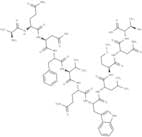
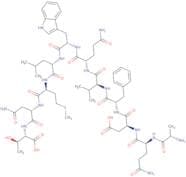
Fórmula:C61H89N15O18S
InChI:InChI=1/C61H89N15O18S/c1-29(2)23-40(55(87)68-39(21-22-95-7)54(86)73-43(26-47(65)80)59(91)76-50(32(6)77)61(93)94)70-56(88)42(25-34-28-66-36-16-12-11-15-35(34)36)72-53(85)38(18-20-46(64)79)69-60(92)49(30(3)4)75-58(90)41(24-33-13-9-8-10-14-33)71-57(89)44(27-48(81)82)74-52(84)37(17-19-45(63)78)67-51(83)31(5)62/h8-16,28-32,37-44,49-50,66,77H,17-27,62H2,1-7H3,(H2,63,78)(H2,64,79)(H2,65,80)(H,67,83)(H,68,87)(H,69,92)(H,70,88)(H,71,89)(H,72,85)(H,73,86)(H,74,84)(H,75,90)(H,76,91)(H,81,82)(H,93,94)/t31-,32+,37-,38-,39-,40-,41-,42-,43-,44-,49-,50-/m0/s1
Sinónimos:- H-Ala-Gln-Asp-Phe-Val-Gln-Trp-Leu-Met-Asn-Thr-OH
- L-alanyl-L-glutaminyl-L-alpha-aspartyl-L-phenylalanyl-L-valyl-L-glutaminyl-L-tryptophyl-L-leucyl-L-methionyl-L-asparaginyl-L-threonine
- Miniglucagon (huMan, rat, porcine)
- GLUCAGON (19-29) (HUMAN, BOVINE, PORCINE)
- Glucagon (19-29) (huMan, rat, porcine)
- L-Alanyl-L-glutaminyl-L-a-aspartyl-L-phenylalanyl-L-valyl-L-glutaminyl-L-tryptophyl-L-leucyl-L-methionyl-L-asparaginyl-L-threonine
- L-Threonine, L-alanyl-L-glutaminyl-L-α-aspartyl-L-phenylalanyl-L-valyl-L-glutaminyl-L-tryptophyl-L-leucyl-L-methionyl-L-asparaginyl-
- glucagon(19-29
- GLUCAGON (19-29), BOVINE, HUMAN, PORCINE
- PHE-VAL-GLN-TRP-LEU-MET-ASN-THR: FVQWLMNT
- GLUCAGON (19-29), HUMAN
- AQDFVQWLMNT
- ALA-GLN-ASP-PHE-VAL-GLN-TRP-LEU-MET-ASN-THR
- Glucagon (19-29) (human, rat, porcine)
- Ver mais sinónimos
Ordenar por
Pureza (%)
0
100
|
0
|
50
|
90
|
95
|
100
4 produtos.
Glucagon (19-29) (human, rat, porcine)
CAS:Miniglucagon inhibited both the Ca²⁺ activated and Mg²⁺ dependent ATPase activity and Ca²⁺ transport in liver plasma membranes with an efficiency 1000-fold higher than that of glucagon. It is likely to be the active peptide involved in the inhibition of the liver Ca²⁺ pump. Miniglucagon, the ultimate processing product of proglucagon, is a regulator of the pancreatic islet physiology.Fórmula:C61H89N15O18SPureza:> 96%Cor e Forma:White PowderPeso molecular:1352.53H-Ala-Gln-Asp-Phe-Val-Gln-Trp-Leu-Met-Asn-Thr-OH
CAS:Fórmula:C61H89N15O18SPureza:95%Cor e Forma:SolidPeso molecular:1352.5141Glucagon (19-29), human
CAS:Glucagon, a 29-amino-acid hormone, is produced by alpha cells in the pancreas' islets of Langerhans.Fórmula:C61H89N15O18SPureza:98%Cor e Forma:SolidPeso molecular:1352.53Glucagon (19-29) (human, rat, porcine) trifluoroacetate salt
CAS:Glucagon is a peptide hormone that belongs to the group of vasoactive intestinal peptides. It is produced by the alpha cells of the pancreas and stimulates gluconeogenesis in the liver, thereby increasing blood glucose levels. Glucagon has also been shown to cause membrane hyperpolarization and cell death in cancer cells. Glucagon is a homologous protein that has been shown to have physiological effects similar to those of insulin, such as increased levels of cytosolic Ca2+ ions and camp levels. Glucagon binds to its receptor on the plasma membrane with high affinity, activating adenylate cyclase and phospholipase C, which leads to an increase in intracellular camp levels. This results in activation of protein kinase A (PKA), which phosphorylates proteins involved in glycogenolysis, glycolysis, and lipolysis. Glucagon also activates mitogen-activated protein kinases (MAPKFórmula:C61H89N15O18SPureza:Min. 95%Peso molecular:1,352.52 g/mol