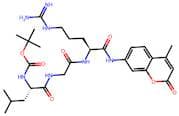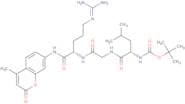
CAS 65147-09-3
:N-T-boc-leu-gly-arg 7-amido-4-*metilcumarina ace
- Boc-Leu-Gly-Arg-AMC
- Boc-Leu-Gly-Arg-Amc Acetate Salt
- N(tert-BOC)-Leu-Gly-Arg-7-amido-4-methylcoumarin acetate
- L-Argininamide, N-[(1,1-dimethylethoxy)carbonyl]-L-leucylglycyl-N-(4-methyl-2-oxo-2H-1-benzopyran-7-yl)-
- N-T-boc-leu-gly-arg 7-amido-4-*methylcoumarin ace
- BOC-LEU-GLY-ARG-AMC ACOH
- BOC-LEU-GLY-ARG-MCA HYDROCHLORIDE
- N-T-BOC-LEU-GLY-ARG 7-AMIDO-4-METHYLCOUMARIN ACETATE)
- BOC-LGR-AMC
- N-ALPHA-T-BOC-L-LEU-GLY-L-ARG-4-METHYLCOUMARYL-7-AMIDE
- BOC-LEU-GLY-ARG-MCA
- Boc-Leu-Gly-Arg-7-amido-4-methylcoumarin acetate salt
- Ver mais sinónimos
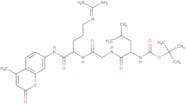
Boc-Leu-Gly-Arg-AMC
CAS:Boc-LGR-AMC, a specific fluorogenic substrate for complement component C3/C5 convertases, coagulation factor Xa, and soybean trypsin-like enzyme. It is also hydrolyzed by macropain, a high molecular weight thiol proteinase from human erythrocytes. Stock solutions of Boc-LGR-AMC are best prepared in DMSO.Fórmula:C29H43N7O7Pureza:> 99%Cor e Forma:White LyophilisatePeso molecular:601.7Boc-Leu-Gly-Arg-AMC
CAS:Boc-Leu-Gly-Arg-AMC is a fluorogenic substrate for detecting C3/C5 convertases, factor Xa, and soybean trypsin-like enzymes; it's also hydrolyzed by macropain.Fórmula:C29H43N7O7Pureza:99.53%Cor e Forma:SolidPeso molecular:601.69Ref: TM-TP2169
1mg49,00€5mg99,00€1mL*10mM (DMSO)148,00€10mg160,00€25mg265,00€50mg402,00€100mg565,00€200mg805,00€Boc-Leu-Gly-Arg-AMC
CAS:Boc-Leu-Gly-Arg-AMC is a peptide that binds to the receptor for N-methyl-D-aspartate (NMDA) and inhibits the ion channel. It has been used as a research tool to study NMDA receptor interactions, as well as in cell biology and pharmacology. Boc-Leu-Gly-Arg-AMC is a high purity, ionic analog of glutamate that binds to the NMDA receptor without activating it, thereby inhibiting ion flow through the channel. This inhibition can be reversed by adding excess glutamate or glycine. The binding of this compound to the NMDA receptor has been shown to block activation of voltage gated calcium channels and reduce neuronal excitation, which may provide an alternative therapeutic strategy for controlling seizures or other neurological disorders.
Fórmula:C29H43N7O7Pureza:Min. 95%Peso molecular:601.69 g/molBoc-Leu-Gly-Arg-AMC acetate salt
CAS:Boc-Leu-Gly-Arg-AMC acetate salt is a potential drug target for leishmaniasis. It inhibits the growth of Leishmania by binding to the 17β-estradiol receptor and inhibiting protein synthesis. This drug also has a hydrolytic activity against proteins, which is activated by an acidic environment. It has been shown to inhibit the growth of bacteria including Staphylococcus aureus and Chlamydia pneumoniae by inhibiting urokinase-type plasminogen activator (uPA) and serine protease activities. Boc-Leu-Gly-Arg-AMC acetate salt has also been shown to inhibit cellular proliferation in cancer cells.
Fórmula:C29H43N7O7•C2H4O2Pureza:Min. 98 Area-%Cor e Forma:PowderPeso molecular:661.74 g/molRef: 3D-FB110486
Produto descontinuado