CAS 6552-68-7
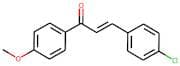
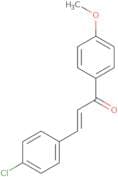
:3-(4-clorofenil)-1-(4-metoxifenil)prop-2-en-1-ona
Descrição:
3-(4-clorofenil)-1-(4-metoxifenil)prop-2-en-1-ona, também conhecido como um tipo de chalcona, é um composto orgânico caracterizado por seu sistema de ligações duplas conjugadas e a presença de anéis aromáticos. Este composto apresenta uma estrutura de prop-2-en-1-ona, que contribui para sua reatividade e potencial atividade biológica. A presença de um grupo 4-clorofenila e um grupo 4-metoxifenila aumenta sua lipofilicidade e pode influenciar sua interação com alvos biológicos. As chalconas são conhecidas por suas diversas propriedades farmacológicas, incluindo atividades anti-inflamatórias, antioxidantes e anticancerígenas. A estrutura do composto permite aplicações potenciais em química medicinal e ciência dos materiais. Geralmente, é sintetizado através da reação de condensação de Claisen-Schmidt, e suas propriedades podem ser influenciadas por substituintes nos anéis aromáticos. Assim como muitos compostos orgânicos, devem ser observadas precauções de segurança e manuseio, pois pode apresentar toxicidade ou efeitos irritantes.
Fórmula:C16H13ClO2
InChI:InChI=1/C16H13ClO2/c1-19-15-9-5-13(6-10-15)16(18)11-4-12-2-7-14(17)8-3-12/h2-11H,1H3
SMILES:COc1ccc(cc1)C(=O)C=Cc1ccc(cc1)Cl
Ordenar por
Pureza (%)
0
100
|
0
|
50
|
90
|
95
|
100
2 produtos.
3-(4-Chlorophenyl)-1-(4-methoxyphenyl)prop-2-en-1-one
CAS:3-(4-Chlorophenyl)-1-(4-methoxyphenyl)prop-2-en-1-onePureza:≥95%4-Chloro-4'-methoxychalcone
CAS:4-Chloro-4'-methoxychalcone (4MC) is a chalcone with an antibacterial activity. It is synthesized from 4,4'-dimethoxychalcone by substitution of one or two methoxy groups on the aromatic ring with chlorine atoms. 4MC has shown to be active against a number of different bacterial strains, including Staphylococcus aureus and Pseudomonas aeruginosa. The dilution method is used for the determination of the minimal inhibitory concentrations (MICs). This method involves serial dilutions in which bacteria are grown in liquid media containing increasing concentrations of the test compound. The lowest concentration of the test compound that inhibits bacterial growth is determined and recorded as MIC. Plutella xylostella larvae were found to be resistant to 4MC because they lack esterase enzymes that hydrolyze 4MC. Irradiation can be used to produce esters that are more reactive towardsFórmula:C16H13ClO2Pureza:Min. 95%Cor e Forma:PowderPeso molecular:272.73 g/mol