CAS 65718-85-6
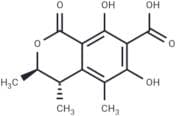
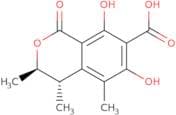
:ácido (3R,4S)-6,8-diidroxi-3,4,5-trimetil-1-oxo-3,4-diidro-1H-isochromeno-7-carboxílico
Descrição:
A substância química conhecida como ácido (3R,4S)-6,8-diidroxi-3,4,5-trimetil-1-oxo-3,4-diidro-1H-isochromeno-7-carboxílico, com o número CAS 65718-85-6, é um composto que ocorre naturalmente e pertence à classe dos isocromenos. Este composto apresenta múltiplos grupos hidroxila, que contribuem para seu potencial como molécula bioativa, influenciando sua solubilidade e reatividade. A presença de um grupo funcional ácido carboxílico sugere que pode participar de reações ácido-base e pode exibir características polares. Sua estereoquímica, indicada pela configuração (3R,4S), implica arranjos espaciais específicos que podem afetar sua atividade biológica e interações com outras moléculas. Os grupos trimetila melhoram seu caráter hidrofóbico, o que pode influenciar sua permeabilidade através de membranas biológicas. No geral, este composto pode ter aplicações em farmacêuticos ou como um produto natural com propriedades terapêuticas potenciais, embora atividades biológicas específicas exijam investigação adicional.
Fórmula:C13H14O6
InChI:InChI=1/C13H14O6/c1-4-6(3)19-13(18)8-7(4)5(2)10(14)9(11(8)15)12(16)17/h4,6,14-15H,1-3H3,(H,16,17)/t4-,6-/m1/s1
SMILES:C[C@@H]1[C@@H](C)OC(=O)c2c1c(C)c(c(c2O)C(=O)O)O
Ordenar por
Pureza (%)
0
100
|
0
|
50
|
90
|
95
|
100
2 produtos.
Dihydrocitrinone
CAS:Dihydrocitrinone is a useful organic compound for research related to life sciences. The catalog number is T124457 and the CAS number is 65718-85-6.Fórmula:C13H14O6Cor e Forma:SolidPeso molecular:266.25Dihydrocitrinone
CAS:Dihydrocitrinone is a weight-loss drug that has been shown to have cytotoxic activity in vitro. It is metabolized by rat liver microsomes into the major metabolites, dihydrocitrinone and citrinone. Dihydrocitrinone has also been shown to be stable when complexed with acetate extract and transport properties. The molecular modeling of dihydrocitrinone shows an interaction with glutathione reductase and cytochrome P450 enzyme. Dihydrocitrinone has been found in urine samples from humans, but not rats or mice, suggesting that this drug may be excreted through the kidneys. There are no known chemical structures for this drug, but it is thought to be an acid conjugate due to its low toxicity.Fórmula:C13H14O6Pureza:85%MinCor e Forma:PowderPeso molecular:266.25 g/mol