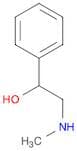
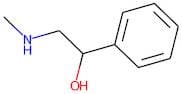
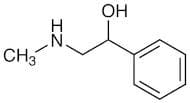
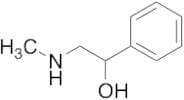
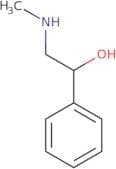
CAS 6589-55-5
:2-(Metilamino)-1-feniletanol
- (±)-Halostachine
- 1-Phenyl-2-(N-methylamino)ethanol
- 2-(Methylamino)-1-Phenylethanol
- 2-Methylamino-1-phenyl-1-ethanol
- 2-hydroxy-N-methyl-2-phenylethanaminium chloride
- Benzenemethanol, α-[(methylamino)methyl]-
- Benzyl alcohol, α-[(methylamino)methyl]-
- Halostachine~2-(Methylamino)-1-phenylethanol
- Methyl(2-hydroxy-2-phenylethyl)amine
- N-Methyl-β-hydroxylphenylethylamine
- N-Methyl-β-hydroxyphenylethylamine
- dl-Halostachine
- α-(Methylaminomethyl)benzyl alcohol
- Ver mais sinónimos
2-(methylamino)-1-phenylethan-1-ol
CAS:Fórmula:C9H13NOPureza:99%Cor e Forma:SolidPeso molecular:151.2056α-(Methylaminomethyl)benzyl alcohol
CAS:α-(Methylaminomethyl)benzyl alcoholPureza:95%Peso molecular:151.21g/mol(±)-2-(Methylamino)-1-phenylethan-1-ol
CAS:Fórmula:C9H13NOPureza:>95.0%(T)(HPLC)Cor e Forma:White to Light yellow powder to crystalPeso molecular:151.212-(Methylamino)-1-phenylethanol
CAS:Produto ControladoFórmula:C9H13NOCor e Forma:NeatPeso molecular:151.21±-(Methylaminomethyl)benzyl alcohol
CAS:±-(Methylaminomethyl)benzyl alcohol is an endophytic fungus that was first isolated from perennial ryegrass. It has been shown to be a potent inhibitor of growth factor and many other molecules, such as ethanolamine. ±-(Methylaminomethyl)benzyl alcohol is homochiral with a molecule weight of 222.2 g/mol, and can be synthesized by hydrogenation of the corresponding ketone. The compound has been shown to have immobilization properties, which may be due to its ability to form hydrogen bonds with surfaces. This chemical is also a substrate for enzymatic reactions, such as amination reactions, condensation reactions, and electrophilic addition reactions. The compound has been shown to inhibit energy metabolism in swiss-webster mice by blocking the conversion of glycogen into glucose in liver cells.
Fórmula:C9H13OPureza:Min. 95%Peso molecular:151.21 g/mol