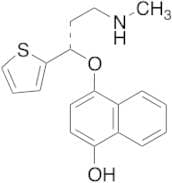
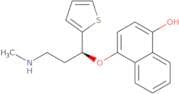
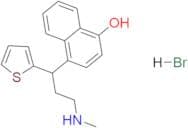
![4-[(1S)-3-(Methylamino)-1-(2-thienyl)propoxy]-1-naphthalenol](/_next/image/?url=https%3A%2Fstatic.cymitquimica.com%2Fcas-image%2Fthumb-webp%2F242077-4-hydroxy-duloxetine.webp&w=3840&q=75)
CAS 662149-13-5
:4-[(1S)-3-(Metilamino)-1-(2-tienil)propoxi]-1-naftalenol
Descrição:
4-[(1S)-3-(Metilamino)-1-(2-tienil)propoxi]-1-naftalenol, com o número CAS 662149-13-5, é um composto químico que pertence à classe dos derivados do naftalenol. Esta substância apresenta um núcleo de naftaleno, que é um hidrocarboneto aromático policíclico, e está substituída por um grupo propóxido que contém um grupo metilamino e um anel de tienilo. A presença do grupo tienilo introduz heteroátomos na estrutura, o que pode afetar sua reatividade e atividade biológica. O composto provavelmente exibirá características polares devido ao grupo hidroxila (-OH) e ao grupo amino (-NH), que podem participar de ligações de hidrogênio. Isso pode influenciar sua solubilidade em vários solventes e sua interação com sistemas biológicos. A estereoquímica indicada pela designação (1S) sugere arranjos espaciais específicos que podem ser cruciais para suas propriedades farmacológicas. No geral, este composto pode ter aplicações em química medicinal, particularmente no desenvolvimento de fármacos que visam vias biológicas específicas.
Fórmula:C18H19NO2S
InChI:InChI=1/C18H19NO2S/c1-19-11-10-17(18-7-4-12-22-18)21-16-9-8-15(20)13-5-2-3-6-14(13)16/h2-9,12,17,19-20H,10-11H2,1H3
Chave InChI:InChIKey=DRRXQCXSBONKPD-KRWDZBQOSA-N
SMILES:O([C@@H](CCNC)C1=CC=CS1)C=2C3=C(C(O)=CC2)C=CC=C3
Sinónimos:- 4-[(1S)-3-(Methylamino)-1-(2-thienyl)propoxy]-1-naphthalenol
- 1-Naphthalenol, 4-[(1S)-3-(methylamino)-1-(2-thienyl)propoxy]-
- 4-Hydroxy Duloxetine
- 4-[(1S)-3-(Methylamino)-1-(2-thienyl)propoxy]-1-naphthaleno
Ordenar por
Pureza (%)
0
100
|
0
|
50
|
90
|
95
|
100
3 produtos.
4-Hydroxy Duloxetine
CAS:Applications A major metabolite of Duloxetine.
References Lantz, R.J., et al.: Drug Dispos. Metab., 31, 1142 (2003), Detke, M., et al.: J. Clin Psy., 63, 308 (2002), Bymaster, F.P., et al.: Bioorg. Med., Chem. Lett., 13, 4477 (2003),Fórmula:C18H19NO2SCor e Forma:NeatPeso molecular:313.414-Hydroxy duloxetine
CAS:Duloxetine is a potent inhibitor of cytochrome P450, which is an enzyme that metabolizes many drugs. Duloxetine inhibits the glucuronidation of 4-hydroxy duloxetine, leading to increased levels in the blood. Duloxetine has been shown to be effective in the treatment of diabetic neuropathy, with statistically significant improvements in symptoms and nerve conduction velocity. The pharmacokinetics of duloxetine has been studied in both rats and humans. In rats, duloxetine was found to have a large volume of distribution and a long half-life, suggesting that it is not well absorbed into the blood stream. In humans, duloxetine is metabolized by CYP2D6 and CYP3A4 enzymes. It has been shown to interact with other drugs such as warfarin, tizanidine, tramadol, and fluconazole.Fórmula:C18H19NO2SPureza:Min. 95%Cor e Forma:Beige To Light Brown SolidPeso molecular:313.42 g/mol