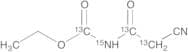
CAS 6629-04-5
:Etil N-(2-cianoacetil)carbamato
Descrição:
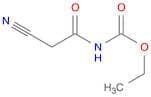
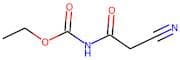
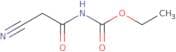
Etil N-(2-cianoacetil)carbamato, com o número CAS 6629-04-5, é um composto orgânico que pertence à classe dos carbamatos. Apresenta um grupo funcional carbamato, que é caracterizado pela presença de um grupo carbonila (C=O) ligado a um átomo de nitrogênio (N) que também está conectado a um grupo etila e a um moiety cianoacetila. Este composto é tipicamente um sólido branco a branco sujo e é solúvel em solventes orgânicos polares. Etil N-(2-cianoacetil)carbamato é conhecido por suas potenciais aplicações na síntese orgânica, particularmente no desenvolvimento de produtos farmacêuticos e agroquímicos, devido à sua capacidade de participar de várias reações químicas, como substituições nucleofílicas e cicloadições. Sua estrutura permite a introdução de diversos grupos funcionais, tornando-o um intermediário versátil na química sintética. Assim como muitas substâncias químicas, o manuseio deve ser feito com cuidado, seguindo os protocolos de segurança apropriados para mitigar quaisquer perigos potenciais associados ao seu uso.
Fórmula:C6H8N2O3
InChI:InChI=1/C6H8N2O3/c1-2-11-6(10)8-5(9)3-4-7/h2-3H2,1H3,(H,8,9,10)
Chave InChI:InChIKey=HSOGVWWWGVFXGF-UHFFFAOYSA-N
SMILES:C(NC(OCC)=O)(CC#N)=O
Sinónimos:- Carbamic acid, (cyanoacetyl)-, ethyl ester
- Carbamic acid, N-(2-cyanoacetyl)-, ethyl ester
- Cyanoacetylurethan
- Ethyl (2-cyanoacetamido)formate
- Ethyl 2-cyanoacetylcarbamate
- Ethyl N-(2-cyanoacetyl)carbamate
- Ethyl N-(cyanoacetyl)carbamate
- Ethyl cyanoacetylcarbamate
- Ethyl(Cyanoacetyl)Carbamate
- N-Carbethoxy-2-cyanoacetamide
- NSC 59709
- Ethyl (2-cyanoacetyl)carbamate
- N-Cyanoacetylurethane
- Cyanoacetylcarbamic acid ethyl ester
- N-(Cyanoacetyl)carbamic acid ethyl ester
- N-Cyanoacetyl ethyl carbamate
- N-Cyanourethane
- N-Cyanoacetylurethane 98%
- N-Cyanoacetylurethane, GC 99%
- cyanoacetyl-carbamicaciethylester
- n-cyanoacetylethylcarbamate
- (Cyanoacetyl)carbamic acid ethyl ester
- Ethyl cyanacetylcarbamate
- 2-Cyanoacetylurethane
- N-Cyanoacetylurethane,Ethyl cyanoacetylcarbamate
- Ethyl (2-cyanoacetyl)
- Ver mais sinónimos
Ordenar por
Pureza (%)
0
100
|
0
|
50
|
90
|
95
|
100
7 produtos.
Ref: IN-DA003SWJ
1g21,00€5g29,00€10g32,00€25g55,00€50g79,00€5kgA consultar100g115,00€10kgA consultar250g175,00€25kgA consultar500g315,00€Ethyl N-(2-cyanoacetyl)carbamate
CAS:Ethyl N-(2-cyanoacetyl)carbamateFórmula:C6H8N2O3Pureza:98%Cor e Forma: faint yellow/faint orange solidPeso molecular:156.14g/molN-Cyanoacetylurethane
CAS:Applications N-Cyanoacetylurethane is used in the synthesis of inhibitors targetting the PDZ domain of PICK1, which is a potential target for brain ischemia, pain and addiction illnesses. Also it is used in the synthesis of cathespin K inhibitors.
References Bach, A. et al.: Org. Biomol. Chem., 8, 4281 (2010); Rankovic, Z. et al.: Bioorg. Med. Chem. Lett., 20, 1488 (2010);Fórmula:C6H8N2O3Cor e Forma:NeatPeso molecular:156.14N-Cyanoacetylurethane
CAS:N-Cyanoacetylurethane is a heterocyclic compound that is an isomer of urethane. The synthesis of the molecule starts with the reaction of ethyl orthoformate and paraformaldehyde to form an amide. The amide is then reacted with chloroacetic acid to form the desired product. N-Cyanoacetylurethane has been shown to be an antifungal agent, inhibiting the growth of yeast cells by disrupting their cell membranes. This drug also has a reductive elimination when in acidic environments, leading to its decomposition into carbon dioxide and ammonia which can be toxic if inhaled.Fórmula:C6H8N2O3Pureza:Min. 95%Peso molecular:156.14 g/molN-Cyanoacetylurethane-13C3,15N2
CAS:Produto ControladoApplications N-Cyanoacetylurethane-13C3,15N2 is an intermediate for the synthesis of Diclazuril-13C3,15N2 (D436202), which is the labelled analogue of Diclazuril (D436200). Diclazuril is a nucleotide analogue with broad-spectrum anticoccidial activity and a coccidiostat.
References Maes, L., et al.: J. Parasitol., 74, 931 (1988)Fórmula:C3C3H815NNO3Cor e Forma:NeatPeso molecular:160.111