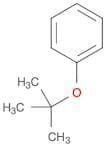
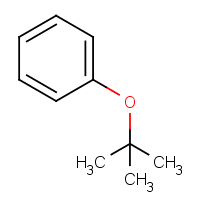
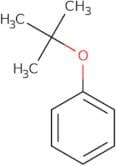
CAS 6669-13-2
:éter fenil terc-butilo
Descrição:
éter fenil terc-butilo, com o número CAS 6669-13-2, é um composto orgânico classificado como um éter. Apresenta um grupo tert-butilo ligado a um anel fenil, o que contribui para suas propriedades únicas. Este composto é tipicamente um líquido incolor a amarelo pálido com um odor aromático característico. É relativamente não polar, tornando-se solúvel em solventes orgânicos, enquanto é menos solúvel em água. éter fenil terc-butilo é conhecido por sua estabilidade em condições normais, mas pode passar por reações típicas de éteres, como a clivagem em condições ácidas fortes. É frequentemente utilizado como solvente na síntese orgânica e como reagente em várias reações químicas. Além disso, tem aplicações na produção de produtos farmacêuticos e agroquímicos. As considerações de segurança incluem manuseá-lo em áreas bem ventiladas e usar equipamentos de proteção individual adequados, pois pode representar riscos à saúde ao ser inalado ou em contato com a pele. No geral, éter fenil terc-butilo é um composto versátil com utilidade significativa em processos químicos.
Fórmula:C10H14O
InChI:InChI=1/C10H14O/c1-10(2,3)11-9-7-5-4-6-8-9/h4-8H,1-3H3
SMILES:CC(C)(C)Oc1ccccc1
Sinónimos:- Benzene, (1,1-dimethylethoxy)-
- (1,1-Dimethylethoxy)benzene
- Tert-Butoxybenzene
Ordenar por
Pureza (%)
0
100
|
0
|
50
|
90
|
95
|
100
5 produtos.
tert-Butoxybenzene
CAS:Fórmula:C10H14OPureza:>98.0%(GC)Cor e Forma:Colorless to Light yellow clear liquidPeso molecular:150.22tert-Butoxybenzene
CAS:Tert-Butoxybenzene is a chemical compound that is used to manufacture other chemicals. It is used as a reagent in organic synthesis, in particular for the preparation of derivatives of salicylic acid. Tert-Butoxybenzene can be detected by electron spin resonance spectroscopy and nuclear magnetic resonance spectroscopy. The health effects of tert-butoxybenzene are not well known, but it has been linked with cancer in animals and humans. Tert-butoxybenzene also reacts with hydrochloric acid to produce hydrogen chloride and benzyl alcohol. Further reactions lead to the formation of isobutene, which can be converted into propylene carbonate or alkylated to form methyl tert-butyl ether (MTBE).Fórmula:C10H14OPureza:Min. 95%Peso molecular:150.21 g/mol