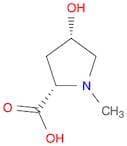
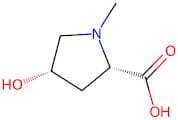
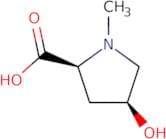
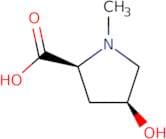
CAS 67463-44-9
:N-Me-cis-Hyp-OH
Descrição:
N-Me-cis-Hyp-OH, também conhecido como N-Metil-cis-4-hidroxiprolina, é um derivado de aminoácido caracterizado por suas características estruturais, que incluem um grupo metila ligado ao átomo de nitrogênio e um grupo hidroxila no anel de prolina. Este composto é um estereoisômero da hidroxiprolina, especificamente a forma cis, que influencia sua atividade biológica e interações. É solúvel em água e exibe propriedades típicas de aminoácidos, como a capacidade de participar de ligações de hidrogênio devido à presença do grupo hidroxila. N-Me-cis-Hyp-OH é de interesse em vários campos, incluindo bioquímica e farmacêutica, devido ao seu papel potencial na síntese de proteínas e suas implicações na estabilidade e estrutura do colágeno. Além disso, pode servir como um bloco de construção na síntese de peptídeos e tem sido estudado por seus efeitos em processos celulares. Suas características estruturais únicas contribuem para sua funcionalidade em sistemas biológicos, tornando-o um assunto de pesquisa em química medicinal e disciplinas relacionadas.
Fórmula:C6H11NO3
Sinónimos:- N-Me-Cis-Hydroxyproline
Ordenar por
Pureza (%)
0
100
|
0
|
50
|
90
|
95
|
100
5 produtos.
(2S,4S)-4-Hydroxy-1-methylpyrrolidine-2-carboxylic acid
CAS:(2S,4S)-4-Hydroxy-1-methylpyrrolidine-2-carboxylic acidPureza:98%Peso molecular:145.16g/molN-Methyl-L-cis-4-hydroxyproline hydrochloride
CAS:N-Methyl-L-cis-4-hydroxyproline hydrochloride is a bioactive compound that has been isolated from the leaves of Semecarpifolia. It is an analysis product, which means that it can be used to identify or characterize a biological material. N-Methyl-L-cis-4-hydroxyproline hydrochloride is an essential component of hexane, ethanolic extracts, and leaves of Semecarpifolia. This compound has been shown to have antiinflammatory properties in research on rats. It also has fatty acid properties, as well as cyclic and butanamide structures. N-Methyl-L-cis-4-hydroxyproline hydrochloride belongs to the family Meliaceae, which includes plants like eucalyptus and camphor. This compound is soluble in solvents such as benzene, chloroform, ether, methanol, or petroleum ether.Fórmula:C6H11NO3•HClPureza:Min. 95%Peso molecular:181.62 g/mol(2S,4S)-4-Hydroxy-1-methylpyrrolidine-2-carboxylic acid
CAS:Fórmula:C6H11NO3Pureza:95.0%Cor e Forma:SolidPeso molecular:145.158N-Methyl-L-trans-4-hydroxyproline hydrochloride
CAS:N-Methyl-L-trans-4-hydroxyproline hydrochloride is a bioactive compound that is present in the leaves of Semecarpifolia. It has been found to have antioxidant and anti-inflammatory properties. The chemical structure of N-methyl-L-trans-4-hydroxyproline hydrochloride is cyclic, butanamide, hexane, ethanolic extracts, and semecarpifolia. The family Meliaceae includes species such as Eucalyptus, which produces the bioactive compound cineole. Solvents used in this process are hexane and ethanolic extracts.Fórmula:C6H11NO3·HClPureza:Min. 95%Cor e Forma:PowderPeso molecular:181.62 g/mol