CAS 67879-58-7
:Ácido caftárico
Descrição:
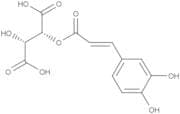
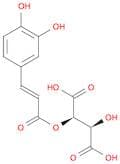
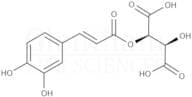
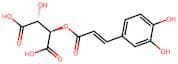
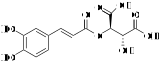
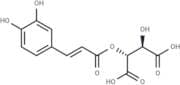
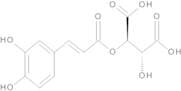
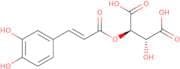
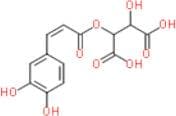
Ácido caftárico é um composto fenólico que ocorre naturalmente, encontrado principalmente em certas plantas, particularmente na família Asteraceae. É caracterizado por sua estrutura, que inclui uma unidade de ácido cafeico ligada a uma unidade de ácido tartárico. Este composto exibe propriedades antioxidantes, tornando-o de interesse em várias áreas, incluindo ciência dos alimentos e farmacologia. Ácido caftárico é solúvel em água e solventes orgânicos, o que aumenta sua biodisponibilidade e aplicações potenciais. Sua atividade antioxidante é atribuída à presença de grupos hidroxila, que podem capturar radicais livres, contribuindo assim para a estabilidade e preservação de produtos derivados de plantas. Além disso, Ácido caftárico tem sido estudado por seus potenciais benefícios à saúde, incluindo efeitos anti-inflamatórios e antimicrobianos. O número CAS do composto, 67879-58-7, é um identificador único que facilita seu reconhecimento na literatura científica e em contextos regulatórios. No geral, Ácido caftárico representa um composto significativo no estudo da bioquímica vegetal e suas implicações para a saúde e nutrição.
Fórmula:C13H12O9
InChI:InChI=1/C13H12O9/c14-7-3-1-6(5-8(7)15)2-4-9(16)22-11(13(20)21)10(17)12(18)19/h1-5,10-11,14-15,17H,(H,18,19)(H,20,21)/b4-2+/t10-,11-/m1/s1
Chave InChI:InChIKey=SWGKAHCIOQPKFW-JTNORFRNSA-N
SMILES:[C@@H](OC(/C=C/C1=CC(O)=C(O)C=C1)=O)([C@H](C(O)=O)O)C(O)=O
Sinónimos:- (2R,3R)-2-[[(2E)-3-(3,4-Dihydroxyphenyl)-1-oxo-2-propen-1-yl]oxy]-3-hydroxybutanedioic acid
- (2R,3R)-2-{[(2E)-3-(3,4-dihydroxyphenyl)prop-2-enoyl]oxy}-3-hydroxybutanedioic acid
- 2-Caffeoyl-L-tartaric acid
- Butanedioic acid, 2-[[(2E)-3-(3,4-dihydroxyphenyl)-1-oxo-2-propen-1-yl]oxy]-3-hydroxy-, (2R,3R)-
- Butanedioic acid, 2-[[(2E)-3-(3,4-dihydroxyphenyl)-1-oxo-2-propenyl]oxy]-3-hydroxy-, (2R,3R)-
- Butanedioic acid, 2-[[3-(3,4-dihydroxyphenyl)-1-oxo-2-propenyl]oxy]-3-hydroxy-, [R-[R*,R*-(E)]]-
- trans-Caftaric acid
- Caftaric acid
- (2R,3R)-2-(((E)-3-(3,4-Dihydroxyphenyl)acryloyl)oxy)-3-hydroxysuccinic acid
- (2R,3R)-(-)-CAFTARIC ACID)
- (2R,3R)-2-[[(E)-3-(3,4-Dihydroxyphenyl)-1-oxo-2-propenyl]oxy]-3-hydroxybutanedioic acid
- CAFTARIC ACID USP/EP/BP
- Caftaricaci
- (2E,3R)-2-[[3-(3,4-DIHYDROXYPHENYL)-1-OXO-2-PROPENYL)OXY]-3-HYDROXYBUTANEDIOIC ACID
- (2R,3R)-2-[[(E)-1-Oxo-3-(3,4-dihydroxyphenyl)-2-propenyl]oxy]-3-hydroxybutanedioic acid
- MONO-(3,4-DIHYDROXYCINNAMOYL)-TARTARIC ACID
- (2R,3R)-2-[(3,4-Dihydroxy-trans-cinnamoyl)oxy]-3-hydroxybutanedioic acid
- Cafftaric acid
- Caftaric acid (trans-Caftaric acid)
- Ver mais sinónimos
Ordenar por
Pureza (%)
0
100
|
0
|
50
|
90
|
95
|
100
13 produtos.
Caftaric acid
CAS:Caftaric acid analytical standard provided with w/w absolute assay, to be used for quantitative titration.Fórmula:C13H12O9Pureza:(HPLC) ≥98%Cor e Forma:PowderPeso molecular:312.23Caftaric acid
CAS:Caftaric acid is an inhibitor of the protein-protein interactions mediated by the Src-family kinases, which has anti-mutagenicity. Caftaric acid is the major dietary polyphenol present in various foods, it before methamphetamine injections can prevent liver toxicity and oxidative stress.Fórmula:C13H12O9Pureza:95%~99%Peso molecular:312.23Caftaric acid
CAS:Caftaric acid: a natural antioxidant, anti-inflammatory, antimutagenic, and Src kinase protein-protein interaction inhibitor.Fórmula:C13H12O9Pureza:98.31% - 99.50%Cor e Forma:White PowderPeso molecular:312.23Ref: TM-T3S2390
1mg34,00€2mg46,00€5mg66,00€1mL*10mM (DMSO)73,00€10mg92,00€25mg177,00€50mg295,00€100mg442,00€200mg620,00€Caftaric acid
CAS:Carboxylic acid with additional oxygen functionsFórmula:C13H12O9Pureza:≥ 95.0 % (HPLC)Cor e Forma:PowderPeso molecular:312.23Caftaric Acid
CAS:Applications Caftaric Acid is used in cancer therapy as an anticancer drug. Affecting the up regulation or down regulation of drug transporters or cytochrome p450 enzymes. Also provides antioxidant effects, found in wines.
References Mooiman, K. et al.: Drug Metab. Disp., 41, 1494 (2013); Cejudo-Bastante, M. et al.: J. Agri. Food Chem., 58, 11483 (2010);Fórmula:C13H12O9Cor e Forma:NeatPeso molecular:312.23Caftaric acid
CAS:Caftaric acid is a tartaric ester of hydroxycinnamic acid. Caftaric acid is a natural phenolic compound present in grapes and wine, in chicory, and in Echinacea plants. In rats, it is quickly absorbed in the stomach, and detected in blood and in kidneys, whereas only its conversion product trans-fertaric acid is found in urine. In humans, caftaric acid has been suggested as an inhibitor of protein phospholipase A2-like (PLA2-like) toxins that are present in snake venom.Fórmula:C13H12O9Pureza:Min. 98 Area-%Cor e Forma:PowderPeso molecular:312.23 g/molCaftaric Acid
CAS:Carboxylic acids with phenol function but without other oxygen function, their anhydrides, halides, peroxides etc, nesoiFórmula:C13H12O9Cor e Forma:Yellow Light Brown PowderPeso molecular:312.04813