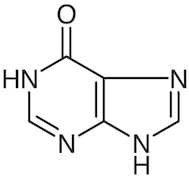
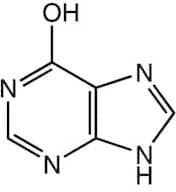
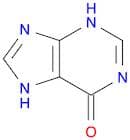
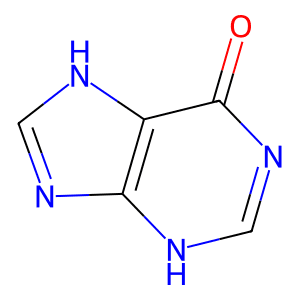
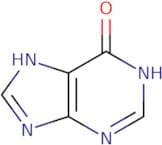
CAS 68-94-0
:hipoxantina
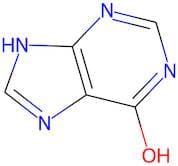
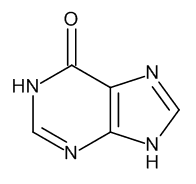
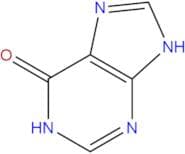
- 1,7-Dihydro-6H-purin-6-one
- 1,9-Dihydro-6H-purin-6-one
- 1,9-Dihydro-purin-6-one
- 1H,7H-Hypoxanthine
- 1H,9H-Hypoxanthine
- 1H-Purin-6(9H)-one
- 3,5-dihydro-6H-purin-6-one
- 3,7-dihydro-6H-purin-6-one
- 3H-Purin-6-ol
- 6-Hydroxy-1H-purine
- 6-Hydroxypurine
- 6-Oxopurine
- 6H-Purin-6-one, 1,7-dihydro-
- 6H-Purin-6-one, 1,9-dihydro-
- 9H-Purin-6(1H)-one
- 9H-Purin-6-ol
- Hypoxanthine 6-Hydroxypurine
- Hypoxanthine enol
- Nsc 129419
- Nsc 14665
- Purin-6(1H)-on
- Purin-6(3H)-one
- Purin-6-ol
- Sarcine
- Sarkin
- Sarkine
- purin-6(1H)-ona
- purin-6(1H)-one
- purine-6(1H)-one
- Ver mais sinónimos
Hypoxanthine
CAS:Fórmula:C5H4N4OPureza:>98.0%(E)(HPLC)Cor e Forma:White to Light yellow to Light red powder to crystalPeso molecular:136.11Hypoxanthine, 99%
CAS:Hypoxanthine, is used as a marker for energy perturbation in hypoxia/ ischemia. It has been also used in DNA studies to investigate the destabilizing effect it has on DNA duplexes containing hypoxanthine as a base, in a gas phase versus a liquid phase. Hypoxanthine has also been used in studies alonFórmula:C5H4N4OPureza:99%Cor e Forma:Powder or lumps, White to pale creamPeso molecular:136.11Didanosine Related Compound A (Hypoxanthine)
CAS:Nucleic acids and their salts, whether or not chemically defined; other heterocyclic compounds, nesoiFórmula:C5H4N4OCor e Forma:Off-White White PowderPeso molecular:136.03851Hypoxanthine
CAS:Hypoxanthine, a purine derivative, is a metabolite in nucleic acid synthesis and oxidizes to uric acid via xanthine.Fórmula:C5H4N4OPureza:98.39% - 99.86%Cor e Forma:SolidPeso molecular:136.11Azathioprine EP Impurity F (Didanosine EP Impurity A, Didanosine USP Related Compound A, Hypoxanthine)
CAS:Fórmula:C5H4N4OPeso molecular:136.11Didanosine EP Impurity A (Azathioprine EP Impurity F)
CAS:Produto ControladoFórmula:C5H4N4OCor e Forma:NeatPeso molecular:136.11Hypoxanthine
CAS:Fórmula:C5H4N4OPureza:≥ 98.0%Cor e Forma:White to off-white crystalline powderPeso molecular:136.11Hypoxanthine
CAS:HypoxanthineFórmula:C5H4N4OPureza:98%Cor e Forma: off-white to pink solidPeso molecular:136.11146g/molHypoxanthine
CAS:Produto ControladoApplications A naturally occurring purine derivative. Pharmaceuticals, Intermediates & Fine Chemicals
References Jansen, R., et al.: Clin. Biochem., 38, 362 (2005), Vorst, O., et al.: Metabolomics, 1, 169 (2005), Want, E., et al.: ChemBioChem., 6, 1941 (2005), van der Werf, M., et al.: Anal. Biochem., 370, 17 (2007),Fórmula:C5H4N4OCor e Forma:NeatPeso molecular:136.11Hypoxanthine, 99%
CAS:M01853 - Hypoxanthine, 99%
Fórmula:C5H4N4OPureza:98%Cor e Forma:Solid, Light yellow powderPeso molecular:136.114Hypoxanthine extrapure, 99%
CAS:Fórmula:C5H4N4OPureza:min. 99%Cor e Forma:White to Off-white to Pale cream, Crystalline powder, Clear, Colourless to Pale yellowPeso molecular:136.11Hypoxanthine
CAS:Hypoxanthine is a nucleoside that is found in human cells. It is synthesized from guanine by the enzyme, xanthine oxidoreductase. Hypoxanthine is also produced from xanthine by adenosine deaminase and converted back to xanthine, which can then be reused for DNA synthesis. Hypoxanthine has been shown to inhibit the growth of photosynthetic bacteria, such as Rhodopseudomonas viridis and Rhodobacter sphaeroides. This inhibition may be due to an equilibrative nucleotide effect on the folate receptor. The x-ray diffraction data collected from the chrysanthemum flower (a source of hypoxanthine) showed that hypoxanthine has a calcium salt structure.
Fórmula:C5H4N4OPureza:Min. 95%Cor e Forma:White PowderPeso molecular:136.11 g/mol