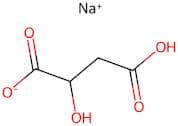
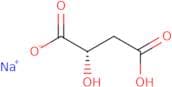
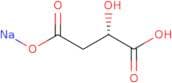
CAS 68303-40-2
:ácido L-málico monossódico cristalino
Descrição:
ácido L-málico monossódico cristalino, com o número CAS 68303-40-2, é um sal de sódio do ácido L-málico, um composto orgânico que desempenha um papel significativo em vários processos bioquímicos, particularmente no ciclo de Krebs. Esta substância geralmente aparece como um pó cristalino branco e é solúvel em água, tornando-a útil em várias aplicações, incluindo as indústrias de alimentos e bebidas como acidulante e realçador de sabor. Possui um gosto levemente ácido e é conhecida por sua capacidade de realçar a acidez dos produtos. Além de seus usos culinários, o ácido L-málico monosódico também pode servir como agente tampão e é utilizado em produtos farmacêuticos e cosméticos por suas propriedades estabilizadoras. O composto é geralmente reconhecido como seguro (GRAS) quando usado em quantidades apropriadas, mas como todas as substâncias, deve ser manuseado com cuidado para evitar quaisquer efeitos adversos potenciais. Sua estrutura química inclui grupos funcionais tanto de ácido carboxílico quanto de hidroxila, contribuindo para sua reatividade e interação com outros compostos.
Fórmula:C4H5NaO5
Sinónimos:- L-Malic acid monosodium salt
- L-Hydroxybutanedioic acid sodium salt
- SODIUM BIMALATE
- SODIUM ACID MALATE
- Malic acid-Na-salt
- L-(-)-Malic acid sodiuM salt 95-100% (enzyMatic)
- L-malic acid monosodium crystalline
- SODIUM HYDROGEN MALATE
- DL-MALIC ACID MONOSODIUM SALT
- SODIUM HYDROGEN DL-MALATE
Ordenar por
Pureza (%)
0
100
|
0
|
50
|
90
|
95
|
100
4 produtos.
Sodium 3-carboxy-2-hydroxypropanoate
CAS:Sodium 3-carboxy-2-hydroxypropanoatePureza:95%Peso molecular:156.07g/molL-(-)-Malic acid monosodium
CAS:L-Malic acid is a dicarboxylic acid that is found in many fruits and vegetables. It is the substrate for the enzyme malate dehydrogenase, which catalyzes the oxidation of L-malate to oxaloacetate. L-Malic acid is used to study mitochondrial function, as it can be used as an alternative energy source. The L-malic acid monosodium salt (LAM) has been shown to be effective in preventing muscle damage caused by exercise. This may be due to its ability to decrease oxidative stress and increase ATP production through increased mitochondrial activity. LAM also has been shown to promote photoreceptor cell survival and improve retinal function in animals with damaged photoreceptors, although it does not have any effect on normal animal eyes.Fórmula:C4H6O5•NaPureza:Min. 95%Cor e Forma:PowderPeso molecular:157.08 g/molL-Malic acid, sodium salt
CAS:L-Malic acid, sodium salt is a white crystalline compound that is soluble in water and has a molecular weight of 136.08. It is a useful scaffold for the synthesis of organic compounds and can be used as a reaction component or as a speciality chemical. L-Malic acid, sodium salt can be used to synthesize many different types of compounds including pharmaceuticals, hormones, industrial chemicals, and research chemicals. This compound is also an important intermediate in the production of amino acids, polymers, and other organic compounds. L-Malic acid, sodium salt has been found to have high purity with few impurities.
Fórmula:C4H5NaO5Peso molecular:156.07 g/mol