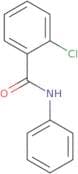
CAS 6833-13-2
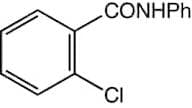
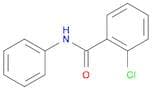
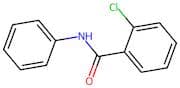
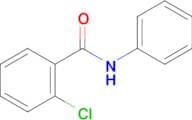
:2-cloro-N-fenilbenzamida
Descrição:
2-cloro-N-fenilbenzamida é um composto orgânico caracterizado pelo seu grupo funcional amida, que consiste em um anel de benzeno substituído por um grupo cloro e um grupo N-fenila. Este composto geralmente aparece como um sólido à temperatura ambiente e é solúvel em solventes orgânicos. A presença do substituinte cloro introduz uma reatividade única, tornando-o útil em várias reações químicas, incluindo substituições nucleofílicas e reações de acoplamento. A ligação amida contribui para sua estabilidade e influencia suas propriedades físicas, como pontos de fusão e ebulição. Além disso, 2-cloro-N-fenilbenzamida pode exibir atividade biológica, tornando-o de interesse na pesquisa farmacêutica. Sua estrutura molecular permite interações potenciais com alvos biológicos, que podem ser exploradas para aplicações terapêuticas. Assim como muitos compostos clorados, é essencial manusear esta substância com cuidado devido à sua potencial toxicidade e preocupações ambientais. Medidas de segurança adequadas devem ser observadas ao trabalhar com este químico em ambientes de laboratório.
Fórmula:C13H10ClNO
InChI:InChI=1/C13H10ClNO/c14-12-9-5-4-8-11(12)13(16)15-10-6-2-1-3-7-10/h1-9H,(H,15,16)
SMILES:c1ccc(cc1)N=C(c1ccccc1Cl)O
Sinónimos:- Benzamide, 2-chloro-N-phenyl-
Ordenar por
Pureza (%)
0
100
|
0
|
50
|
90
|
95
|
100
5 produtos.
2-Chloro-N-phenylbenzamide, 97%
CAS:This Thermo Scientific Chemicals brand product was originally part of the Alfa Aesar product portfolio. Some documentation and label information may refer to the legacy brand. The original Alfa Aesar product / item code or SKU reference has not changed as a part of the brand transition to Thermo Sci
Fórmula:C13H10ClNOPureza:97%Peso molecular:231.682-Chlorobenzanilide
CAS:2-Chlorobenzanilide is a chlorine compound that has been used to inhibit the growth of soil microorganisms. It is also an inhibitor of phenanthridone, which is an important intermediate in the synthesis of many herbicides. 2-Chlorobenzanilide can be prepared by reacting phenylhydrazine with chloroacetanilide. It can also be prepared by treating benzene with phosphorus chloride and then adding aniline to the reaction product. The rate of this reaction depends on the concentration of reactants, temperature, and pH. If more water is added to the reaction mixture, there will be a lower rate of reaction because hydroxide ions will compete with chloride ions for reactant molecules. The kinetic equation for this reaction follows:Fórmula:C13H10ClNOPureza:Min. 95%Peso molecular:231.68 g/mol