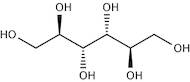
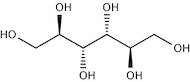
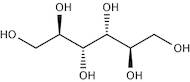
CAS 69-65-8
:Manitol
- (2R,3R,4R,5R)-Hexane-1,2,3,4,5,6-hexaol
- <span class="text-smallcaps">D</span>-(-)-Mannitol
- <span class="text-smallcaps">D</span>-Mannit
- Ai3-19511
- Brightmoon
- Bronchitol
- Cerestar 16700
- Cordycepic acid
- D-Mannit
- D-Mannitol
- D-manitol
- DL-Mannitol
- Diosmol
- E 421
- Granitol S
- Granutol F
- Granutol R
- Granutol S
- Hexahydroxyhexane
- Hexitol
- Isotol
- L-altritol
- M 100
- Manicol
- Maniton S
- Manna sugar
- Mannidex
- Mannidex 16700
- Mannigen
- Mannistol
- Mannit
- Mannit 60
- Mannit P
- Mannit Q
- Mannit S
- Mannite
- Mannitol 300DC
- Mannitol 35
- Mannitol 60
- Mannitol P 60
- Mannitol SD 200
- Mannitol, <span class="text-smallcaps">D</span>-
- Mannitol, D-
- Mannitol, Powder
- Mannitolum
- Mannogem 2080
- Mannogem EZ
- Marine Crystal
- Nonpareil 108
- Nonpareil 108(200)
- Nsc 9256
- Orocell 200
- Osmitrol
- Osmosal
- Parteck 300
- Parteck Delta M
- Parteck M 100
- Parteck M 200
- Parteck M 300
- Partek M
- Pearlitol
- Pearlitol 100
- Pearlitol 100SD
- Pearlitol 160C
- Pearlitol 2005D
- Pearlitol 200SD
- Pearlitol 25C
- Pearlitol 50C
- Pearlitol SD 100
- Perlitol SD 200
- Perteck M
- PharmMannidex
- PharmMannidex 16701
- Ver mais sinónimos
- Preços em ordem crescente
- Preços em ordem decrescente
- Menor grau de pureza
- Maior grau de pureza
- Estimativa de entrega mais rápida
D-Mannitol-d8
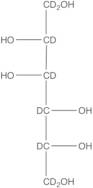
CAS:Produto ControladoApplications Labelled D-Mannitol (M165000). D-Mannitol is widespread in plants and plant exudates; obtained from manna and seaweeds. D-Mannitol is used in the food industry as anticaking and free-flow agent, flavoring agent, lubricant and release agent, stabilizer and thickener and nutritive sweetener.
References Pigman, W., et al.: The Carbohydrates, 249 (1957), Makkee, M., et al.: Chem. Commun., 930 (1980),Fórmula:C6D8H6O6Cor e Forma:NeatPeso molecular:190.2211D-Mannitol-[1-13C;1,1'-d2]
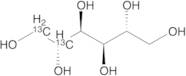
CAS:Produto ControladoApplications Labeled D-Mannitol is widespread in plants and plant exudates; obtained from manna and seaweeds. D-Mannitol is used in the food industry as anticaking and free-flow agent, flavoring agent, lubricant and release agent, stabilizer and thickener and nutritive sweetener.
References Pigman, W., et al.: The Carbohydrates, 249 (1957), Makkee, M., et al.: Chem. Commun., 930 (1980),Fórmula:CC5H12D2O6Cor e Forma:NeatPeso molecular:185.18D(-)-Mannitol (USP, BP, Ph. Eur.) pure
CAS:D(-)-Mannitol (USP, BP, Ph. Eur.) pureFórmula:C6H14O6Pureza:Pharma GradeCor e Forma:SolidPeso molecular:182.17175D-Mannitol low endotoxin (Ph. Eur., BP, USP, JP)
CAS:D-Mannitol low endotoxin (Ph. Eur., BP, USP, JP)
Fórmula:C6H14O6Cor e Forma:SolidPeso molecular:182.17g/molD-Mannitol
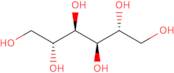
CAS:Produto ControladoApplications D-Mannitol is widespread in plants and plant exudates; obtained from manna and seaweeds. D-Mannitol is used in the food industry as anticaking and free-flow agent, flavoring agent, lubricant and release agent, stabilizer and thickener and nutritive sweetener.
References Pigman, W., et al.: The Carbohydrates, 249 (1957), Makkee, M., et al.: Chem. Commun., 930 (1980),Fórmula:C6H14O6Cor e Forma:NeatPeso molecular:182.17D-Mannitol
CAS:Mannitol is a sugar alcohol occurring widely in plants and they are exudates, for example, in olive and plane trees (Collins, 2006). It is produced commercially by the catalytic hydrogenation of fructose (Zelin, 2019). Mannitol is used extensively in food and pharmaceutical industries because of its unique functional properties. It is about 50% as sweet as sucrose and has a desirable cooling effect often used to mask bitter tastes. Mannitol is non-cariogenic and has a low caloric content. Mannitol is an osmotic diuretic that is metabolically inert in humans and is used for: the promotion of diuresis before irreversible renal failure becomes established, the promotion of urinary excretion of toxic substances, as an Antiglaucoma agent, and as a renal function diagnostic aid (OâNeil, 2013). Additonally, in 2020, mannitol was approved by the FDA as add-on maintenance therapy for the control of pulmonary symptoms associated with cystic fibrosis in adult patients (McKenna, 2020).Fórmula:C6H14O6Pureza:Min. 95%Cor e Forma:White PowderPeso molecular:182.17 g/molD-Mannitol ACS, 99%
CAS:Fórmula:C6H14O6Pureza:min. 99%Cor e Forma:Crystalline powder, White, Clear, ColourlessPeso molecular:182.17D-Mannitol extrapure, 98.5%
CAS:Fórmula:C6H14O6Pureza:min.98.5%Cor e Forma:White, Crystalline Powder, Clear, ColourlessPeso molecular:182.17D-Mannitol ACS, ExiPlus, Multi-Compendial, 99%
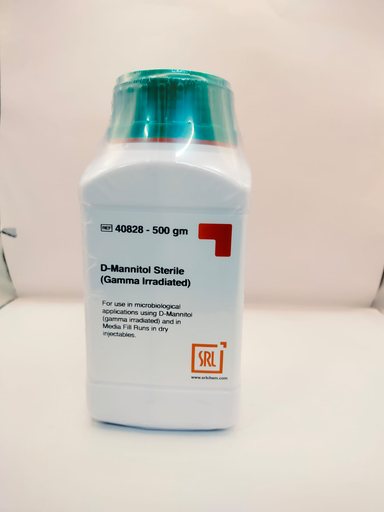
CAS:Fórmula:C6H14O6Pureza:min.99.0%Cor e Forma:White, Crystalline powder, Clear, ColourlessPeso molecular:182.17D-Mannitol Sterile (γ Irradiated)
CAS:Pureza:98.5%Cor e Forma:White, Crystalline powder, Clear, colourless solutionD-Mannitol-1,6-13C2
CAS:Produto ControladoApplications Labeled D-Mannitol is widespread in plants and plant exudates; obtained from manna and seaweeds. D-Mannitol is used in the food industry as anticaking and free-flow agent, flavoring agent, lubricant and release agent, stabilizer and thickener and nutritive sweetener.
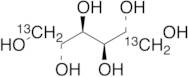
References Pigman, W., et al.: The Carbohydrates, 249 (1957), Makkee, M., et al.: Chem. Commun., 930 (1980),Fórmula:C413C2H15O6Cor e Forma:NeatPeso molecular:184.16D-Mannitol-1,2-13C2
CAS:Produto ControladoApplications Labeled D-Mannitol is widespread in plants and plant exudates; obtained from manna and seaweeds. D-Mannitol is used in the food industry as anticaking and free-flow agent, flavoring agent, lubricant and release agent, stabilizer and thickener and nutritive sweetener.
References Pigman, W., et al.: The Carbohydrates, 249 (1957); Makkee, M., et al.: Chem. Commun., 930 (1980);Fórmula:C413C2H14O6Cor e Forma:NeatPeso molecular:184.16D-Mannitol - EP
CAS:Mannitol is a sugar alcohol occurring widely in plants and they are exudates, for example, in olive and plane trees (Collins, 2006). It is produced commercially by the catalytic hydrogenation of fructose (Zelin, 2019). Mannitol is used extensively in food and pharmaceutical industries because of its unique functional properties. It is about 50% as sweet as sucrose and has a desirable cooling effect often used to mask bitter tastes. Mannitol is non-cariogenic and has a low caloric content. Mannitol is an osmotic diuretic that is metabolically inert in humans and is used for: the promotion of diuresis before irreversible renal failure becomes established, the promotion of urinary excretion of toxic substances, as an Antiglaucoma agent, and as a renal function diagnostic aid (OâNeil, 2013). Additonally, in 2020, mannitol was approved by the FDA as add-on maintenance therapy for the control of pulmonary symptoms associated with cystic fibrosis in adult patients (McKenna, 2020).Fórmula:C6H14O6Pureza:Min. 97 Area-%Cor e Forma:White PowderPeso molecular:182.17 g/mol

![D-Mannitol-[1-13C;1,1'-d2]](https://static.cymitquimica.com/products/TR/thumb/M165012.jpg)