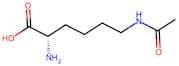
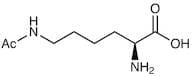
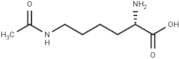
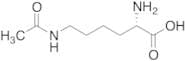
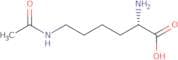
CAS 692-04-6
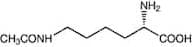
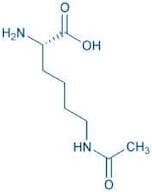
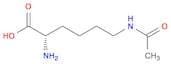
:Nepsilon-Acetil-L-lisina
- (2S)-6-Acetamido-2-aminohexanoic acid
- 6-Acetamido-2-aminohexanoic acid
- <span class="text-smallcaps">L</span>-Lysine, N<sup>6</sup>-acetyl-
- <span class="text-smallcaps">L</span>-ε-N-Acetyllysine
- H-Lys(Ac)-OH
- H-Lys(Ac)-OH・HCl
- Lysine, N<sup>6</sup>-acetyl-
- Lysine, N<sup>6</sup>-acetyl-, <span class="text-smallcaps">L</span>-
- N-Epsilon-Acetyl-L-Lysine
- N6-Acetyllysine
- N<sup>6</sup>-Acetyl-<span class="text-smallcaps">L</span>-lysine
- N<sup>6</sup>-Acetyllysine
- N<sup>ε</sup>-Acetyl-<span class="text-smallcaps">L</span>-lysine
- N<sup>ε</sup>-Acetyllysine
- NSC 102777
- ε-Acetyl-<span class="text-smallcaps">L</span>-lysine
- ε-N-Acetyl-<span class="text-smallcaps">L</span>-lysine
- ε-N-Acetyllysine
- ω-N-Acetyl-<span class="text-smallcaps">L</span>-lysine
- N6-Acetyl-L-lysine
- Lysine, N6-acetyl-, L-
- L-Lysine, N6-acetyl-
- Lysine, N6-acetyl-
- ε-N-Acetyl-L-lysine
- N-E-ACETYL-L-LYSINE
- H-L-LYS(AC)-OH
- N-epsilon-acetyllysine
- N-EPSILON-ACETYL-L-LYS
- Nε-Ac-L-Lys-OH
- LYSINE(AC)-OH
- (2S)-6-acetamido-2-amino-hexanoic acid
- Ver mais sinónimos
N(ε)-Acetyl-L-lysine, 99%
CAS:N(epsilon)-Acetyl-L-lysine is an R-chain N-acetylated amino acid used together with other lysine analogues to differentiate and characterized various aminoacylases and regulator 2 (Sir2) enzymes/sirtuins. This Thermo Scientific Chemicals brand product was originally part of the Alfa Aesar product pFórmula:C8H16N2O3Pureza:99%Cor e Forma:White, PowderPeso molecular:188.23H-Lys(Ac)-OH
CAS:Bachem ID: 4015284.
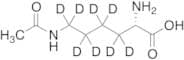
Fórmula:C8H16N2O3Pureza:> 99%Cor e Forma:White PowderPeso molecular:188.236-N-Acetyl-L-lysine-3,3,4,4,5,5,6,6-d8
CAS:Fórmula:CH3CONH(CD2)4CH(NH2)COOHPureza:99 atom % DCor e Forma:White SolidPeso molecular:196.16631Nε-Acetyl-L-lysine
CAS:Fórmula:C8H16N2O3Pureza:>98.0%(T)Cor e Forma:White to Almost white powder to crystalPeso molecular:188.23Nε-Acetyl-L-lysine
CAS:Nepsilon-Acetyl-L-lysine is a derivative of the lysine.Fórmula:C8H16N2O3Pureza:99.66% - 99.95%Cor e Forma:SolidPeso molecular:188.22N-Epsilon-acetyl-l-lysine
CAS:Produto ControladoApplications N-Epsilon-acetyl-l-lysine is used in the metabolomics study on the combined effect of cocaine and ethanol via liquid chromatography-mass spectrometry metabolomics approach.
References Sanchez-Lopez, E., et al.: J. Pharm. Biomed. Anal., 140, 313 (2017)Fórmula:C8H16N2O3Cor e Forma:NeatPeso molecular:188.22N-epsilon-Acetyl-L-lysine
CAS:N-epsilon-acetyl-L-lysine is a diagnostic agent that is used to identify cancer cells. This compound is synthesized by the enzyme polymerase chain reaction (PCR) and is a fluorescent probe that selectively binds to lysine residues in proteins of the cell membrane, including glycoproteins and proteoglycans. The presence of this compound can be detected using spectroscopy. It has been shown that higher levels of N-epsilon-acetyl-L-lysine in urine are associated with an increased body mass index and fatty acid content.
Fórmula:C8H16N2O3Pureza:Min. 98 Area-%Cor e Forma:White PowderPeso molecular:188.22 g/mol(S)-6-Acetamido-2-aminohexanoic acid
CAS:Fórmula:C8H16N2O3Pureza:97%Cor e Forma:SolidPeso molecular:188.2276-N-Acetyl-L-lysine-d8
CAS:Produto ControladoStability Hygroscopic
Applications 6-N-Acetyl-L-lysine-d8 is an isotopic analog of N-Acetyl-L-lysine (E588725(P)), which is used in the metabolomics study on the combined effect of cocaine and ethanol via liquid chromatography-mass spectrometry metabolomics approach.
References Sanchez-Lopez, E., et al.: J. Pharm. Biomed. Anal., 140, 313 (2017)Fórmula:C8D8H8N2O3Cor e Forma:NeatPeso molecular:196.274