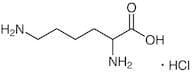
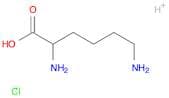
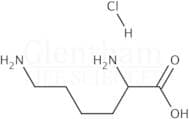
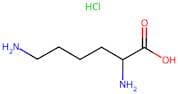
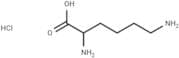
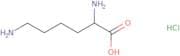
CAS 70-53-1
:Lisina, cloridrato (1:1)
Descrição:
O cloridrato de lisina (1:1), com o número CAS 70-53-1, é um sal formado a partir do aminoácido lisina e do ácido clorídrico. É um pó branco cristalino que é altamente solúvel em água, tornando-o adequado para várias aplicações em bioquímica e nutrição. A lisina é classificada como um aminoácido essencial, o que significa que deve ser obtida através da dieta, uma vez que o corpo humano não pode sintetizá-la. Este composto desempenha um papel crucial na síntese de proteínas, na produção de hormônios e na absorção de cálcio. Além de sua importância nutricional, o cloridrato de lisina é frequentemente utilizado em suplementos dietéticos e como aditivo alimentar para melhorar o perfil nutricional de vários produtos. Também é utilizado em formulações farmacêuticas devido à sua capacidade de estabilizar proteínas e melhorar sua solubilidade. Embora geralmente seja considerado seguro, a ingestão excessiva pode levar a distúrbios gastrointestinais. No geral, o cloridrato de lisina é valorizado por suas propriedades funcionais tanto em aplicações de saúde quanto industriais.
Fórmula:C6H14N2O2·ClH
InChI:InChI=1S/C6H14N2O2.ClH/c7-4-2-1-3-5(8)6(9)10;/h5H,1-4,7-8H2,(H,9,10);1H
Chave InChI:InChIKey=BVHLGVCQOALMSV-UHFFFAOYSA-N
SMILES:C(CCCCN)(C(O)=O)N.Cl
Sinónimos:- 2,6-Diaminohexanoic acid hydrochloride
- <span class="text-smallcaps">DL</span>-Lysine hydrochloride
- <span class="text-smallcaps">DL</span>-Lysine, monohydrochloride
- D-lysine - L-lysine hydrochloride (1:1:2)
- DL-lysine monohydrochloride
- Lysine, hydrochloride (1:1)
- Lysine, monohydrochloride
- Lysine, monohydrochloride, <span class="text-smallcaps">DL</span>-
- NSC 46705
- Lysine, monohydrochloride, DL-
- DL-Lysine hydrochloride
Ordenar por
Pureza (%)
0
100
|
0
|
50
|
90
|
95
|
100
8 produtos.
DL-Lysine Monohydrochloride
CAS:Fórmula:C6H14N2O2·HClPureza:>98.0%(T)Cor e Forma:White to Light yellow powder to crystalPeso molecular:182.65DL-Lysine monohydrochloride, 99%
CAS:DL-Lysine monohydrochloride acts as an intermediate in the preparation of 3-amino-azepan-2-one. It also serves as an essential amino acid. It is used as animal feed. In addition to this, it is used in the construction of polylysine polymers, which finds application in lysine-based polypeptide gelsFórmula:C6H15ClN2O2Pureza:99%Cor e Forma:White to pale cream, PowderPeso molecular:182.65DL-Lysine monohydrochloride
CAS:Fórmula:C6H14N2O2·HClPureza:≥ 98.0%Cor e Forma:White to off-white, crystalline powderPeso molecular:182.65H-DL-Lys-OH HCl
CAS:H-DL-Lys-OH HCl is the hydrochloride salt of lysine, widely used in biochemical experiments and drug synthesis research.Fórmula:C6H15ClN2O2Pureza:99.94%Cor e Forma:SolidPeso molecular:182.65DL-Lysine hydrochloride
CAS:The solubility of DL-Lysine hydrochloride in water is low, with a solubility of 0.01 g/100 mL at 25 °C. The pH of the solution is 7.0 and the concentration is 10.00%. The pH of the solution was determined using a pH meter. The concentration was determined by weight measurements using a balance and a volumetric flask. DL-Lysine hydrochloride reacts with hydrochloric acid to form an amide linkage between lysine residues on adjacent polypeptides or proteins, which may be used as a cross-linking agent for cell culture experiments. This compound has been shown to inhibit the growth of herpes simplex virus type 1 (HSV-1) in cell culture experiments, although it has no effect on HSV-2 because it lacks an amino group at position 2 on its side chain.Fórmula:C6H14N2O2·HClPureza:Min. 98%Cor e Forma:PowderPeso molecular:182.65 g/mol2,6-Diaminohexanoic acid hydrochloride
CAS:Fórmula:C6H15ClN2O2Pureza:97%Cor e Forma:Solid, White to slightly pale yellow powderPeso molecular:182.65