CAS 70023-02-8
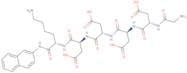
:glicina-ácido aspártico-ácido aspártico-ácido aspártico-ácido aspártico-lisina-B-naftilamida
Descrição:
glicina-ácido aspártico-ácido aspártico-ácido aspártico-ácido aspártico-lisina-B-naftilamida, também conhecido pelo seu número CAS 70023-02-8, é um peptídeo sintético que consiste em uma sequência de aminoácidos, especificamente glicina (Gly), ácido aspártico (Asp) e lisina (Lys), ligados a um grupo B-naftilamida. Este composto é caracterizado por sua estrutura única, que combina componentes peptídicos e aromáticos, potencialmente influenciando sua atividade biológica e interações. A presença de múltiplos resíduos de ácido aspártico pode contribuir para sua capacidade de formar ligações de hidrogênio e interagir com vários alvos biológicos, enquanto o grupo B-naftilamida pode aumentar a lipofilicidade e facilitar a permeabilidade da membrana. Tais características o tornam de interesse na pesquisa bioquímica, particularmente em estudos relacionados à síntese de peptídeos, design de fármacos e reconhecimento molecular. Suas propriedades específicas, como solubilidade, estabilidade e reatividade, dependeriam das condições sob as quais é estudado, incluindo pH e temperatura. No geral, este composto exemplifica a complexidade e versatilidade das moléculas baseadas em peptídeos na química medicinal.
Fórmula:C34H44N8O14
InChI:InChI=1/C34H44N8O14/c35-10-4-3-7-20(30(52)37-19-9-8-17-5-1-2-6-18(17)11-19)39-32(54)22(13-27(46)47)41-34(56)24(15-29(50)51)42-33(55)23(14-28(48)49)40-31(53)21(12-26(44)45)38-25(43)16-36/h1-2,5-6,8-9,11,20-24H,3-4,7,10,12-16,35-36H2,(H,37,52)(H,38,43)(H,39,54)(H,40,53)(H,41,56)(H,42,55)(H,44,45)(H,46,47)(H,48,49)(H,50,51)/t20-,21-,22?,23-,24-/m0/s1
SMILES:c1ccc2cc(ccc2c1)N=C([C@H](CCCCN)N=C(C(CC(=O)O)N=C([C@H](CC(=O)O)N=C([C@H](CC(=O)O)N=C([C@H](CC(=O)O)N=C(CN)O)O)O)O)O)O
Sinónimos:- H-Gly-Asp-Asp-Asp-Asp-Lys-.beta.NA
- glycyl-L-alpha-aspartyl-L-alpha-aspartyl-L-alpha-aspartyl-alpha-aspartyl-N-naphthalen-2-yl-L-lysinamide
- Gly-Asp-Asp-Asp-Asp-Lys Beta-Naphthylamide
Ordenar por
Pureza (%)
0
100
|
0
|
50
|
90
|
95
|
100
3 produtos.
H-Gly-Asp-Asp-Asp-Asp-Lys-βNA
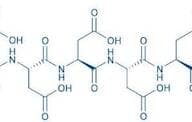
CAS:GDDDDK-βNA, specific substrate for the determination of enteropeptidase (enterokinase), also used in histochemistry.Fórmula:C34H44N8O14Pureza:98.1%Cor e Forma:WhitePeso molecular:788.77Gly-L-Asp-L-Asp-L-Asp-L-Asp-L-Lys-beta-naphthylamide
CAS:<p>Gly-L-Asp-L-Asp-L-Asp-L-Asp-L-Lys (GLAD) is a peptide that has been shown to inhibit the activity of protein kinases. GLAD binds to the ATP binding site and prevents ATP from binding to the kinase, which inhibits the phosphorylation of other proteins. GLAD may also activate certain protein kinases by binding to their ATP binding site. GLAD is a valuable research tool for studying protein interactions, as well as for identifying new receptor ligands and ion channels.</p>Fórmula:C34H44N8O14Pureza:Min. 95%Peso molecular:788.8 g/molH-Gly-Asp-Asp-Asp-Asp-Lys-bNA trifluoroacetic acid
CAS:<p>H-Gly-Asp-Asp-Asp-Asp-Lys-bNA trifluoroacetic acid is a peptide that is used as a biocatalyst in the production of microspheres. It is also known as enterokinase, and cleaves proteins at their N termini. This enzyme has been immobilized on silica gel and then applied to the production of microspheres. The half life of this enzyme is 1 hour at 37°C, but it can be increased to 8 hours by immobilizing it on silica gel using glutaraldehyde. HGAASDAAKLysBNAtrifluoroacetic acid has been shown to have a high specific activity with an efficiency of 60% and a pH range between 4 and 10. It has been shown to have high protein cleavage rates at 30°C, 37°C, and 40°C, with bovine serum albumin being the</p>Fórmula:C38H45N8O16F3Pureza:Min. 95%Peso molecular:788.76 g/mol