CAS 719-22-2
:2,6-Di-terc-butil-1,4-benzoquinona
Descrição:
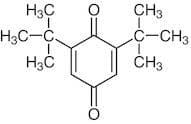
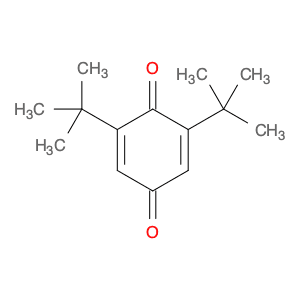
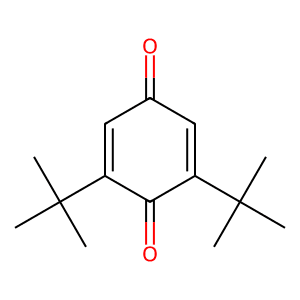
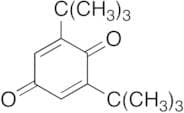
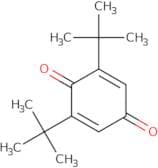
2,6-Di-terc-butil-1,4-benzoquinona é um composto orgânico caracterizado por sua estrutura de quinona, que apresenta dois grupos tert-butilo nas posições 2 e 6 do anel benzênico. Este composto é conhecido por suas fortes propriedades antioxidantes, tornando-o útil em várias aplicações, incluindo como estabilizador em polímeros e como reagente em síntese orgânica. Normalmente, é um sólido amarelo a laranja à temperatura ambiente e é solúvel em solventes orgânicos como acetona e clorofórmio, mas tem solubilidade limitada em água. A presença dos volumosos grupos tert-butilo contribui para sua hindrance estérica, influenciando sua reatividade e estabilidade. Além disso, 2,6-Di-terc-butil-1,4-benzoquinona pode sofrer reações redox, permitindo que participe de processos de transferência de elétrons. Precauções de segurança devem ser tomadas ao manusear este composto, pois pode representar riscos à saúde se inalado ou ingerido. No geral, suas características estruturais únicas e propriedades o tornam um composto valioso tanto em ambientes industriais quanto de pesquisa.
Fórmula:C14H20O2
InChI:InChI=1/C14H20O2/c1-13(2,3)10-7-9(15)8-11(12(10)16)14(4,5)6/h7-8H,1-6H3
Chave InChI:InChIKey=RDQSIADLBQFVMY-UHFFFAOYSA-N
SMILES:C(C)(C)(C)C=1C(=O)C(C(C)(C)C)=CC(=O)C1
Sinónimos:- 2,5-Cyclohexadiene-1,4-dione, 2,6-bis(1,1-dimethylethyl)-
- 2,6-Bis(1,1-dimethylethyl)-2,5-cyclohexadiene-1,4-dione
- 2,6-Bis[1,1-dimethyl ethyl]quinone
- 2,6-Di-Tert-Butyl-P-Benzoquinon
- 2,6-Di-Tert-Butylcyclohexa-2,5-Diene-1,4-Dione
- 2,6-Di-tert-butyl-1,4-benzoquinone
- 2,6-Di-tert-butyl-2,5-cyclohexadien-1,4-dione
- 2,6-Di-tert-butyl-2,5-cyclohexadiene-1,4-dione
- 2,6-Di-tert-butyl-p-quinone
- 2,6-Di-tert-butylbenzoquinone
- 2,6-Di-tert-butylquinone
- 2,6-Ditert-butylcyclohexa-2,5-diene-1,4-dione
- 3,5-Di-tert-butyl-p-benzoquinone
- 3,5-Di-tert-butylquinone
- Dibutylpbenzoquinone
- NSC 14448
- p-Benzoquinone, 2,6-di-tert-butyl-
- DBQ
- 2,5-Cyclohexadiene-1,4-dione,2,6-
- 2,6-Di-tert-butyl-p-benzoquinone, 98+%
- 2,6-DI(TERT-BUTYL)BENZO-1,4-QUINONE
- 4-dione,2,6-bis(1,1-dimethylethyl)-5-cyclohexadiene-1
- 2,6-DI-T-BUTYL-1,4-BENZOQUINONE
- 2,6-di-tert-Butyl-p-benzoquino
- p-Benzoquinone, 2,6-bis-(1,1-dimethylethyl)
- 2,6-DI-T-BUTYL-P-BENZOQUINONE
- 2,6-DI-TERT-BUTYL-P-BENZOQUINONE
- Benzoquinone, 2,6-di-(1,1-dimethylethyl)
- Ver mais sinónimos
Ordenar por
Pureza (%)
0
100
|
0
|
50
|
90
|
95
|
100
8 produtos.
2,6-Di-tert-butyl-1,4-benzoquinone
CAS:Fórmula:C14H20O2Pureza:>98.0%(GC)Cor e Forma:Light yellow to Yellow to Orange powder to crystalPeso molecular:220.312,6-Di-tert-butyl-p-benzoquinone, 98+%
CAS:2,6-Di-tert-butyl-1,4-benzoquinone was used as an antioxidant to study the elimination rate of micro pollutant from storm and waste water. It was also used as a metabolite of butylated hydroxytoluene. It is used as a treatment agent to improve germination and plant health. This Thermo Scientific CheFórmula:C14H20O2Pureza:98+%Cor e Forma:Orange, Crystals or crystalline powderPeso molecular:220.312,6-Di-tert-butylcyclohexa-2,5-diene-1,4-dione
CAS:Fórmula:C14H20O2Pureza:98%Cor e Forma:SolidPeso molecular:220.30742,6-di(tert-butyl)benzo-1,4-quinone
CAS:2,6-di(tert-butyl)benzo-1,4-quinoneFórmula:C14H20O2Pureza:98%Cor e Forma: yellow solidPeso molecular:220.31g/mol2,6-Di-tert-butyl-p-benzoquinone
CAS:Applications 2.6-Di-tert-butyl-p-benzoquinone was used as a treatment agent to improve germination, plant health and yield.
Fórmula:C14H20O2Cor e Forma:NeatPeso molecular:220.312,6-Di-tert-butylcyclohexa-2,5-diene-1,4-dione
CAS:Fórmula:C14H20O2Pureza:98%Cor e Forma:Solid, Reddish yellow to yellow red powderPeso molecular:220.3122,6-Di-tert-butylcyclohexa-2,5-diene-1,4-dione
CAS:2,6-Di-tert-butylcyclohexa-2,5-diene-1,4-dione (BHT) is a chemical compound that is used as an oxygenation catalyst and analytical method. The molecular structure of BHT contains a hydroxyl group with a redox potential of 0.3 V and a thermal expansion coefficient of 7 x 10 K. This compound has been shown to be toxic in mice, causing lung damage and oxidative DNA damage. BHT also inhibits the transcriptional regulation of genes by binding to amines in the cell membrane. It can act as an antioxidant because it binds to reactive oxygen species and prevents them from oxidizing other molecules in the cell. These properties make it useful for protecting cells from oxidative stress caused by reactive oxygen species or peroxides.Fórmula:C14H20O2Pureza:Min. 95%Peso molecular:220.31 g/mol