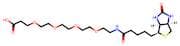
![4,7,10,13-Tetraoxa-16-azaheneicosanoicacid, 21-[(3aS,4S,6aR)-hexahydro-2-oxo-1H-thieno[3,4-d]imida…](/_next/image/?url=https%3A%2Fstatic.cymitquimica.com%2Fcas-image%2Fthumb-webp%2F307440-471013-tetraoxa-16-azaheneicosanoicacid-21-3as-4s-6ar-hexahydro-2-oxo-1h-thieno-34-d-imidazol-4-yl-17-oxo.webp&w=3840&q=75)
CAS 721431-18-1
:ácido 4,7,10,13-tetraoxa-16-azaheneicosanoico, 21-[(3aS,4S,6aR)-hexahidro-2-oxo-1H-tieno[3,4-d]imidazol-4-il]-17-oxo-
Descrição:
O ácido 4,7,10,13-tetraoxa-16-azaheneicosanoico, com o número CAS 721431-18-1, é um composto orgânico complexo caracterizado por suas características estruturais únicas, incluindo múltiplos átomos de oxigênio e nitrogênio dentro de sua estrutura molecular. Este composto contém uma longa cadeia de carbono, que contribui para suas propriedades hidrofóbicas, enquanto a presença de grupos funcionais de tetraoxa e ácido azaheneicosanoico confere hidrofobicidade e potencial reatividade. A porção de tieno[3,4-d]imidazol sugere atividade biológica, possivelmente indicando seu papel na química medicinal ou como um farmacóforo. A estereoquímica, indicada pela configuração específica do grupo hexahidro-2-oxo, pode influenciar suas interações biológicas e eficácia. No geral, a estrutura intrincada deste composto sugere aplicações potenciais no desenvolvimento de medicamentos, particularmente na orientação de vias biológicas ou funções específicas. Estudos adicionais seriam necessários para elucidar seu comportamento químico completo, estabilidade e possíveis usos terapêuticos.
Fórmula:C21H37N3O8S
Sinónimos:- 15-[D(+)-Biotinylamino]-4,7,10,13-Tetraoxapentadecanoic Acid
Ordenar por
Pureza (%)
0
100
|
0
|
50
|
90
|
95
|
100
9 produtos.
Biotin-PEG4-propionic Acid
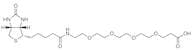
CAS:Fórmula:C21H37N3O8SPureza:>98.0%(T)Cor e Forma:White to Light yellow powder to crystalPeso molecular:491.6015-[D-(+)-Biotinylamino]-4,7,10,13-tetraoxapentadecanoic acid
CAS:Fórmula:C21H37N3O8SPureza:97%Cor e Forma:SolidPeso molecular:491.5988Ref: IN-DA005JT7
5gA consultar10gA consultar50gA consultar25mg51,00€50mg63,00€100mg75,00€250mg111,00€1g245,00€Biotin-PEG4-acid
CAS:Biotin-PEG4-acid is a PEG-based linker for PROTACs which joins two essential ligands, crucial for forming PROTAC molecules.Fórmula:C21H37N3O8SCor e Forma:SolidPeso molecular:491.6Biotin-PEG4-propionic acid
CAS:Biotin-PEG4-propionic acid is a PEG compound with two different functional groups (also known as heterobifunctional). Unlike homobifunctional PEG compounds (same functional group on both ends), this type of compounds are more versatile as have two different anchor points. Biotin-PEG4-propionic acid is used as a linker and spacer to add a PEG moiety, via pegylation (a bioconjugation technique) to proteins, peptides, oligonucleotides, small molecules and nanoparticles.Fórmula:C21H37N3O8SPureza:Min. 95%Cor e Forma:PowderPeso molecular:491.6 g/moldPEG®24-Biotin Acid
CAS:dPEG®24-Biotin Acid is a PEG compound with two different functional groups (also known as heterobifunctional). Unlike homobifunctional PEG compounds (same functional group on both ends), this type of compounds are more versatile as have two different anchor points. dPEG®24-Biotin Acid is used as a linker and spacer to add a PEG moiety, via pegylation (a bioconjugation technique) to proteins, peptides, oligonucleotides, small molecules and nanoparticles.Fórmula:C61H117N3O28SPureza:Min. 95%Peso molecular:1,325.6 g/moldPEG®4 Biotin Acid
CAS:dPEG®4 Biotin Acid is a PEG compound with two different functional groups (also known as heterobifunctional). Unlike homobifunctional PEG compounds (same functional group on both ends), this type of compounds are more versatile as have two different anchor points. dPEG®4 Biotin Acid is used as a linker and spacer to add a PEG moiety, via pegylation (a bioconjugation technique) to proteins, peptides, oligonucleotides, small molecules and nanoparticles.
Pureza:Min. 95%Peso molecular:491.6 g/moldPEG®48-Biotin Acid
CAS:dPEG®48-Biotin Acid is a PEG compound with two different functional groups (also known as heterobifunctional). Unlike homobifunctional PEG compounds (same functional group on both ends), this type of compounds are more versatile as have two different anchor points. dPEG®48-Biotin Acid is used as a linker and spacer to add a PEG moiety, via pegylation (a bioconjugation technique) to proteins, peptides, oligonucleotides, small molecules and nanoparticles.Fórmula:C112H218N4O53SPureza:Min. 95%Peso molecular:2,500.99 g/mol

![15-[D-(+)-Biotinylamino]-4,7,10,13-tetraoxapentadecanoic acid](/_next/image/?url=https%3A%2Fstatic.cymitquimica.com%2Fproducts%2FIN%2Fthumb%2FDA005JT7.jpg&w=3840&q=75)