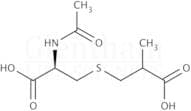
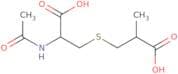
CAS 73614-35-4
:N-acetil-S-(2-carboxipropil)-L-cisteína
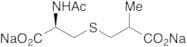
N-Acetyl-S-(2-carboxypropyl)-L-cysteine Disodium Salt(Mixture of Diastereomers)
CAS:Fórmula:C9H13NNa2O5SCor e Forma:NeatPeso molecular:293.24N-Acetyl-S-(2-carboxypropyl)-L-cysteine (Mixture of Diaster
CAS:Produto ControladoApplications A metabolite of S-(2-Carboxypropyl)glutathione.
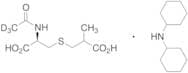
References Suzuki, T., et al.: Chem. Pharm. Bull., 10 346 (1962),Fórmula:C9H15NO5S·2(C12H23N)Cor e Forma:WhitePeso molecular:249.28 + 2(181.32)N-(Acetyl-d3)-S-(2-carboxypropyl)-L-cysteine (Mixture of Di
CAS:Produto ControladoApplications A labelled metabolite of S-(2-Carboxypropyl)glutathione.
References Suzuki, T., et al.: Chem. Pharm. Bull., 10 346 (1962),Fórmula:C9D3H12NO5S·C12H23NCor e Forma:NeatPeso molecular:433.62N-Acetyl-S-(2-carboxypropyl)-L-cysteine disodium salt
CAS:N-Acetyl-S-(2-carboxypropyl)-L-cysteine disodium salt is an analog of a human kinase inhibitor that has been shown to inhibit cyclin-dependent kinases. This compound induces apoptosis in cancer cells and has been tested in Chinese hamster ovary cells. N-Acetyl-S-(2-carboxypropyl)-L-cysteine disodium salt is a potent anticancer agent that inhibits the growth of tumor cells by blocking protein synthesis. It has been used as a research tool to study the effects of kinase inhibitors on cancer cell growth and may have potential therapeutic applications in cancer treatment. The compound has also been detected in human urine and may serve as a biomarker for the presence of certain types of cancer.
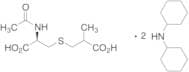
Fórmula:C9H15NO5SPureza:Min. 95%Peso molecular:249.29 g/molN-Acetyl-S-(2-carboxypropyl)-L-cysteine bis(dicyclohexylammonium) (Mixture of Diastereomers)
CAS:Please enquire for more information about N-Acetyl-S-(2-carboxypropyl)-L-cysteine bis(dicyclohexylammonium) (Mixture of Diastereomers) including the price, delivery time and more detailed product information at the technical inquiry form on this pageFórmula:C9H15NO5S•(C12H23N)2Pureza:Min. 95%Peso molecular:611.92 g/mol