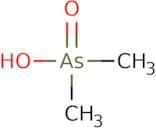
CAS 75-60-5
:Ácido dimetilarsínico
Descrição:
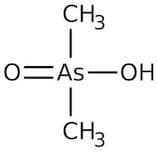
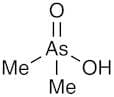
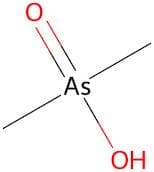
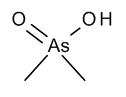
Ácido dimetilarsínico (DMAA) é um composto organoarsênico caracterizado por seus dois grupos metila ligados a um átomo de arsênio, juntamente com um grupo funcional de ácido carboxílico. É tipicamente encontrado como um líquido incolor a amarelo pálido ou sólido, dependendo de sua forma e pureza. O DMAA é solúvel em água e em solventes orgânicos polares, o que facilita seu uso em várias aplicações, incluindo como reagente em síntese orgânica e em estudos relacionados ao metabolismo do arsênio. O composto é de interesse devido à sua potencial toxicidade e impacto ambiental, uma vez que o arsênio é um carcinógeno conhecido. Em sistemas biológicos, Ácido dimetilarsínico pode passar por transformações metabólicas, levando à formação de outras espécies de arsênio. Sua presença no meio ambiente, particularmente em fontes de água contaminadas, levanta preocupações sobre a saúde humana e os efeitos ecológicos. Medidas de segurança são essenciais ao manusear DMAA, pois a exposição pode levar a efeitos adversos à saúde. No geral, Ácido dimetilarsínico serve como um composto significativo tanto na pesquisa química quanto em estudos ambientais relacionados a compostos de arsênio.
Fórmula:C2H7AsO2
InChI:InChI=1/C2H7AsO2/c1-3(2,4)5/h1-2H3,(H,4,5)
Chave InChI:InChIKey=OGGXGZAMXPVRFZ-UHFFFAOYSA-N
SMILES:[As](C)(C)(=O)O
Sinónimos:- Acide dimethylarsinique
- Acido Dimetilarsinico
- Ansar 138
- Arsan
- Arsine oxide, hydroxydimethyl-
- Arsinic Acid, Dimethyl-
- Arsinic acid, As,As-dimethyl-
- As,As-Dimethylarsinic acid
- Dimethylarsenic acid
- Dimethylarsinic acid
- Dimethylarsinsaure
- Dimethylarsonic acid
- Hydroxydimethylarsine oxide
- Kakodylsaeure
- Nsc 103115
- Nsc 71157
- Nsc 71158
- Phytar
- Silvisar 510
- Sylvicor
- Cacodylic acid
- agentblue
- Cacodylie acid
- Ansar
- DIMETHYLHYDROXYARSINE OXIDE
- Acide cacodylique
- Agent blue
- RAD-E-CATE 35(R)
- SILVISAR(R)
- alkargen
- acidecacodylique(french)
- PHYTAR(R)
- ANSAR(R)
- acidedimethylarsinique
- acidedimethylarsenique(french)
- Ver mais sinónimos
Ordenar por
Pureza (%)
0
100
|
0
|
50
|
90
|
95
|
100
6 produtos.
Cacodylic acid, 98%
CAS:A useful arsenic acid for proteomics research. It a good substitute for phosphate in applications to avoid phosphates. Cacodylic Acid is useful for some DNA applications and is also popular in microscopy. This Thermo Scientific Chemicals brand product was originally part of the Alfa Aesar productFórmula:C2H7AsO2Pureza:98%Cor e Forma:White, Crystals or powder or crystalline powderPeso molecular:138.00Dimethylarsinic acid (Cacodylic acid), 98%
CAS:Dimethylarsinic acid (Cacodylic acid), 98%
Fórmula:(CH3)2AsOOHPureza:98%Cor e Forma:white pwdr.Peso molecular:138.00Cacodylic Acid
CAS:Applications Cacodylic acid is used for dermatologic treatment in cronic eczema, anemia and as a tonic.
Not a dangerous good if item is equal to or less than 1g/ml and there is less than 100g/ml in the package
References Mandal, B., et al.: Talanta, 58, 201 (2002), Naranmandura, H., et al.: Chem. Res. Toxicol., 20, 616 (2007), Naranmandura, H., et al.: Toxicol. Appl. Pharmacol., 227, 390 (2008), Violin, J., et al.: J. Biol. Chem., 283, 2949 (2008),Fórmula:C2H7AsO2Cor e Forma:NeatPeso molecular:138.00Cacodylic acid
CAS:Cacodylic acid is a white to brown crystalline powder that is soluble in water. It has been used as an analytical reagent, polymerase chain reaction (PCR) inhibitor, and skin cancer treatment. Cacodylic acid inhibits the activity of the bacterial enzyme activities in humans and other mammals. The mechanism of action of cacodylic acid is not completely understood but it appears that it binds to inorganic iron and blocks its availability for use by bacterial enzymes such as dihydropteroate synthase, which is required for DNA synthesis. This leads to cell death. Cacodylic acid has also been shown to inhibit the growth of human HL-60 cells in vitro, suggesting that it may have carcinogenic potential.Fórmula:C2H7AsO2Pureza:Min. 95%Cor e Forma:PowderPeso molecular:138 g/mol