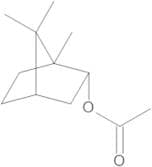
CAS 76-49-3
:(±)-Acetato de bornilo
Descrição:
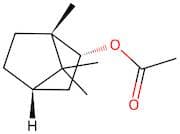
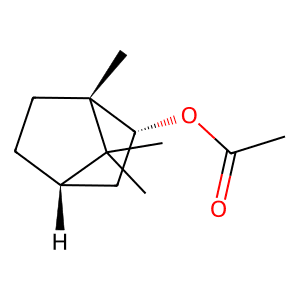
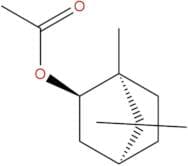
(±)-Acetato de bornilo é um composto orgânico classificado como um éster, especificamente derivado do álcool bornílico e do ácido acético. É um líquido incolor a amarelo pálido com um aroma característico agradável, semelhante ao pinho, tornando-o popular nas indústrias de fragrâncias e sabores. O composto tem um ponto de ebulição relativamente baixo e é solúvel em solventes orgânicos, mas apenas ligeiramente solúvel em água. Sua fórmula molecular é C12H20O2, e apresenta uma estrutura bicíclica típica dos terpenos, que contribui para seu aroma distinto. (±)-Acetato de bornilo é frequentemente utilizado em perfumes, cosméticos e aromatizantes alimentares devido às suas propriedades aromáticas. Além disso, exibe algumas atividades antimicrobianas e repelentes de insetos, tornando-o de interesse em várias aplicações além da fragrância. Como um composto quiral, existe em duas formas enantioméricas, mas a mistura racêmica é comumente referida como (±)-Acetato de bornilo. Os dados de segurança indicam que deve ser manuseado com cuidado, pois pode causar irritação ao contato com a pele ou os olhos.
Fórmula:C12H20O2
InChI:InChI=1/C12H20O2/c1-8(13)14-10-7-9-5-6-12(10,4)11(9,2)3/h9-10H,5-7H2,1-4H3/t9-,10+,12+/s2
Chave InChI:InChIKey=KGEKLUUHTZCSIP-QJUVKGSQNA-N
SMILES:C[C@@]12[C@H](OC(C)=O)C[C@@](C1(C)C)(CC2)[H]
Sinónimos:- 1,7,7-Trimethylbicyclo(2.2.1)heptan-2-ol acetate
- 1,7,7-Trimethylbicyclo(2.2.1)heptan-2-yl acetate, endo-
- 2-Camphanol acetate
- 2-Camphanyl acetate
- Acetate de endo-1,7,7-trimethylbicyclo[2.2.1]hept-2-yle
- Acetate, 1,7,7-Trimethyl-Bicyclo(2.2.1)Hept-2-Yl, Endo-
- Acetato De Endo-1,7,7-Trimetilbiciclo[2.2.1]Hept-2-Ilo
- Ai3-00665
- Bicyclo(2.2.1)heptan-2-ol, 1,7,7-trimethyl-, 2-acetate, (1R,2S,4R)-rel-
- Bicyclo(2.2.1)heptan-2-ol, 1,7,7-trimethyl-, acetate, (1R,2S,4R)-rel-
- Bicyclo(2.2.1)heptan-2-ol, 1,7,7-trimethyl-, acetate, endo-
- Borneol, acetate
- Borneol, acetate (8CI)
- Borneyl acetate
- Bornyl acetic ester
- Bornyl acetic ether
- Bornyl ethanoate
- Endo-1,7,7-trimethylbicyclo[2.2.1]hept-2-yl aceatate
- FEMA No. 2159
- Nsc 407158
- dl-Bornyl acetate
- endo-1,7,7-Trimethylbicyclo(2.2.1)hept-2-yl acetate
- endo-1,7,7-Trimethylbicyclo[2.2.1]hept-2-ylacetat
- endo-2-Camphanyl ethanoate
- endo-Bornyl acetate
- Ver mais sinónimos
Ordenar por
Pureza (%)
0
100
|
0
|
50
|
90
|
95
|
100
10 produtos.
Bicyclo[2.2.1]heptan-2-ol,1,7,7-trimethyl-, 2-acetate, (1R,2S,4R)-rel-
CAS:Fórmula:C12H20O2Pureza:97%Peso molecular:196.2860Bornyl acetate
CAS:Bornyl acetate (Isobornyl acetate) has an anti-inflammatory effect. It is the volatile ingredient in some Chinese traditional herbs and numerous conifer oils.Fórmula:C12H20O2Pureza:99.19%Cor e Forma:LiquidPeso molecular:196.29Bornyl acetate
CAS:Fórmula:C12H20O2Pureza:≥ 90.0%Cor e Forma:Clear, colourless to pale yellow liquidPeso molecular:196.29Bornyl Acetate (Mixture of Diastereomers)
CAS:Applications Bornyl Acetate (Mixture of Diastereomers) is a monoterpene ester, and also the main, natural constituent of valerian root oil. Bornyl acetate also has analgesic and anti-inflammatory properties.
References Buchbauer, G., et al.: Die Pharm., 47, 620 (1992); Oh, H., et al.: Appl. Micro., 15, 777 (1967); Wu, X., et al.: J. Chinese Med. Mat., 27, 438 (2004)Fórmula:C12H20O2Cor e Forma:NeatPeso molecular:196.29(+/-)-Bornyl acetate
CAS:(-)Bornyl acetate is a natural product that has been shown to have antimicrobial properties. It is extracted from plants such as the Boronia and has been shown to inhibit the growth of bacteria. (-)Bornyl acetate interacts with hydroxyl groups on proteins, inhibiting their function. This interaction leads to the production of reactive oxygen species, which causes cellular damage and death. Bornyl acetate also can interact with other sites on proteins, including the nitro group, which may lead to reduced nitric oxide production and decreased inflammatory response. The compound class of (-)bornyl acetate includes alkanoic acids and fatty acids. Molecular docking analysis has identified a number of possible binding sites for this molecule in protein structures. -Bornyl acetate is not active against viruses or fungi.br>br> Bornyl acetate has been shown to be an anti-inflammatory agent that inhibits prostaglandin synthesis and exhibits anti-infective properties.br>brFórmula:C12H20O2Pureza:Min. 95%Cor e Forma:Clear LiquidPeso molecular:196.29 g/mol
![Bicyclo[2.2.1]heptan-2-ol,1,7,7-trimethyl-, 2-acetate, (1R,2S,4R)-rel-](/_next/image/?url=https%3A%2Fstatic.cymitquimica.com%2Fproducts%2FIN%2Fthumb%2FDA0038GL.jpg&w=3840&q=75)