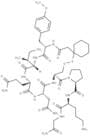
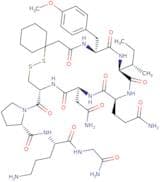
![1-{[(10S,13S,16S,22S)-13-(2-amino-2-oxoethyl)-16-(3-amino-3-oxopropyl)-19-[(2S)-butan-2-yl]-22-(4-…](/_next/image/?url=https%3A%2Fstatic.cymitquimica.com%2Fcas-image%2Fthumb-webp%2F42892-1-10s-13s-16s-22s-13-2-amino-2-oxoethyl-16-3-amino-3-oxopropyl-19-2s-butan-2-yl-22-4-methoxybenzyl-1215182124-pentaoxo-78-dithia-1114172023-pentaazaspiro-5-19-pentacos-10-yl-carbonyl-l-prolyl-l-ornithylglycinamide.webp&w=3840&q=75)
CAS 77327-45-8
:1-{[(10S,13S,16S,22S)-13-(2-amino-2-oxoetil)-16-(3-amino-3-oxopropil)-19-[(2S)-butan-2-il]-22-(4-metoxibenzil)-12,15,18,21,24-pentaoxo-7,8-ditia-11,14,17,20,23-pentaazaspiro[5.19]pentacos-10-il]carbonil}-L-prolil-L-ornitilglicinamida
Descrição:
A substância química conhecida como "1-{[(10S,13S,16S,22S)-13-(2-amino-2-oxoetil)-16-(3-amino-3-oxopropil)-19-[(2S)-butan-2-il]-22-(4-metoxibenzil)-12,15,18,21,24-pentaoxo-7,8-ditia-11,14,17,20,23-pentaazaspiro[5.19]pentacos-10-il]carbonil}-L-prolil-L-ornitilglicinamida" com número CAS 77327-45-8 é um composto orgânico complexo caracterizado por sua estrutura intrincada, que inclui múltiplos grupos funcionais e estereocentros. Este composto apresenta uma estrutura espiraloide, incorporando átomos de enxofre e nitrogênio, indicativa de sua potencial atividade biológica. A presença de resíduos de aminoácidos, como prolina e ornitina, sugere que pode interagir com sistemas biológicos, possivelmente servindo como uma molécula peptídica ou semelhante a um peptídeo. Seus múltiplos grupos carbonila e o substituinte metoxibenzila contribuem para sua reatividade química e propriedades de solubilidade. A complexidade estrutural do composto também pode implicar características conformacionais específicas que poderiam influenciar seu perfil farmacológico. No geral, esta substância é de interesse na química medicinal e bioquímica, particularmente no desenvolvimento de agentes terapêuticos.
Fórmula:C48H74N12O12S2
InChI:InChI=1/C48H74N12O12S2/c1-4-27(2)40-46(70)56-31(16-17-36(50)61)42(66)57-33(23-37(51)62)43(67)58-34(47(71)60-21-9-11-35(60)45(69)55-30(10-8-20-49)41(65)53-25-38(52)63)26-73-74-48(18-6-5-7-19-48)24-39(64)54-32(44(68)59-40)22-28-12-14-29(72-3)15-13-28/h12-15,27,30-35,40H,4-11,16-26,49H2,1-3H3,(H2,50,61)(H2,51,62)(H2,52,63)(H,53,65)(H,54,64)(H,55,69)(H,56,70)(H,57,66)(H,58,67)(H,59,68)/t27-,30-,31-,32-,33-,34+,35-,40?/m0/s1
Ordenar por
Pureza (%)
0
100
|
0
|
50
|
90
|
95
|
100
4 produtos.
(d(CH₂)₅¹,Tyr(Me)²,Orn⁸)-Oxytocin
CAS:Potent oxytocin antagonist with a pA₂ value of 7.35 ± 0.08. (d(CH₂)₅¹,Tyr(Me)²,Orn⁸)-Vasotocin has been used to support the hypothesis that pituitary secretion of oxytocin is associated with coactivation of centrally projecting brain oxytocin pathways, some of which are causally related to the induced inhibition of food intake. Furthermore, this compound competitively inhibited arginine vasotocin (AVT) contractions without affecting AVT efficacy.Fórmula:C48H74N12O12S2Pureza:99.2%Cor e Forma:White PowderPeso molecular:1075.32[β-Mercapto-β,β-cyclopentamethylenepropionyl1, O-Me-Tyr2, Orn8]-Oxytocin
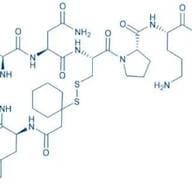
CAS:Fórmula:C48H74N12O12S2Peso molecular:1075.30(d(CH2)51,Tyr(Me)2,Orn8)-Oxytocin
CAS:(d(CH2)51,Tyr(Me)2, Orn8)-Oxytocin (OVT) is an antagonist of the oxytocin receptor that finds application in the study of neurological diseases [1].Fórmula:C48H74N12O12S2Pureza:98%Cor e Forma:SolidPeso molecular:1075.3(d(CH2)51,Tyr(Me)2, Orn 8)-Oxytocin trifluoroacetate salt
CAS:Oxytocin is a hormone that is produced in the hypothalamus and released by the posterior pituitary gland. It is used to facilitate childbirth and breastfeeding, as well as for postpartum hemorrhage. Oxytocin has been shown to have dose-dependent effects on various tissues such as the kidney, heart, uterus, and brain. Oxytocin also has an effect on cellular functions such as cell growth and proliferation. This drug has been shown to increase blood pressure in rats and may also have some effect on sexual behavior by acting on response element-binding protein in tissues of the brain.Fórmula:C48H74N12O12S2Pureza:Min. 95%Peso molecular:1,075.31 g/mol

![[β-Mercapto-β,β-cyclopentamethylenepropionyl1, O-Me-Tyr2, Orn8]-Oxytocin](/_next/image/?url=https%3A%2Fstatic.cymitquimica.com%2Fproducts%2F7W%2Fthumb%2FGL3626.jpg&w=3840&q=75)