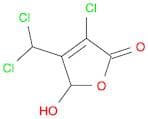
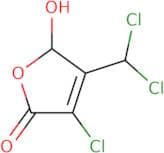
CAS 77439-76-0
:3-Cloro-4-(diclorometil)-5-hidroxi-2(5H)-furanona
Descrição:
3-Cloro-4-(diclorometil)-5-hidroxi-2(5H)-furanona, com o número CAS 77439-76-0, é um composto orgânico sintético caracterizado por sua estrutura de furanona, que inclui um anel de furanona com vários substituintes. Este composto apresenta um átomo de cloro na posição 3, um grupo diclorometilo na posição 4 e um grupo hidroxila na posição 5 do anel de furanona. A presença desses grupos funcionais contribui para sua reatividade e potenciais aplicações em vários processos químicos. É conhecido por seu papel na síntese de outras entidades químicas e pode exibir atividade biológica, tornando-o de interesse na pesquisa farmacêutica. O composto é tipicamente manuseado com cuidado devido à sua natureza halogenada, que pode conferir toxicidade e preocupações ambientais. Assim como muitos furanonas, também pode participar de reações como substituições nucleofílicas ou cicloadições, dependendo das condições de reação e da presença de outros reagentes. Medidas de segurança adequadas devem ser observadas ao trabalhar com este composto em ambientes de laboratório.
Fórmula:C5H3Cl3O3
InChI:InChI=1S/C5H3Cl3O3/c6-2-1(3(7)8)4(9)11-5(2)10/h3-4,9H
Chave InChI:InChIKey=WNTRMRXAGJOLCU-UHFFFAOYSA-N
SMILES:C(Cl)(Cl)C1=C(Cl)C(=O)OC1O
Sinónimos:- 2(5H)-Furanone, 3-chloro-4-(dichloromethyl)-5-hydroxy-
- 3-Chloro-4-(dichloromethyl)-5-hydroxy-2,5-dihydrofuran-2-one
- 3-chloro-4-(dichloromethyl)-5-hydroxy-*2(5H)-fura
- MX (bacterial mutagen)
- Mutagen X
- 3-Chloro-4-(dichloromethyl)-5-hydroxy-2(5H)-furanone
- MX
Ordenar por
Pureza (%)
0
100
|
0
|
50
|
90
|
95
|
100
3 produtos.
3-Chloro-4-(dichloromethyl)-5-hydroxyfuran-2(5H)-one
CAS:Fórmula:C5H3Cl3O3Cor e Forma:LiquidPeso molecular:217.43453-Chloro-4-(dichloromethyl)-5-hydroxy-2(5H)-furanone
CAS:Produto ControladoApplications Mutagen X (MX) is a chlorinated furanone that accounts for more of the mutagenic activity of drinking water than any other disinfection byproduct. DNA damages provoked by the six mutagens (furylframide, MX, 4-nitroquinoline N-oxide, sodium azide, 1-nitropyrene, and captan) used in the present study have been known to subject to the nucleotide excision repair system.
Not a dangerous good if item is equal to or less than 1g/ml and there is less than 100g/ml in the package
References Hakulinen, P., et al.: Toxicol. Lett., 151, 439 (2004), Richardson, S., et al.: Mutat. Res., 636, 178 (2007), Kim, J., et al.: Environ. Toxicol., 23, 319 (2008),Fórmula:C5H3Cl3O3Cor e Forma:NeatPeso molecular:217.433-Chloro-4-(dichloromethyl)-5-hydroxy-2(5H)-furanone
CAS:3-Chloro-4-(dichloromethyl)-5-hydroxy-2(5H)-furanone belongs to the class of polymerase chain inhibitors. It inhibits DNA synthesis by binding to the enzyme DNA polymerase and blocking the progression of DNA synthesis. 3-Chloro-4-(dichloromethyl)-5-hydroxy-2(5H)-furanone has significant cytotoxicity in mammalian cells and is genotoxic, which may be due to its mutagenicity. The mechanism of its mutagenicity is not known, but it has been shown that this compound reacts with effector proteins such as thiols and sulfhydryls. 3-Chloro-4-(dichloromethyl)-5-hydroxy-2(5H)-furanone can react with chlorine in water to form a chlorinated derivative that is more stable than the parent compound. This chemical stability has been usedFórmula:C5H3Cl3O3Pureza:(%) Min. 95%Cor e Forma:PowderPeso molecular:217.43 g/mol