CAS 78432-77-6
:10-Desacetiltaxol
Descrição:
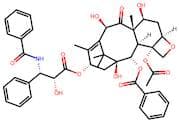
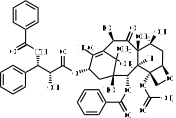
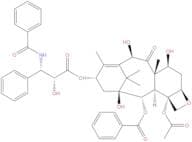
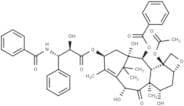
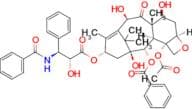
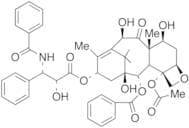
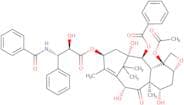
10-Desacetiltaxol, com o número CAS 78432-77-6, é um derivado do produto natural taxol, conhecido por suas propriedades anticancerígenas. Este composto é caracterizado pela ausência de um grupo acetil na posição C10, o que o distingue do taxol. Apresenta uma estrutura policíclica complexa típica dos taxanos, com um núcleo de taxano que contribui para sua atividade biológica. 10-Desacetiltaxol é reconhecido principalmente por sua capacidade de estabilizar microtúbulos, inibindo assim a divisão celular, que é um mecanismo crucial no tratamento do câncer. O composto é frequentemente estudado por suas potenciais aplicações terapêuticas e pode apresentar diferentes graus de citotoxicidade contra diferentes linhagens celulares cancerosas. Além disso, sua solubilidade e estabilidade em sistemas biológicos podem influenciar sua eficácia como agente terapêutico. No geral, 10-Desacetiltaxol representa um composto importante no campo da química medicinal, particularmente no desenvolvimento de agentes quimioterapêuticos.
Fórmula:C45H49NO13
InChI:InChI=1S/C45H49NO13/c1-24-29(57-41(54)35(50)33(26-15-9-6-10-16-26)46-39(52)27-17-11-7-12-18-27)22-45(55)38(58-40(53)28-19-13-8-14-20-28)36-43(5,37(51)34(49)32(24)42(45,3)4)30(48)21-31-44(36,23-56-31)59-25(2)47/h6-20,29-31,33-36,38,48-50,55H,21-23H2,1-5H3,(H,46,52)/t29-,30-,31+,33-,34+,35+,36-,38-,43+,44-,45+/m0/s1
Chave InChI:InChIKey=TYLVGQKNNUHXIP-MHHARFCSSA-N
SMILES:O(C(C)=O)[C@]12[C@]3([C@H](OC(=O)C4=CC=CC=C4)[C@@]5(O)C(C)(C)C([C@@H](O)C(=O)[C@]3(C)[C@@H](O)C[C@]1(OC2)[H])=C(C)[C@@H](OC([C@@H]([C@@H](NC(=O)C6=CC=CC=C6)C7=CC=CC=C7)O)=O)C5)[H]
Sinónimos:- (2alpha,5beta,7beta,10beta,13alpha)-4-(acetyloxy)-13-{[(2R,3S)-3-(benzoylamino)-2-hydroxy-3-phenylpropanoyl]oxy}-1,7,10-trihydroxy-9-oxo-5,20-epoxytax-11-en-2-yl benzoate
- 10-Deacetylpaclitaxel
- 10-Deacetyltaxol
- 10-Deacetyltaxol A
- 10-Desacetylpaclitaxel
- 10-Desacetyltaxol
- 10-O-Deacetyltaxol
- 7,11-Methano-1H-cyclodeca[3,4]benz[1,2-b]oxete, benzenepropanoic acid deriv.
- 7-Epi-10-deacetyl paclitaxel
- Benzenepropanoic acid, β-(benzoylamino)-α-hydroxy-, (2aR,4S,4aS,6R,9S,11S,12S,12aR,12bS)-12b-(acetyloxy)-12-(benzoyloxy)-2a,3,4,4a,5,6,9,10,11,12,12a,12b-dodecahydro-4,6,11-trihydroxy-4a,8,13,13-tetramethyl-5-oxo-7,11-methano-1H-cyclodeca[3,4]benz[1,2-b]oxet-9-yl ester, (αR,βS)-
- Benzenepropanoic acid, β-(benzoylamino)-α-hydroxy-, 12b-(acetyloxy)-12-(benzoyloxy)-2a,3,4,4a,5,6,9,10,11,12,12a,12b-dodecahydro-4,6,11-trihydroxy-4a,8,13,13-tetramethyl-5-oxo-7,11-methano-1H-cyclodeca[3,4]benz[1,2-b]oxet-9-yl ester, [2aR-[2aα,4β,4aβ,6β,9α(αR*,βS*),11α,12α,12aα,12bα]]-
- Ver mais sinónimos
Ordenar por
Pureza (%)
0
100
|
0
|
50
|
90
|
95
|
100
10 produtos.
10-Deacetyltaxol
CAS:Fórmula:C45H49NO13Pureza:≥ 98.0%Cor e Forma:White to off-white powderPeso molecular:811.88Paclitaxel EP Impurity G (10-Desacetyl Paclitaxel)
CAS:Fórmula:C45H49NO13Cor e Forma:Pink SolidPeso molecular:811.8810-Deacetyltaxol
CAS:10-Deacetyltaxol and cephalomannine have cytotoxicity in human glial and neuroblastoma cell-lines, the tumors of the central and peripheral nervous system are sensitive to 10-deacetyltaxol and cephalomannine and these drugs are less toxic than taxol but remain within a therapeutic range.Fórmula:C45H49NO13Pureza:95%~99%Peso molecular:811.88110-Deacetyltaxol
CAS:10-Deacetyltaxol (10-DAT) is extracted from Taxus brevifolia barks.Fórmula:C45H49NO13Pureza:94.63% - 99.93%Cor e Forma:SolidPeso molecular:811.8710-Desacetyl Paclitaxel
CAS:Impurity Paclitaxel - impurity G
Applications A semi-synthetic precursor of Paclitaxel. Paclitaxel - impurity G.Fórmula:C45H49NO13Cor e Forma:White To Off-WhitePeso molecular:811.8710-Desacetyl paclitaxel
CAS:10-Desacetyl paclitaxel is a form of paclitaxel that has been modified chemically. It is soluble in water and can be injected intravenously. 10-Desacetyl paclitaxel is used to treat inflammatory diseases, such as rheumatoid arthritis and psoriasis. This drug binds to the hydroxyl groups on the surface of the bacterial cell wall and prevents the formation of covalent linkages with polysaccharides, which leads to its increased patency in bacterial cells. 10-Desacetyl paclitaxel has also been shown to inhibit the activity of certain enzymes that are involved in synthesis of DNA, RNA, and proteins. This inhibition results in cell death by apoptosis or necrosis. The increase in viability after treatment with 10-desacetyl paclitaxel was observed for both gram-positive bacteria (e.g., Bacillus subtilis) and gram-negative bacteria (e.g., EscherFórmula:C45H49NO13Pureza:Min. 95%Cor e Forma:White PowderPeso molecular:811.87 g/mol