CAS 8049-97-6
:Melaninas
Descrição:
Melaninas são um grupo de biopolímeros complexos que são principalmente responsáveis pela pigmentação em vários organismos, incluindo os humanos. Eles são produzidos através da polimerização oxidativa de compostos fenólicos, particularmente da tirosina, e são caracterizados por sua cor marrom escura a preta. Melaninas são insolúveis em água e solventes orgânicos, o que contribui para sua estabilidade e resistência à degradação. Eles exibem um alto grau de heterogeneidade estrutural, com variações no peso molecular e na composição dependendo da fonte e das condições ambientais. Melaninas desempenham papéis cruciais em sistemas biológicos, incluindo proteção contra radiação UV, captura de radicais livres e contribuição para a coloração da pele, cabelo e olhos. Além disso, eles têm aplicações potenciais em vários campos, incluindo medicina, cosméticos e ciência dos materiais, devido às suas propriedades únicas, como biocompatibilidade e atividade antioxidante. O número CAS 8049-97-6 refere-se especificamente a um tipo de melanina, destacando sua importância tanto em contextos biológicos quanto industriais.
Fórmula:Unspecified
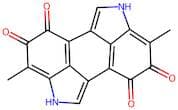
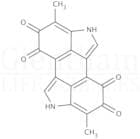
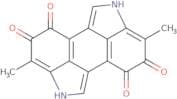
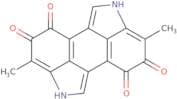
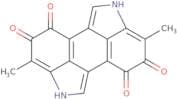
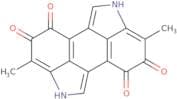
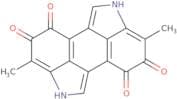
InChI:InChI=1/C18H10N2O4/c1-5-13-9-7(3-19-13)12-10-8(11(9)17(23)15(5)21)4-20-14(10)6(2)16(22)18(12)24/h3-4,19-20H,1-2H3
SMILES:Cc1c2c3c(c[nH]2)c2c4c(c[nH]c4c(C)c(=O)c2=O)c3c(=O)c1=O
Sinónimos:- 3,8-Dimethyl-2,7-Dihydrobenzo[1,2,3-Cd:4,5,6-C'D']Diindole-4,5,9,10-Tetrone
- Melanin
- Melanin From Sepia Officinalis
- Melanins
- Melanoids
- MeSH ID: D008543
- Melanines
Ordenar por
Pureza (%)
0
100
|
0
|
50
|
90
|
95
|
100
8 produtos.
Melanin
CAS:Melanin is a multifunctional biotin and a powerful cation chelator with antimicrobial, antioxidant and antiradiation activities.Fórmula:C18H10N2O4Cor e Forma:SolidPeso molecular:318.288Melanin - fungal (Ganoderma lucidum)
CAS:Melanin - fungal (Ganoderma lucidum) is a high-molecular-weight polymer, which is derived from the fruiting body and mycelium of the Ganoderma lucidum mushroom. This compound is a biopolymer formed through the oxidative polymerization of phenolic and/or indolic compounds, a process catalyzed by tyrosinase. The mode of action of this melanin involves its ability to absorb harmful ultraviolet (UV) radiation and scavenge reactive oxygen species (ROS), thereby acting as a potent antioxidant and protective agent.Fórmula:C18H10N2O4Cor e Forma:PowderPeso molecular:318.28 g/molMelanin, from Sepia officinalis
CAS:Melanin is a natural pigment, which is derived from Sepia officinalis, commonly known as the common cuttlefish. This pigment is a complex biopolymer sourced from the ink sac of the cuttlefish, a cephalopod that produces ink as a defense mechanism. The mode of action of melanin involves its unique ability to absorb a broad range of the electromagnetic spectrum, providing effective protection against ultraviolet radiation. Additionally, it exhibits remarkable antioxidant properties due to its free radical scavenging abilities.Fórmula:C18H10N2O4Peso molecular:318.28 g/molMelanin - insect (Hermetia illucens)
CAS:Melanin is a substance that plays a crucial role in the human body. It is responsible for the color of our hair, skin, and eyes. Melanin acts as a natural sunscreen, protecting our skin from harmful UV radiation. It also helps in the synthesis of vitamin D and acts as an antioxidant, protecting our cells from damage caused by free radicals. Gadolinium-based synthetic melanin has been developed to mimic the natural melanin pigment. This synthetic melanin has various applications in industries such as cosmetics, paints, and plastics. It can be used to create vibrant colors and provide UV protection in these products. Researchers have also discovered that certain natural products can enhance melanogenesis, the process of melanin production in the body. These natural pigments have shown antioxidant properties and can inhibit tyrosinase, an enzyme involved in melanin synthesis. By promoting the production of eumelanin (dark brown/black pigment) and inhibiting pheomelanin (yellow/red pigmentFórmula:C18H10N2O4Peso molecular:318.28 g/molMelanin - plant (Osmanthus fragrans)
CAS:Melanin is a substance that plays a crucial role in the human body. It is responsible for the color of our hair, skin, and eyes. Melanin acts as a natural sunscreen, protecting our skin from harmful UV radiation. It also helps in the synthesis of vitamin D and acts as an antioxidant, protecting our cells from damage caused by free radicals. Gadolinium-based synthetic melanin has been developed to mimic the natural melanin pigment. This synthetic melanin has various applications in industries such as cosmetics, paints, and plastics. It can be used to create vibrant colors and provide UV protection in these products. Researchers have also discovered that certain natural products can enhance melanogenesis, the process of melanin production in the body. These natural pigments have shown antioxidant properties and can inhibit tyrosinase, an enzyme involved in melanin synthesis. By promoting the production of eumelanin (dark brown/black pigment) and inhibiting pheomelanin (yellow/red pigmentFórmula:C18H10N2O4Peso molecular:318.28 g/molMelanin, synthetic
CAS:Melanin, synthetic, is a bioengineered pigment that mimics the natural biopolymer found in organisms. It is derived from controlled chemical synthesis or microbial processes, designed to replicate the structure and properties of naturally occurring melanin.
Fórmula:C18H10N2O4Cor e Forma:PowderPeso molecular:318.28 g/mol