CAS 83150-76-9
:Acetato de octreotida
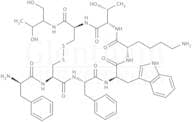
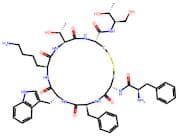
- L-cysteinamide, D-phenylalanyl-L-cysteinyl-L-phenylalanyl-D-tryptophyl-L-lysyl-L-threonyl-N-(2-hydroxy-1-(hydroxymethyl) propyl)-cyclic (2->7)-disulfide, (R-(R*,R*))
- OctreotideAcetate
- 10-(4-aminobutyl)-16-benzyl-N-[(2R,3R)-1,3-dihydroxybutan-2-yl]-7-(1-hydroxyethyl)-13-(1H-indol-3-ylmethyl)-6,9,12,15,18-pentaoxo-19-(phenylalanylamino)-1,2-dithia-5,8,11,14,17-pentaazacycloicosane-4-carboxamide acetate (1:2)
- (4R,7S,10S,13R,16S,19R)-10-(4-aminobutyl)-16-benzyl-N-[(2R,3R)-1,3-dihydroxybutan-2-yl]-7-[(1R)-1-hydroxyethyl]-13-(1H-indol-3-ylmethyl)-6,9,12,15,18-pentaoxo-19-(D-phenylalanylamino)-1,2-dithia-5,8,11,14,17-pentaazacycloicosane-4-carboxamide
- (4R,7S,10S,13R,16S,19R)-10-(4-aminobutyl)-16-benzyl-N-[(2R,3R)-1,3-dihydroxybutan-2-yl]-7-(1-hydroxyethyl)-13-(1H-indol-3-ylmethyl)-6,9,12,15,18-pentaoxo-19-(D-phenylalanylamino)-1,2-dithia-5,8,11,14,17-pentaazacycloicosane-4-carboxamide
- 1: PN: EP1118336 SEQID: 1 claimed protein
- 11: PN: US20030229017 PAGE: 13 claimed protein
- 14: PN: DE10147056 PAGE: 40 claimed protein
- 17: PN: US6268342 SEQID: 18 claimed protein
- 25: PN: WO2007081792 SEQID: 40 claimed protein
- L-Cysteinamide, D-phenylalanyl-L-cysteinyl-L-phenylalanyl-D-tryptophyl-L-lysyl-L-threonyl-N-[(1R,2R)-2-hydroxy-1-(hydroxymethyl)propyl]-, cyclic (2→7)-disulfide
- Longastatin
- Octreotide
- Ver mais sinónimos
Octreotide
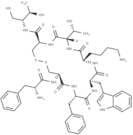
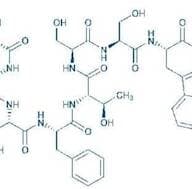
CAS:A slow-release form of octreotide. Pamoate is the bivalent anion of pamoic acid (embonic acid, 4,4·-methylene-bis-(3-hydroxy-2-naphthoic acid)). CAS-number (octreotide pamoate): 135467-16-2.Fórmula:C49H66N10O10S2Pureza:> 98%Peso molecular:1019.26[R-(R*,R*)]-D-Phenylalanyl-L-cysteinyl-L-phenylalanyl-D-tryptophyl-L-lysyl-L-threonyl-N-[2-hydroxy-1-(hydroxy-methyl)propyl]-cysteinamide cyclic(2→7)-disulfide
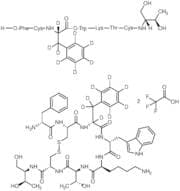
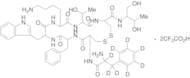
CAS:Fórmula:C49H66N10O10S2Pureza:98%Cor e Forma:SolidPeso molecular:1019.2393Octreotide-Phenylalanine-d8 Ditrifluoroacetate
CAS:Fórmula:C49H58D8N10O10S2·2C2HF3O2Peso molecular:1027.30 2*114.02Octreotide
CAS:Octreotide (SMS 201-995) is a potent inhibitor of growth hormone, glucagon, and insulin.Fórmula:C49H66N10O10S2Pureza:99.3% - 99.64%Cor e Forma:White PowderPeso molecular:1019.24Octreotide-phenylalanine-d8 di-Trifluoroacetic Acid Salt
CAS:Produto ControladoApplications Labelled octapeptide analog of Somatostatin. A gastric antisecretory agent. Used in treatment of acromegaly.
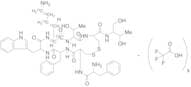
References Bauer, W., et al.: Life Sci., 31, 1133 (1982), Plewe, G., et al.: Lancet, 2, 782 (1984), Kraenzlin, M.E., et al.: Experientia, 41, 738 (1985), del Pozo, E., et al.: Acta Endocrinol., 111, 433 (1986),Fórmula:C53H60D8F6N10O14S2Cor e Forma:NeatPeso molecular:1255.3413C6-Lys Octreotide Trifluoroacetate
CAS:Produto ControladoFórmula:C4313C6H66N10O10S2•xC2HF3O2Cor e Forma:White To Off-WhitePeso molecular:1025.2011402Octreotide
CAS:Octreotide is a drug that belongs to the macrocycle class of polymers. It is used in the treatment of cancer, as well as for diseases such as diabetes mellitus and acromegaly. Octreotide has been shown to inhibit p-glycoprotein (P-gp) and other drug transporters, which leads to an increase in oral bioavailability. In addition, octreotide also inhibits cellular proliferation by interfering with intracellular signalling pathways and protein synthesis. This drug has been shown to have a wide range of biochemical properties and is being investigated as an investigational agent for the treatment of various cancers.
Fórmula:C49H66N10O10S2Pureza:Min. 95%Peso molecular:1,019.24 g/molOctreotide
CAS:Octreotide is a synthetic somatostatin analogue used for the treatment of acromegaly and neuroendocrine tumours. In clinical settings, Octreotide is used for the treatment of vasoactive intestinal peptide-secreting tumours, growth hormone producing tumours, and pituitary tumours. Octreotide also displays efficacy in the treatment of cluster headaches, acute haemorrhage from liver cirrhosis, malignant bowel obstruction, and idiopathic intracranial hypertension. Octreotide exerts its organ protective effects through several mechanisms, including its ability to decrease the levels of endotoxin and the proinflammatory cytokines TNF-alpha and IL-1β, and by inhibiting hepatocellular apoptosis. Octreotide also exerts a protective effect in hepatic ischemia-reperfusion (HIR) injury, which often occurs after complex liver surgeries such as major resection or transplantation.Peso molecular:1,018.4 g/mol

![[R-(R*,R*)]-D-Phenylalanyl-L-cysteinyl-L-phenylalanyl-D-tryptophyl-L-lysyl-L-threonyl-N-[2-hydroxy…](/_next/image/?url=https%3A%2Fstatic.cymitquimica.com%2Fproducts%2FIN%2Fthumb%2FDA003A7L.jpg&w=3840&q=75)