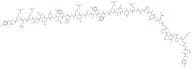
CAS 83589-17-7
:Neuropeptídeo Y (suíno)
Descrição:
Neuropeptídeo Y (suíno), com o número CAS 83589-17-7, é um peptídeo que desempenha um papel significativo em vários processos fisiológicos, particularmente no sistema nervoso central e nos tecidos periféricos. Consiste em 36 aminoácidos e é conhecido por sua participação na regulação do apetite, ansiedade, ritmos circadianos e funções cardiovasculares. O neuropeptídeo Y é produzido principalmente no cérebro e é liberado em resposta ao estresse, influenciando a ingestão de alimentos e o equilíbrio energético. Sua estrutura apresenta uma região C-terminal conservada que é crítica para a ligação ao receptor e a atividade biológica. O peptídeo interage com receptores específicos de neuropeptídeo Y, que são receptores acoplados à proteína G, mediando seus efeitos na sinalização neuronal. Em espécies suínas, este neuropeptídeo é particularmente estudado por suas implicações no crescimento, metabolismo e respostas ao estresse, tornando-se um tema de interesse tanto na pesquisa veterinária quanto biomédica. No geral, o neuropeptídeo Y é um componente vital da sinalização neuroendócrina, com papéis diversos na manutenção da homeostase e na resposta a mudanças ambientais.
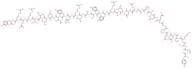
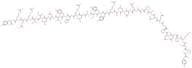
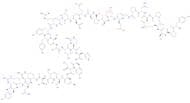
Fórmula:C10H287N55O57
InChI:InChI=1/C190H286N54O58/c1-16-94(9)149(180(296)234-129(81-140(193)253)169(285)226-124(74-93(7)8)172(288)239-150(95(10)17-2)181(297)240-151(100(15)247)182(298)221-116(32-23-67-208-190(202)203)156(272)220-119(59-62-145(260)261)161(277)218-114(30-21-65-206-188(198)199)157(273)223-121(152(195)268)76-102-39-49-108(249)50-40-102)238-173(289)127(79-105-45-55-111(252)56-46-105)229-168(284)128(80-106-86-204-90-210-106)230-159(275)115(31-22-66-207-189(200)201)219-165(281)123(73-92(5)6)224-155(271)97(12)212-174(290)134(88-245)236-167(283)126(78-104-43-53-110(251)54-44-104)228-166(282)125(77-103-41-51-109(250)52-42-103)227-158(274)113(29-20-64-205-187(196)197)216-153(269)96(11)211-163(279)122(72-91(3)4)225-170(286)131(84-147(264)265)232-162(278)118(58-61-144(258)259)217-154(270)98(13)213-177(293)137-34-25-68-241(137)183(299)99(14)214-164(280)130(83-146(262)263)231-160(276)117(57-60-143(256)257)215-142(255)87-209-176(292)136-33-24-70-243(136)186(302)133(82-141(194)254)235-171(287)132(85-148(266)267)233-178(294)139-36-27-71-244(139)185(301)120(28-18-19-63-191)222-175(291)135(89-246)237-179(295)138-35-26-69-242(138)184(300)112(192)75-101-37-47-107(248)48-38-101/h37-56,86,90-100,112-139,149-151,245-252H,16-36,57-85,87-89,191-192H2,1-15H3,(H2,193,253)(H2,194,254)(H2,195,268)(H,204,210)(H,209,292)(H,211,279)(H,212,290)(H,213,293)(H,214,280)(H,215,255)(H,216,269)(H,217,270)(H,218,277)(H,219,281)(H,220,272)(H,221,298)(H,222,291)(H,223,273)(H,224,271)(H,225,286)(H,226,285)(H,227,274)(H,228,282)(H,229,284)(H,230,275)(H,231,276)(H,232,278)(H,233,294)(H,234,296)(H,235,287)(H,236,283)(H,237,295)(H,238,289)(H,239,288)(H,240,297)(H,256,257)(H,258,259)(H,260,261)(H,262,263)(H,264,265)(H,266,267)(H4,196,197,205)(H4,198,199,206)(H4,200,201,207)(H4,202,203,208)/t94-,95-,96-,97-,98-,99-,100+,112-,113-,114-,115-,116-,117-,118-,119-,120-,121-,122-,123-,124-,125-,126-,127-,128-,129-,130-,131-,132-,133-,134-,135-,136-,137-,138-,139-,149-,150-,151-/m0/s1
Sinónimos:- H-Tyr-Pro-Ser-Lys-Pro-Asp-Asn-Pro-Gly-Glu-Asp-Ala-Pro-Ala-Glu-Asp-Leu-Ala-Arg-Tyr-Tyr-Ser-Ala-Leu-Arg-His-Tyr-Ile-Asn-Leu-Ile-Thr-Arg-Gln-Arg-Tyr-NH2
- Neuropeptide Y (13-36), Porcine Syntheti C >97%
Ordenar por
Pureza (%)
0
100
|
0
|
50
|
90
|
95
|
100
6 produtos.
Neuropeptide Y, Porcine
CAS:<p>For cellular and molecular biology applications</p>Fórmula:C190H287N55O57Peso molecular:4253.7Neuropeptide Y (porcine)
CAS:<p>Bachem ID: 4011654.</p>Fórmula:C190H287N55O57Pureza:97.3%Cor e Forma:White LyophilisatePeso molecular:4253.71NPY (Porcine, Bovine)
CAS:<p>NPY is a peptide that belongs to the family of neuropeptides. NPY regulates appetite and energy expenditure, among other physiological processes, by binding to receptors in the brain. NPY has been shown to be an inhibitor of protein interactions, activator of ligands, and a receptor for antibodies. This peptide is synthesized in the hypothalamus as well as other parts of the central nervous system. NPY is also found in blood platelets, pancreas, and intestines.</p>Fórmula:C190H287N55O57Pureza:Min. 95%Peso molecular:4,253.6 g/molNPY (Porcine, Bovine)
CAS:<p>NPY is a peptide that belongs to the family of neuropeptides. It is an endogenous regulator of appetite and energy expenditure in the central nervous system, which has been shown to act as a neurotransmitter and neuromodulator. NPY is also an activator of ion channels, such as potassium channels, sodium channels, and calcium channels. NPY has been shown to bind with high affinity to receptors in the brain, heart, lungs, kidneys, and intestines. The binding of NPY to its receptor leads to activation of protein interactions. This process can lead to changes in cell physiology or regulation of physiological functions by altering gene expression or changing the concentration of ions in the blood. NPY has also been shown as an inhibitor for many different ligands and receptors including dopamine D1 receptors and serotonin 5-HT2A/C receptors.</p>Fórmula:C190H287N55O57Pureza:Min. 95%Peso molecular:4,253.6 g/molNeuropeptide Y (porcine) trifluoroacetate salt
CAS:<p>Neuropeptide Y (porcine) trifluoroacetate salt H-Tyr-Pro-Ser-Lys-Pro-Asp-Asn-Pro-Gly-Glu-Asp-Ala-Pro-Ala-Glu-Asp-Leu -Ala -Arg Tyr Tyr Ser Ala Leu Arg His Tyr Ile Asn Leu Ile Thr Arg Gln Arg Tyr NH2 trifluoroacetate salt is a peroxidase enzyme that is biotinylated and purified from porcine sources. It has been used as an antiserum in the development of a plate sealer.</p>Fórmula:C190H287N55O57Pureza:Min. 95%Peso molecular:4,253.65 g/molRef: IN-DA01E9QM
Produto descontinuado