CAS 847818-49-9
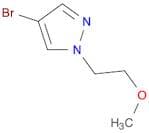
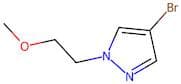
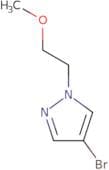
:4-Bromo-1-(2-metoxietil)-1H-pirazol
Descrição:
4-Bromo-1-(2-metoxietil)-1H-pirazol é um composto químico caracterizado por seu núcleo de pirazol, que é um anel de cinco membros contendo dois átomos de nitrogênio adjacentes. A presença de um átomo de bromo na posição 4 do anel de pirazol contribui para sua reatividade e potenciais aplicações em várias reações químicas. O substituinte na posição 1, um grupo 2-metoxietila, melhora sua solubilidade e pode influenciar sua atividade biológica. Este composto é tipicamente um líquido ou sólido incolor, a amarelo claro, dependendo de sua pureza e forma. É solúvel em solventes orgânicos, o que o torna útil em química sintética e aplicações farmacêuticas. A presença de grupos bromo e metoxi sugere potencial para interações diversas em sistemas biológicos, tornando-o de interesse em química medicinal. Dados de segurança devem ser consultados para manuseio, pois compostos halogenados podem representar riscos à saúde. No geral, 4-Bromo-1-(2-metoxietil)-1H-pirazol é um composto versátil com aplicações potenciais no desenvolvimento de medicamentos e síntese orgânica.
Fórmula:C6H9BrN2O
InChI:InChI=1S/C6H9BrN2O/c1-10-3-2-9-5-6(7)4-8-9/h4-5H,2-3H2,1H3
Chave InChI:InChIKey=SJIMZWZHTDHXRI-UHFFFAOYSA-N
SMILES:C(COC)N1C=C(Br)C=N1
Sinónimos:- 4-Bromo-1-(2-methoxyethyl)-1H-pyrazole
- 1-(2-Methoxyethyl)-4-bromo-1H-pyrazole
- 1H-Pyrazole, 4-bromo-1-(2-methoxyethyl)-
Ordenar por
Pureza (%)
0
100
|
0
|
50
|
90
|
95
|
100
6 produtos.
4-Bromo-1-(2-methoxyethyl)-1H-pyrazole
CAS:Fórmula:C6H9BrN2OPureza:98%Cor e Forma:LiquidPeso molecular:205.05254-Bromo-1-(2-methoxyethyl)-1H-pyrazole
CAS:4-Bromo-1-(2-methoxyethyl)-1H-pyrazolePureza:98%Peso molecular:205.05g/mol4-bromo-1-(2-methoxyethyl)-1H-pyrazole
CAS:Produto ControladoApplications 4-bromo-1-(2-methoxyethyl)-1H-pyrazole (cas# 847818-49-9) is a useful research chemical.
Fórmula:C6H9N2OBrCor e Forma:NeatPeso molecular:205.054-bromo-1-(2-methoxyethyl)-1H-pyrazole
CAS:4-bromo-1-(2-methoxyethyl)-1H-pyrazole is a potent and selective inhibitor of the enzyme tyrosine hydroxylase. It binds to the active site of the enzyme and inhibits its function, thereby reducing dopamine production and preventing the development of Parkinson's disease. The positioning and simulations were conducted using molecular dynamics techniques to determine the most probable binding site for this compound. The energy efficiency was calculated by comparing the free energy of activation for 4-bromo-1-(2-methoxyethyl)-1H-pyrazole with that of other inhibitors. Mathematical models have been developed to simulate how these inhibitors are able to bind to tyrosine hydroxylase in order to inhibit dopamine production. This has led to a better understanding of dyskinesia, which is a symptom of Parkinson's disease, and methods for controlling it. The profile and trajectory data were collected from an autonomous underwater vehicle (AUV)Fórmula:C6H9BrN2OPureza:Min. 95%Peso molecular:205.06 g/mol