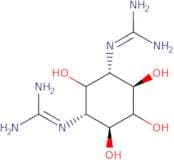
CAS 85-17-6
:Estreptidina
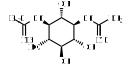
- 2,2'-(2,4,5,6-Tetrahydroxycyclohexane-1,3-Diyl)Diguanidine
- 2,2'-[(1R,3S,4R,6S)-2,4,5,6-tetrahydroxycyclohexane-1,3-diyl]diguanidine
- Guanidine, N,N′′′-(2,4,5,6-tetrahydroxy-1,3-cyclohexanediyl)bis-
- N,N′-Diamidinostreptamine
- N<sup>1</sup>,N<sup>3</sup>-Bis(aminoiminomethyl)streptamine
- Streptamine, N,N′-bis(aminoiminomethyl)-
- Streptamine, N,N′-diamidino-
- Streptamine, N<sup>1</sup>,N<sup>3</sup>-bis(aminoiminomethyl)-
- Streptidin
- Streptidine
- Streptamine, N1,N3-bis(aminoiminomethyl)-
- Ver mais sinónimos
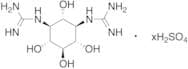
Streptidine Sulfate Salt
CAS:Produto ControladoApplications Streptidine, is a metabolite derivative of Streptomycin (S687500), an antibiotic (antimycobacterial) drug, used for patients suffering from tuberculosis or other infectious diseases.
References Granados, O., et al.: Histology and Histopathology, 20(2), 357 (2005);Fórmula:C8H18N6O4xH2SO4Cor e Forma:White To Off-WhitePeso molecular:262.27Streptidine Dihydrochloride
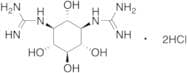
CAS:Produto ControladoStability Hygroscopic
Applications Streptidine is a metabolite derivative of Streptomycin (S687500), an antibiotic (antimycobacterial) drug, used for patients suffering from tuberculosis or other infectious diseases.
References Granados, O., et al.: Histology and Histopathology, 20, 357 (2005)Fórmula:C8H20Cl2N6O4Cor e Forma:NeatPeso molecular:335.19Streptidine
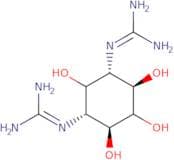
CAS:Streptidine is an amino cyclitol, which is a component of certain aminoglycoside antibiotics. This compound originates from the actinomycete *Streptomyces griseus*, a soil bacterium known for its ability to produce a variety of antibiotics. Streptidine plays a crucial role in the mechanism of aminoglycosides by contributing to the binding affinity of these antibiotics to the bacterial ribosome.Fórmula:C8H18N6O4Pureza:Min. 95%Peso molecular:262.13895Streptidine dihydrochloride
CAS:Streptidine dihydrochloride is a biochemical compound, specifically a derivative of streptomycin, which is obtained through chemical modification of the aminoglycoside antibiotic streptomycin. It is composed of streptidine, a constituent sugar derivative, that is integral to the structure of streptomycin, rendered as a hydrochloride salt to enhance solubility and stability.
Fórmula:C8H18N6O4·2HClPureza:Min. 95%