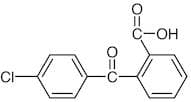
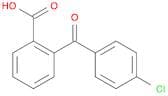
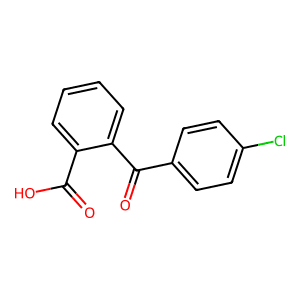
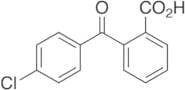
CAS 85-56-3
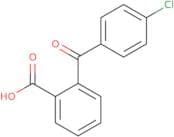
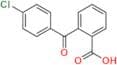
:Ácido 2-(4-clorobenzoil)benzoico
- 2-(p-Chlorobenzoyl)benzoic acid
- 2-Carboxy-4-chlorobenzophenone
- 4'-Chlorobenzophenone-2-carboxylic acid
- Benzoic acid, 2-(4-chlorobenzoyl)-
- Benzoic acid, o-(p-chlorobenzoyl)-
- CBB
- NSC 7825
- o-(4-Chlorobenzoyl)benzoic acid
- o-(p-Chlorobenzoyl)benzoic acid
- 2-(4-chlorobenzoyl)-benzoic acid
- 2-(4-Chlorobenzoyl)benzoic acid
- Ver mais sinónimos
4'-Chlorobenzophenone-2-carboxylic Acid
CAS:Fórmula:C14H9ClO3Pureza:>98.0%(GC)(T)Cor e Forma:White to Almost white powder to crystalPeso molecular:260.672-(4-Chlorobenzoyl)benzoic acid
CAS:Fórmula:C14H9ClO3Pureza:98%Cor e Forma:SolidPeso molecular:260.67252-(4-Chlorobenzoyl)benzoic acid
CAS:2-(4-Chlorobenzoyl)benzoic acidPureza:98%Peso molecular:260.67g/mol2-(4’-Chlorobenzoyl)benzoic Acid
CAS:Produto ControladoApplications 2-(4’-Chlorobenzoyl)benzoic Acid (cas# 85-56-3) is a compound useful in organic synthesis.
Fórmula:C14H9ClO3Cor e Forma:NeatPeso molecular:260.6722-(4'-Chlorobenzoyl)benzoic acid
CAS:2-(4'-Chlorobenzoyl)benzoic acid (2-CBA) is a sulfa drug that inhibits bacterial growth by blocking the synthesis of folic acid. It is also known to be luminescent and can be used in techniques such as luminescent probes. 2-CBA has antibacterial activity and can inhibit bacterial growth in a chromatographic method. 2-CBA is chemically stable and has been shown to have antibacterial properties against gram-positive bacteria, including Bacillus subtilis and Staphylococcus aureus. 2-CBA also has the ability to react with phthalazinone, an inhibitor of glutamine synthetase, which is involved in the production of ATP from ADP. This reaction results in the formation of an unstable intermediate which decomposes into CO2 and benzoic acid.
Fórmula:C14H9ClO3Pureza:Min. 95%Cor e Forma:White PowderPeso molecular:260.67 g/mol2-(4-Chlorobenzoyl)benzoic acid
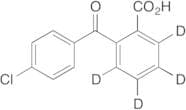
CAS:Fórmula:C14H9ClO3Pureza:98%Cor e Forma:SolidPeso molecular:260.672-(4’-Chlorobenzoyl)benzoic Acid-d4
CAS:Produto ControladoApplications 2-(4’-Chlorobenzoyl)benzoic Acid-d4 is an intermediate in the synthesis of labelled Chlorthalidone. Chlorthalidone is used as a diuretic; antihypertensive.
References Beisenherz, et al.: Arch. Int. Pharmacodyn. Ther., 161, 76 (1966); Zsoter, et al.: J. Pharmacol. Exp. Ther., 180, 723 (1972); Singer, J.M., et al.: Anal. Profiles Drug Subs., 14, 1 (1985);Fórmula:C14D4H5ClO3Cor e Forma:NeatPeso molecular:264.697