CAS 855-38-9
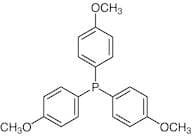
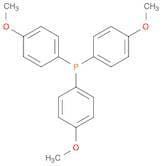
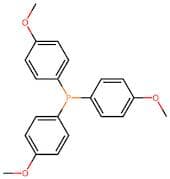
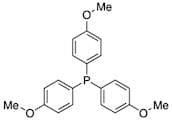
:Tris(4-metoxifenil)fosfina
Descrição:
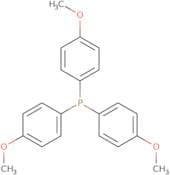
Tris(4-metoxifenil)fosfina, com o número CAS 855-38-9, é um composto organofosforado caracterizado pela presença de um átomo de fósforo ligado a três grupos 4-metoxifenila. Este composto geralmente aparece como um sólido branco a amarelo claro e é solúvel em solventes orgânicos como diclorometano e clorofórmio. Apresenta uma estabilidade térmica relativamente alta, tornando-o adequado para várias aplicações químicas. Os grupos metóxi aumentam sua solubilidade e reatividade, permitindo que participe de várias reações orgânicas, incluindo aquelas que envolvem substituição nucleofílica e química de coordenação. Tris(4-metoxifenil)fosfina é frequentemente utilizado como um ligante em complexos de metais de transição, contribuindo para a catálise e a ciência dos materiais. Além disso, pode exibir propriedades eletrônicas interessantes devido à presença dos substituintes metóxi, que podem influenciar a distribuição eletrônica dentro da molécula. Devem ser observadas precauções de segurança ao manusear este composto, assim como com muitos compostos organofosforados, devido à potencial toxicidade e preocupações ambientais.
Fórmula:C21H21O3P
InChI:InChI=1S/C21H21O3P/c1-22-16-4-10-19(11-5-16)25(20-12-6-17(23-2)7-13-20)21-14-8-18(24-3)9-15-21/h4-15H,1-3H3
Chave InChI:InChIKey=UYUUAUOYLFIRJG-UHFFFAOYSA-N
SMILES:P(C1=CC=C(OC)C=C1)(C2=CC=C(OC)C=C2)C3=CC=C(OC)C=C3
Sinónimos:- Ai3-62578
- Nsc 136458
- Phosphine, tris(4-methoxyphenyl)-
- Phosphine, tris(p-methoxyphenyl)-
- Tri(4-methoxyphenyl)phosphine
- Tri(p-methoxyphenyl)phosphine
- Tri-p-anisylphosphine
- Trianisylphosphine
- Tris(4-Methoxyphenyl)Phosphane
- Tris(4-anisyl)phosphine
- Tris(4-methoxylphenyl)phosphine
- Tris(p-anisyl)phosphine
- tris(p-Methoxyphenyl)phosphine
- Ver mais sinónimos
Ordenar por
Pureza (%)
0
100
|
0
|
50
|
90
|
95
|
100
7 produtos.
Tris(4-methoxyphenyl)phosphine
CAS:Fórmula:C21H21O3PPureza:>97.0%(T)Cor e Forma:White to Yellow to Orange powder to crystalPeso molecular:352.37Tris(4-Methoxyphenyl)Phosphine
CAS:Fórmula:C21H21O3PPureza:95%Cor e Forma:SolidPeso molecular:352.3634Ref: IN-DA0035S1
1kgA consultar5kgA consultar50gA consultar1g24,00€5g27,00€10g36,00€25g58,00€100g141,00€250g280,00€500g672,00€Tris(p-methoxyphenyl)phosphine
CAS:Tris(p-methoxyphenyl)phosphineFórmula:C21H21O3PPureza:97%Cor e Forma: white crystalline solidPeso molecular:352.36g/molTris(4-methoxyphenyl)phosphine
CAS:Fórmula:C21H21O3PPureza:95%Cor e Forma:Solid, White to yellow crystal powderPeso molecular:352.37Tris(4-methoxyphenyl)phosphine
CAS:Produto ControladoFórmula:C21H21O3PCor e Forma:NeatPeso molecular:352.36Tris(p-methoxyphenyl)phosphine, 98%
CAS:Tris(p-methoxyphenyl)phosphine, 98%
Fórmula:(pCH3OC6H4)3PPureza:98%Cor e Forma:white to pale yellow xtl.Peso molecular:352.37Tris(4-methoxyphenyl)phosphine
CAS:Tris(4-methoxyphenyl)phosphine (TMPP) is a molecule that exhibits a variety of biological properties. TMPP has been shown to inhibit transcription and DNA replication in prostate cancer cells. It also has the ability to form palladium complexes, which are used in analytical methods for the determination of metal ions. The binding constants of TMPP have been determined by x-ray crystal structures and molecular modeling techniques. TMPP is water soluble and is able to bind metal ions such as zinc or mercury, which may be due to its zwitterion structure. TMPP has been used as a chemiluminescence agent in titration calorimetry experiments, where it reacts with oxygen to produce light at a wavelength of 560 nm. This reaction is exothermic and can be used to measure energy changes in chemical reactions without the need for expensive equipment.Fórmula:C21H21O3PPureza:Min. 95%Cor e Forma:Yellow PowderPeso molecular:352.36 g/mol