CAS 85901-57-1
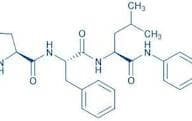
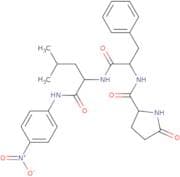
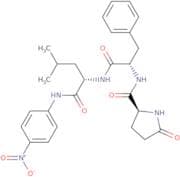
:Pyr-Phe-Leu-pNA
Descrição:
Pyr-Phe-Leu-pNA, também conhecido como Leucina p-Nitroanilida Fenil Piridila, é um substrato peptídico sintético comumente utilizado em ensaios bioquímicos, particularmente no estudo de enzimas proteolíticas. Este composto apresenta um grupo piridina, um resíduo de fenilalanina, um resíduo de leucina e um grupo de p-nitroanilida, que em conjunto contribuem para suas propriedades como substrato para várias proteases. A presença do grupo p-nitroanilida permite a detecção colorimétrica após a clivagem por enzimas, tornando-o útil em ensaios de atividade enzimática. Pyr-Phe-Leu-pNA é tipicamente solúvel em solventes orgânicos e exibe estabilidade sob condições laboratoriais padrão. Sua estrutura molecular permite interações específicas com enzimas-alvo, facilitando o estudo da cinética e mecanismos enzimáticos. Além disso, devido à sua natureza sintética, pode ser modificado para aumentar a especificidade ou sensibilidade para aplicações particulares em pesquisa e diagnóstico. Assim como com todas as substâncias químicas, devem ser observadas as precauções adequadas de manuseio e segurança ao trabalhar com Pyr-Phe-Leu-pNA em ambientes laboratoriais.
Fórmula:C26H31N5O6
InChI:InChI=1/C26H31N5O6/c1-16(2)14-21(25(34)27-18-8-10-19(11-9-18)31(36)37)29-26(35)22(15-17-6-4-3-5-7-17)30-24(33)20-12-13-23(32)28-20/h3-11,16,20-22H,12-15H2,1-2H3,(H,27,34)(H,28,32)(H,29,35)(H,30,33)/t20-,21-,22-/m0/s1
SMILES:CC(C)C[C@@H](C(=O)Nc1ccc(cc1)N(=O)=O)N=C([C@H](Cc1ccccc1)N=C([C@@H]1CCC(=N1)O)O)O
Sinónimos:- Pyroglutamyl-phenylalanyl-leucine-4-nitroanilide
- Pglu-phe-leu-pna
- L-Leucinamide, 5-oxo-L-prolyl-L-phenylalanyl-N-(4-nitrophenyl)-
- 5-oxo-L-prolyl-L-phenylalanyl-N-(4-nitrophenyl)-L-leucinamide
- pglu-phe-leu P-nitroanilide
- PYR-FL-PNA
- PYR-PHE-LEU-PNA
- PYR-PHE-GLY-PNA
- Pyr-FG-pNA
- L-PYROGLUTAMYL-L-PHENYLALANYL-L-LEUCINE P-NITROANILIDE
Ordenar por
Pureza (%)
0
100
|
0
|
50
|
90
|
95
|
100
3 produtos.
Pyr-Phe-Leu-pNA
CAS:Chromogenic substrate for thiol proteinases from plants (caricain, papain, ficin, and bromelain) and from mammalian brain (cathepsin B). pEFL-pNA is also cleaved by a serine carboxypeptidase (HlSCP1) identified in the midgut of the hard tick Haemaphysalis longicornis, which was shown to process hemoglobin.Fórmula:C26H31N5O6Pureza:99.4%Cor e Forma:Light YellowPeso molecular:509.56Pyr-Phe-Leu-pNA
CAS:Pyr-Phe-Leu-pNA is a proteolytic enzyme that can be used as a pharmaceutical drug. It has been shown to have insecticidal activity against the Anopheles mosquito and other insects, as well as antimicrobial activity against bacteria and fungi. Pyr-Phe-Leu-pNA is activated by tryptophan fluorescence, which is why it is suitable for use in peptide mapping. This enzyme also has an important physiological function in the zymogen activation pathway, which enables it to act as an enzyme substrate. Pyr-Phe-Leu-pNA will also degrade proteins that contain sequences of leishmania protease activity or signal peptide.Fórmula:C26H31N5O6Pureza:Min. 95%Peso molecular:509.55 g/molPyr-Phe-Leu-pNA
CAS:Pyr-Phe-Leu-pNA is a proteolytic enzyme that is used in the production of monoclonal antibodies. The enzyme was originally isolated from human pancreas, but has also been found in other sources including eggs, bovine pancreas, and various bacteria. Pyr-Phe-Leu-pNA hydrolyzes peptide bonds with a preference for serine and threonine residues. This enzyme has been shown to be effective at cleaving influenza virus protein hemagglutinin, which may be useful in the development of new vaccines. Pyr-Phe-Leu-pNA has also been shown to have high salt tolerance, making it a good candidate for use in food processing applications.
Fórmula:C26H31N5O6Pureza:Min. 95%Peso molecular:509.55 g/mol