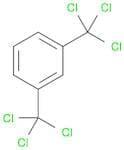
CAS 881-99-2
:1,3-Bis(triclorometil)benzeno
Descrição:
1,3-Bis(triclorometil)benzeno, também conhecido como benzeno, 1,3-bis(triclorometil)-, é um composto aromático caracterizado pela presença de dois grupos triclorometil (-CCl3) ligados ao anel de benzeno nas posições 1 e 3. Este composto é tipicamente um sólido incolor a amarelo pálido à temperatura ambiente e possui um odor forte e distinto. É conhecido por sua alta densidade e baixa solubilidade em água, mas é solúvel em solventes orgânicos. A presença de múltiplos átomos de cloro contribui para sua estabilidade química e reatividade, tornando-o um assunto de interesse em várias sínteses químicas e aplicações. No entanto, devido à toxicidade associada a compostos clorados, apresenta riscos ambientais e à saúde, exigindo manuseio e descarte cuidadosos. Além disso, pode passar por reações típicas de compostos aromáticos, como substituição eletrofílica, e pode estar envolvido na formação de estruturas químicas mais complexas na química orgânica sintética.
Fórmula:C8H4Cl6
InChI:InChI=1S/C8H4Cl6/c9-7(10,11)5-2-1-3-6(4-5)8(12,13)14/h1-4H
Chave InChI:InChIKey=GGZIUXGYCNYNNV-UHFFFAOYSA-N
SMILES:C(Cl)(Cl)(Cl)C1=CC(C(Cl)(Cl)Cl)=CC=C1
Sinónimos:- 1,3-Di(trichloromethyl)benzene
- 3-(Trichloromethyl)benzotrichloride
- Alpha,Alpha,Alpha,Alpha',Alpha',Alpha'-Hexachloro-M-Xylene
- Benzene, 1,3-bis(trichloromethyl)-
- Hexachloro-m-Xylene
- NSC 41882
- m-Bis(trichloromethyl)benzene
- m-Xylene, α,α,α,α′,α′,α′-hexachloro-
- α,α,α,α′,α′,α′-Hexachloro-m-xylene
- 1,3-Bis(trichloromethyl)benzene
- m-bis(trichlormethyl)benzene
- alpha,alpha,alpha,alpha’,alpha’,alpha’-hexachloro-m-xylen
- 1,3-bis(trichloromethyl)benzoyl
- M-XYLENE HEXACHLORIDE
- alpha,alpha’-hexachloro-m-xylene
- hexachlorometaxylol
- 1,3-bis(trichloromethyl)-benzen
- alpha,alpha,alpha,alpha’,alpha’,alpha’-hexachloroxylene
- Ver mais sinónimos
Ordenar por
Pureza (%)
0
100
|
0
|
50
|
90
|
95
|
100
2 produtos.
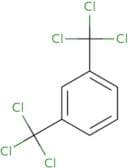
1,3-Bis(trichloromethyl)benzene
CAS:1,3-Bis(trichloromethyl)benzene is a chlorinated hydrocarbon that is used as an intermediate in the industrial production of pharmaceuticals. It is produced by heating chlorine with benzene in the presence of a catalyst, such as cocl2. The reaction produces hydrogen chloride and 1,3-bis(trichloromethyl)benzene. The synthesis process may be carried out in either an organic or aqueous solvent. Hydrogen chloride gas is generated during the process and can be released into the environment during production or processing. Irradiation may also be used to produce 1,3-bis(trichloromethyl)benzene. 1,3-Bis(trichloromethyl)benzene is not toxic to humans because it does not react with human tissues and cells. However, it has been shown to cause liver cancer in rats when they were exposed to high doses overFórmula:C8H4Cl6Pureza:Min. 95%Peso molecular:312.84 g/mol