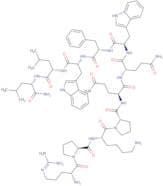
CAS 91224-37-2
:(D-arg1,D-trp7,9,leu11)-substância P*acetato
- (D-Arg1,D-Trp79,Leu11)-Substance P
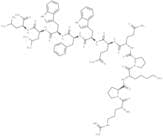
- H-D-Arg-Pro-Lys-Pro-Gln-Gln-D-Trp-Phe-D-Trp-Leu-Leu-NH2
- D-Arg-Pro-Lys-Pro-Gln-Gln-D-Trp-Phe-D-Trp-Leu-Leu-Nh2 Hydrochloride
(D-Arg¹,D-Trp⁷·⁹,Leu¹¹)-Substance P
CAS:Spantide I, a high potency substance P antagonist with a weak spasmogenic and a poor histamine releasing effect.Fórmula:C75H108N20O13Pureza:95.2%Cor e Forma:Beige PowderPeso molecular:1497.81Spantide I
CAS:Spantide antagonizes both bombesin & substance P. It is also tachykinin receptor antagonist.Fórmula:C75H108N20O13Pureza:98%Cor e Forma:SolidPeso molecular:1497.79[D-Arg1,D-Trp7,9,Leu11]-Substance P
CAS:This product is a Substance P antagonist in the Hydrochloride salt from and as a 0.5mg vial. Substance P is a neuropeptide that acts as a neurotransmitter and neuromodulator. It is best known for its role in nociception or pain perception. Substance P is also involved in other biological processes such as the regulation of gastrointestinal motility and the inflammatory response. As a tachykinin neuropeptide, substance P acts through binding to its specific neurokinin 1 receptor (NK-1R). NK-1R is present in neurons and on glial cell types. Substance P is also involved in: increased inflammation in the lungs, gastrointestinal tract and the skin and neuroinflammation. Interestingly the levels of Substance P are raised in inflammatory bowel diseases and through its involvement in cytokine release, it contributes to asthma pathology. These diverse selection of functions makes substance P a target for therapeutic research.
Fórmula:C75H108N20O13Pureza:Min. 95%Peso molecular:1,497.8 g/mol(D-Arg1,D-Trp7·9,Leu11)-Substance P
CAS:Substance P is a neuropeptide that is involved in the transmission of pain signals from the nerves to the brain. It also has been implicated in inflammatory and autoimmune diseases. Substance P is a potent agonist of the neurokinin-1 receptor, which causes an increase in intracellular calcium ion levels, leading to neuronal excitation. The release of substance P from nerve fibers can be blocked by administration of an analog (e.g., N-acetyl-D-Arg1,D-Trp7·9,Leu11)-substance P H-D-Arg-Pro-Lys-Pro-Gln-Gln-D-Trp-Phe-D-Trp-Leu -Leu -NH2). This compound blocks the activation of substance P receptors with high affinity and specificity.Fórmula:C75H108N20O13Pureza:Min. 95%Peso molecular:1,497.79 g/mol


![[D-Arg1, D-Trp7,9, Leu11]-Substance P](/_next/image/?url=https%3A%2Fstatic.cymitquimica.com%2Fproducts%2F7W%2Fthumb%2FGL0691.jpg&w=3840&q=75)


![[D-Arg1,D-Trp7,9,Leu11]-Substance P](/_next/image/?url=https%3A%2Fstatic.cymitquimica.com%2Fproducts%2F3D%2Fthumb%2FPSP-4173-V.jpg&w=3840&q=75)