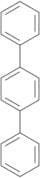
CAS 92-94-4
:p-Terfenilo
Descrição:
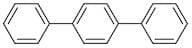
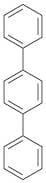
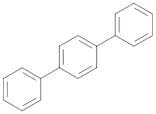
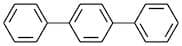
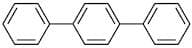
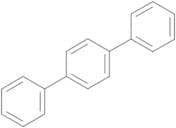
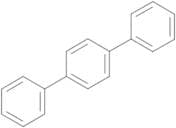
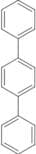
p-Terfenilo, com o número CAS 92-94-4, é um composto orgânico caracterizado por sua estrutura, que consiste em três anéis de fenilo conectados (C6H5) dispostos de forma linear. Este hidrocarboneto aromático é um sólido cristalino incolor a temperatura ambiente e é conhecido por seu alto ponto de fusão e estabilidade sob várias condições. p-Terfenilo é insolúvel em água, mas solúvel em solventes orgânicos como benzeno e tolueno. Apresenta notável estabilidade térmica e é frequentemente utilizado como meio de transferência de calor em aplicações de alta temperatura. Além disso, p-Terfenilo tem aplicações no campo da eletrônica orgânica, particularmente no desenvolvimento de materiais fosforescentes e como componente em detectores de cintilação devido à sua capacidade de emitir luz quando excitado. Suas propriedades químicas incluem a capacidade de sofrer reações de substituição eletrofílica típicas de compostos aromáticos, tornando-o um composto versátil na química orgânica sintética. No geral, p-Terfenilo é significativo tanto em aplicações industriais quanto em ambientes de pesquisa.
Fórmula:C18H14
InChI:InChI=1/C18H14/c1-3-7-15(8-4-1)17-11-13-18(14-12-17)16-9-5-2-6-10-16/h1-14H
Chave InChI:InChIKey=XJKSTNDFUHDPQJ-UHFFFAOYSA-N
SMILES:C1(=CC=C(C=C1)C2=CC=CC=C2)C3=CC=CC=C3
Sinónimos:- 1,1'-Biphenyl, 4-phenyl-
- 1,1′:4′,1′′-Terphenyl
- 1,4-Diphenylbenzene
- 1,4-Diphenylbenzol
- 4-Phenyl-1,1'-biphenyl
- 4-Phenylbiphenyl
- Nsc 6810
- P-Terfenilo
- P-Terphenyl
- PT
- PTP
- Santowax P
- T 3203
- TP
- TP (scintillator)
- p-Diphenylbenzene
- p-Phenylene trimer
- p-Terphenyle
- p-Triphenyl
- 1,1':4',1''-Terphenyl
- [1,1'
- biphenyl,4-phenyl
- diphenyl-1,4benzene
- 4-phenyl-1’-biphenyl
- Biphenyl, 4-phenyl-
- benzene,1,4-diphenyl-
- 4',1'']-Terphenyl
- para-terphenyl
- TERPHENYL, P-
- 4-Phenyldiphenyl
- 4-phenyl-bipheny
- Ver mais sinónimos
Ordenar por
Pureza (%)
0
100
|
0
|
50
|
90
|
95
|
100
12 produtos.
p-Terphenyl
CAS:Fórmula:C18H14Pureza:>99.0%(GC)Cor e Forma:White to Almost white powder to crystalPeso molecular:230.31p-Terphenyl, 99+%
CAS:p-Terphenyl is a specialty material, and may be used in ionized radiation detectors, nonpolar laser dye, and single molecule optical probe of scanning near-field microscopy. This Thermo Scientific Chemicals brand product was originally part of the Alfa Aesar product portfolio. Some documentation anFórmula:C18H14Pureza:99+%Cor e Forma:White, Crystals or powder or crystalline powderPeso molecular:230.31p-Terphenyl
CAS:p-Terphenyl is a triphenyl derivative used in industry as a heat transfer medium and dye carrier, and can be used for related research in the life sciences.Fórmula:C18H14Cor e Forma:SolidPeso molecular:230.3p-Terphenyl
CAS:Fórmula:C18H14Pureza:≥ 98.5%Cor e Forma:White to off-white crystalline powderPeso molecular:230.31Ref: 54-OR46216
5g37,00€25g37,00€100g53,00€500g156,00€2.5kg615,00€10kg2.194,00€25kg5.027,00€50kg9.356,00€100kg17.322,00€950kg139.836,00€p-Terphenyl (purified by sublimation)
CAS:Fórmula:C18H14Pureza:>99.5%(GC)Cor e Forma:White powder to crystalPeso molecular:230.31p-Terphenyl
CAS:Produto ControladoApplications p-Terphenyl is used in analytical studies, it can be used as a neutron detector.
Not a dangerous good if item is equal to or less than 1g/ml and there is less than 100g/ml in the package
References Matei, C. et al.: Nucl. Instrum. Meth. A., 676, 135 (2012);Fórmula:C18H14Cor e Forma:WhitePeso molecular:230.31,4-Diphenylbenzene
CAS:1,4-Diphenylbenzene is an aromatic hydrocarbon that has a phenyl group and four benzene rings. It has been shown to have x-ray crystal structures with hydroxyl groups that can be deprotonated to form anion radicals. 1,4-Diphenylbenzene has also been shown to have antioxidant properties in prostate cancer cells by scavenging anion radicals and preventing the oxidation of DNA bases. It also inhibits the growth of rat liver microsomes due to its chemical stability and ability to form conjugates with benzalkonium chloride. The synthesis methods for 1,4-diphenylbenzene include the acetate extract method, which uses acetone as a solvent and sodium or potassium acetate as a catalyst. Another method includes the etoac extract method, which uses ethanol as a solvent and sodium or potassium acetate as a catalyst.Fórmula:C18H14Pureza:Min. 95%Cor e Forma:White Off-White PowderPeso molecular:230.3 g/mol