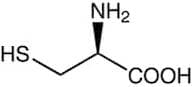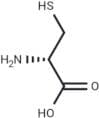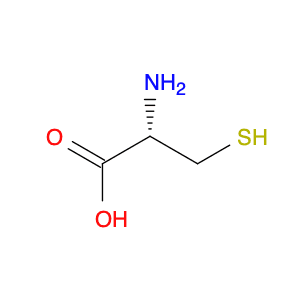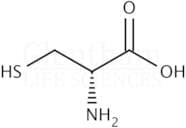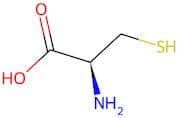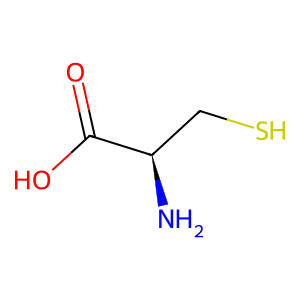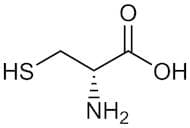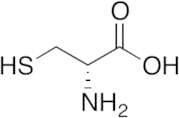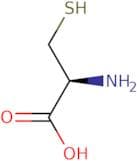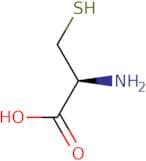
CAS 921-01-7
:D-Cisteína
- (2S)-2-Amino-3-sulfanylpropanoic acid
- (R)-2-Amino-3-mercaptopropanoic acid
- (R)-Cysteine
- (S)-2-Amino-3-mercaptopropanoic acid
- (S)-Cysteine
- <span class="text-smallcaps">D</span>-Cysteine
- Cysteine, <span class="text-smallcaps">D</span>-
- D-cycsteine
- D-cysteine free base crystalline
- Propanoic acid, 2-amino-3-mercapto-,(R)-
- D-Cysteine
- Cysteine, D-
- Ver mais sinónimos
D-Cysteine, 98%
CAS:D-Cysteine is an important source of sulfide in human metabolism. It is the precursor for glutathione. It plays important role in protein structure and in metal binding. This Thermo Scientific Chemicals brand product was originally part of the Alfa Aesar product portfolio. Some documentation and lab
Fórmula:C3H7NO2SPureza:98%Cor e Forma:Crystalline powder, White to off-whitePeso molecular:121.15D-Cysteine
CAS:D-Cysteine, a D-isomer, suppresses E. coli growth, forms H2S via D-amino acid oxidase, and protects against cerebellar ataxia.Fórmula:C3H7NO2SPureza:98.65% - 99.89%Cor e Forma:SolidPeso molecular:121.16(2S)-2-amino-3-sulfanylpropanoic acid
CAS:Fórmula:C3H7NO2SPureza:95%Cor e Forma:SolidPeso molecular:121.1582D-Cysteine
CAS:Fórmula:C3H7NO2SPureza:≥ 98.0%Cor e Forma:White or almost white crystalline powderPeso molecular:121.16D-Cysteine
CAS:Fórmula:C3H7NO2SPureza:>95.0%(T)Cor e Forma:White to Light yellow powder to crystalPeso molecular:121.15D-Cysteine
CAS:Produto ControladoApplications D-Cysteine is a strong inhibitor of Escherichia coli growth and also functions to provide inorganic sulfates for the sulfation of xenobiotics. D-Cysteine is a non-physiological isomer of L-Cysteine (C995000), and is not involved in protein or glutathione synthesis.
References Glazenburg, E., et al.: Biochem. Pharm., 33, 625 (1984); Klassen, C. & Boles, J.: FASEB J., 11, 404 (1997); Soutourina, J., et al.: J. Biol. Chem., 276, 40864 (2001);Fórmula:C3H7NO2SCor e Forma:NeatPeso molecular:121.16D-Cysteine
CAS:D-Cysteine is a versatile building block for the synthesis of complex compounds and peptides.Fórmula:C3H7NO2SPeso molecular:121.16 g/molRef: 3D-C-9600
1gA consultar5gA consultar10gA consultar25gA consultar2500mgA consultar-Unit-ggA consultarD-Cysteine
CAS:D-Cysteine is the L-cysteine stereoisomer. It has been shown to inhibit the response of nicotinic acetylcholine receptors and toll-like receptor 4, which are proteins that play a role in inflammation. D-Cysteine also inhibits the production of nitric oxide by inhibiting NADPH oxidase. This inhibition leads to decreased inflammation, as well as decreased oxidation of proteins and DNA. D-Cysteine has been shown to be a specific inhibitor of wild type strains of Escherichia coli, but not mutant strains with defects in iron homeostasis. The enzyme activity for d-cysteine is also inhibited by l-cysteine, which may result in drug interactions. D-Cysteine can be found naturally in foods such as garlic, onions, broccoli, and cauliflower.
Fórmula:C3H7NO2SCor e Forma:White PowderPeso molecular:121.16 g/molD-Cysteine (base) extrapure, 99%
CAS:Fórmula:C3H7NO2SPureza:min. 99%Cor e Forma:White, Crystalline powder, Clear, ColourlessPeso molecular:121.16