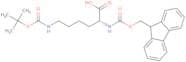
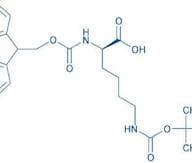
CAS 92122-45-7
:Fmoc-D-Lys(Boc)-OH
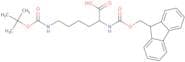
- N-alpha-(9-fluorenylmethyloxycarbonyl)-N-epsilon-t-butyl-oxycarbonyl-D-lysine
- N2,N6-bis[(9H-fluoren-9-ylmethoxy)carbonyl]-D-lysine
Nε-(tert-Butoxycarbonyl)-Nα-[(9H-fluoren-9-ylmethoxy)carbonyl]-D-lysine
CAS:Fórmula:C26H32N2O6Pureza:>98.0%(T)(HPLC)Cor e Forma:White to Almost white powder to crystalPeso molecular:468.55N(ε)-Boc-N(α)-Fmoc-D-lysine, 98%
CAS:This Thermo Scientific Chemicals brand product was originally part of the Alfa Aesar product portfolio. Some documentation and label information may refer to the legacy brand. The original Alfa Aesar product / item code or SKU reference has not changed as a part of the brand transition to Thermo SciFórmula:C26H32N2O6Pureza:98%Cor e Forma:Powder, WhitePeso molecular:468.55Ref: IN-DA006I0U
1kgA consultar1g22,00€5g27,00€10g44,00€25g67,00€50g104,00€100g153,00€250g247,00€500g577,00€Fmoc-D-Lys(Boc)-OH
CAS:Fórmula:C26H32N2O6Pureza:≥ 98.0%Cor e Forma:White to almost white powder or crystalsPeso molecular:468.54Fmoc-D-Lys(Boc)-OH
CAS:Fmoc-D-Lys(Boc)-OH is a building block for the synthesis of peptides. It can be used to synthesize chains that are up to 17 amino acids long. Fmoc-D-Lys(Boc)-OH is a protected amino acid with an active group on the alpha carbon and has been used in the synthesis of ganirelix acetate, a peptide that is used in the treatment of prostate cancer. The Boc group is an organic compound that protects the lysine side chain from reacting with other compounds. The Fmoc group is also an organic compound, which helps to protect the side chain from reactions with other compounds. These groups are removed at different stages of synthesis, depending on what type of reaction needs to take place next.
Fórmula:C26H32N2O6Pureza:Min. 95%Peso molecular:468.55 g/molFmoc-D-Lys(Boc)-OH
CAS:M03424 - Fmoc-D-Lys(Boc)-OH
Fórmula:C26H32N2O6Pureza:98%Cor e Forma:White powderPeso molecular:468.55N6-[(1,1-Dimethylethoxy)carbonyl]-N2-[(9H-fluoren-9-ylmethoxy)carbonyl]-D-lysine
CAS:Produto ControladoApplications Derivative of N6-[(1,1-Dimethylethoxy)carbonyl]-N2-[(9H-fluoren-9-ylmethoxy)carbonyl]-D-lysine is a hetero-bifunctional traceless linker for temporarily attaching highly solubilizing peptide sequences onto insoluble peptides.
References Jacobsen, M., et al.: J. Am. Chem. Soc., 138, 11775-11782 (2016)Fórmula:C26H32N2O6Cor e Forma:NeatPeso molecular:468.54N-alpha-Fmoc-Nepsilon-Boc-D-lysine
CAS:N-alpha-Fmoc-Nepsilon-Boc-D-lysine is a synthetic amino acid that is used for the treatment of bacterial, fungal, and cancer cells. It has been shown to induce apoptosis in cancer cells by increasing the mitochondrial membrane potential and reducing the cellular uptake of glucose. This drug also increases the production of reactive oxygen species in cancer cells, which can lead to cancer cell death. N-alpha-Fmoc-Nepsilon-Boc-D-lysine has been shown to have synergistic anticancer effects when combined with other drugs, such as antibiotics or antimicrobial peptides. NAPBODA has a high affinity for bacterial membranes and can be used as an antimicrobial agent.
Fórmula:C26H32N2O6Pureza:Min. 95%Cor e Forma:PowderPeso molecular:468.54 g/molFmoc-D-Lys(Boc)-OH
CAS:Bachem ID: 4004439.
Fórmula:C26H32N2O6Pureza:99.9%Cor e Forma:WhitePeso molecular:468.55
![Nε-(tert-Butoxycarbonyl)-Nα-[(9H-fluoren-9-ylmethoxy)carbonyl]-D-lysine](/_next/image/?url=https%3A%2Fstatic.cymitquimica.com%2Fproducts%2F3B%2Fthumb%2FB3071.jpg&w=3840&q=75)

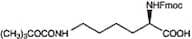

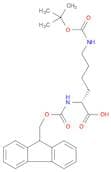





![N6-[(1,1-Dimethylethoxy)carbonyl]-N2-[(9H-fluoren-9-ylmethoxy)carbonyl]-D-lysine](/_next/image/?url=https%3A%2Fstatic.cymitquimica.com%2Fproducts%2FTR%2Fthumb%2FD447255.jpg&w=3840&q=75)