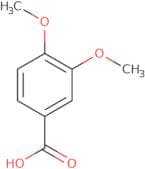
CAS 93-07-2
:Ácido verátrico
Descrição:
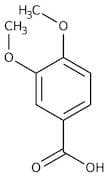
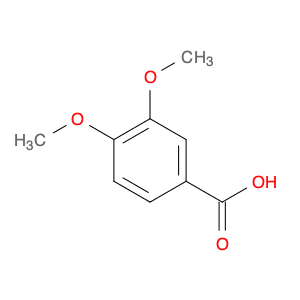
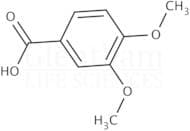
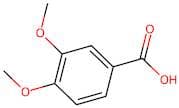
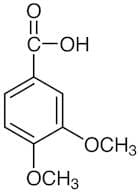
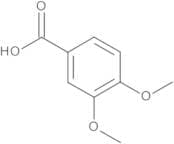
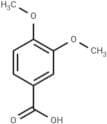
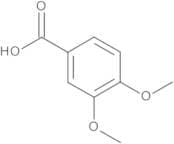
Ácido verátrico, também conhecido como ácido 3,4-dimetoxibenzoico, é um ácido carboxílico aromático caracterizado por seus substituintes metóxicos no anel benzênico. Possui a fórmula molecular C9H10O4 e apresenta um grupo funcional ácido carboxílico (-COOH) que contribui para suas propriedades ácidas. Ácido verátrico é tipicamente um sólido cristalino branco com um ponto de fusão que varia dependendo da pureza e das condições. É solúvel em solventes orgânicos como etanol e éter, mas tem solubilidade limitada em água. Este composto é frequentemente utilizado na síntese orgânica e como intermediário na produção de vários compostos químicos. Além disso, Ácido verátrico tem aplicações no campo farmacêutico e agroquímico. Sua estrutura permite interações potenciais em sistemas biológicos, tornando-o de interesse na química medicinal. Os dados de segurança indicam que deve ser manuseado com cuidado, assim como muitos ácidos orgânicos, para evitar irritação ou reações adversas.
Fórmula:C9H10O4
InChI:InChI=1/C9H10O4/c1-12-7-4-3-6(9(10)11)5-8(7)13-2/h3-5H,1-2H3,(H,10,11)/p-1
Chave InChI:InChIKey=DAUAQNGYDSHRET-UHFFFAOYSA-N
SMILES:O(C)C1=C(OC)C=CC(C(O)=O)=C1
Sinónimos:- 3,4-Bis(methyloxy)benzoic acid
- 3,4-Dimethoxybenzoate
- Acide veratrique
- Acido Veratrico
- Benzoic acid, 3,4-dimethoxy-
- Dimethylprotocatechuic acid
- Nsc 7721
- Veratric acid
- Veratrumsaure
- 3,4-Dimethoxybenzoic acid
- 3,4-dimethoxylbenzoic acid
- RARECHEM AL BO 0042
- VERATRIC ACID(RG)
- AKOS 220-15
- 3,4-Dimethylprotocatechuic acid
- Veratrumenoic acid
- 3,4-dimethoxy-benzoicaci
- 3,4-DIMETHOXYBENZOIC ACID (VERATRIC ACID)
- 3,4-Dimethoxybenzoic
- 3,4-DimethoxbenzoicAcid99%
- reratric acid
- 3,4-DIMETHOXY BENZOIC ACID (VERATRIC ACID) ,99+%
- 3,4-DIMETHOXYENZIOC ACID
- AKOS BBS-00003717
- PROTOCATECHUIC ACID DIMETHYL ETHER
- 3,4-dimethylprotocatechuicacid
- Ver mais sinónimos
Ordenar por
Pureza (%)
0
100
|
0
|
50
|
90
|
95
|
100
14 produtos.
3,4-Dimethoxybenzoic acid, 99+%
CAS:3,4-Dimethoxybenzoic acid plays an important role in producing antibiotics and various dyes. They are used as intermediates for pharmaceuticals (especially for antipyretic analgesic, antirheumatism) and other organic synthesis. It is used as matrix for ionization of peptides, proteins and carbohydraFórmula:C9H10O4Pureza:99+%Cor e Forma:White, PowderPeso molecular:182.183,4-Dimethoxybenzoic acid
CAS:Fórmula:C9H10O4Pureza:98%Cor e Forma:Solid, Light yellow powderPeso molecular:182.1753,4-Dimethoxybenzoic acid
CAS:Fórmula:C9H10O4Pureza:(Titration) 98.5 - 101.5 %Cor e Forma:White to faint yellow or faint orange powder or crystalsPeso molecular:182.183,4-Dimethoxybenzoic Acid
CAS:Fórmula:C9H10O4Pureza:>98.0%(GC)(T)Cor e Forma:White to Light yellow to Light orange powder to crystalPeso molecular:182.18Veratric acid
CAS:Veratric acid (3,4-Dimethoxybenzoic acid) is a simple benzoic acid derived from plants and fruits with anti-oxidant, anti-inflammation and blood pressure-Fórmula:C9H10O4Pureza:99.44%Cor e Forma:SolidPeso molecular:182.173,4-Dimethoxybenzoic acid
CAS:3,4-Dimethoxybenzoic acidFórmula:C9H10O4Pureza:97%Cor e Forma: white to faint yellow powderPeso molecular:182.17g/mol3,4-Dimethoxybenzoic Acid (Veratric Acid)
CAS:Produto ControladoApplications Veratric Acid is a derivative of Protocatechuic Acid. Veratric Acid is a reagent used in the production of antimicrobial agents, antifeedants, and a variety of other biologically active compounds.
References Alissandrakis, E., et al.: Eur. Food Res. Technol., 229, 365 (2009), Spaccini, R., et al.: Soil Biol. Biochem., 41, 1164 (2009), Narasimhan, B., et al.: Eur. J. Med. Chem., 44, 689 (2009), Pereira, L., et al.: J. Biotechnol., 139, 68 (2009),Fórmula:C9H10O4Cor e Forma:NeatPeso molecular:182.17Veratric acid
CAS:Veratric acid is a natural compound that is found in plants such as Vitis vinifera and Vaccinium myrtillus. It has been shown to have antimicrobial activity against Gram-positive bacteria, including Staphylococcus aureus and Streptococcus pneumoniae. Veratric acid binds to toll-like receptor 4 (TLR4), which activates the transcription factor nuclear factor kappa B (NF-κB) and increases expression of bacterial genes. It also inhibits pro-inflammatory cytokines by preventing the acetylation of histones at position H3, which are involved in transcriptional regulation. Veratric acid has synergistic effects when combined with p-hydroxybenzoic acid or ester hydrochloride. These compounds inhibit cell wall synthesis by inhibiting the enzyme peptidoglycan synthetase, leading to cell death. Veratric acid has also been shown to increase glomerular filtration rate and improve coordinationFórmula:C9H10O4Pureza:Min. 95%Cor e Forma:White/Off-White SolidPeso molecular:182.17 g/mol