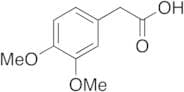
CAS 93-40-3
:Ácido (3,4-dimetoxifenil)acético
Descrição:
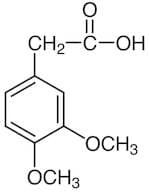
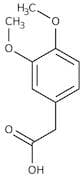
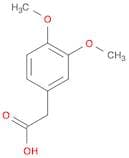
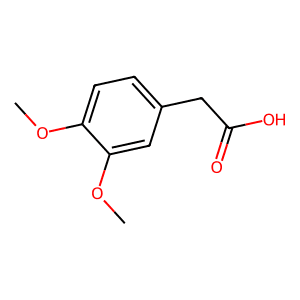
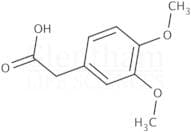
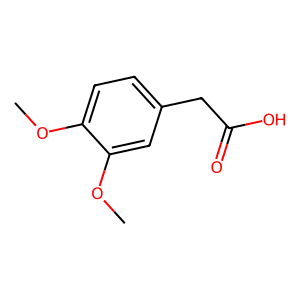
Ácido (3,4-dimetoxifenil)acético, com o número CAS 93-40-3, é um composto orgânico caracterizado por sua estrutura aromática e pela presença de dois grupos metóxi (-OCH3) ligados a um anel de fenila nas posições 3 e 4. Este composto apresenta um grupo funcional ácido acético (-COOH) que contribui para suas propriedades ácidas. Normalmente é um sólido branco a off-white à temperatura ambiente e é solúvel em solventes orgânicos como etanol e acetona, mas menos solúvel em água devido à sua estrutura aromática hidrofóbica. A presença dos grupos metóxi aumenta sua lipofilicidade e pode influenciar sua atividade biológica. Ácido (3,4-dimetoxifenil)acético é de interesse em vários campos, incluindo química medicinal, onde pode apresentar propriedades anti-inflamatórias ou analgésicas. Sua síntese geralmente envolve a metilação de compostos fenólicos seguida de carboxilação. Como muitos ácidos orgânicos, deve ser manuseado com cuidado, pois pode ser irritante para a pele e os olhos.
Fórmula:C10H12O4
InChI:InChI=1S/C10H12O4/c1-13-8-4-3-7(6-10(11)12)5-9(8)14-2/h3-5H,6H2,1-2H3,(H,11,12)
Chave InChI:InChIKey=WUAXWQRULBZETB-UHFFFAOYSA-N
SMILES:O(C)C1=C(OC)C=C(CC(O)=O)C=C1
Sinónimos:- (3,4-Dimethoxyphenyl)Acetate
- 2-(3,4-Dimethoxyphenyl)acetate
- 2-(3,4-Dimethoxyphenyl)acetic acid
- 3,4-Dimethoxybenzeneacetic acid
- 3,4-Dimethoxyphenylacetic acid
- 3,4-Dimethyloxy phenyl acetic acid
- Acetic acid, (3,4-dimethoxyphenyl)-
- Benzeneacetic acid, 3,4-dimethoxy-
- Dmpaa
- Homoveratric acid
- Homoveratricacid
- NSC 2753
- NSC 27897
- 3,4-Dimethoxyphenyl acetic acid
- Ver mais sinónimos
Ordenar por
Pureza (%)
0
100
|
0
|
50
|
90
|
95
|
100
10 produtos.
Homoveratric Acid
CAS:Fórmula:C10H12O4Pureza:>98.0%(T)Cor e Forma:White to Light yellow powder to crystalPeso molecular:196.203,4-Dimethoxyphenylacetic acid, 98%
CAS:It reacts with formaldehyde in the presence of acid to give an isochromanone. This Thermo Scientific Chemicals brand product was originally part of the Alfa Aesar product portfolio. Some documentation and label information may refer to the legacy brand. The original Alfa Aesar product / item code oFórmula:C10H12O4Pureza:98%Cor e Forma:Powder, Pale creamPeso molecular:196.20(3,4-Dimethoxyphenyl) Acetic Acid
CAS:Fórmula:C10H12O4Pureza:97%Cor e Forma:SolidPeso molecular:196.19993,4-Dimethoxyphenylacetic acid
CAS:3,4-Dimethoxyphenylacetic acid (Homoveratrumic acid) is the papaverine intermediate, used to synthesis cardiovascular drugs.Fórmula:C10H12O4Pureza:99.63%Cor e Forma:SolidPeso molecular:196.23,4-Dimethoxyphenylacetic acid
CAS:3,4-Dimethoxyphenylacetic acidPureza:≥98%Peso molecular:196.2g/mol3,4-Dimethoxyphenylacetic acid (Homoveratric acid)
CAS:Fórmula:C10H12O4Pureza:≥ 98.0%Cor e Forma:White to beige powderPeso molecular:196.203,4-Dimethoxyphenylacetic acid
CAS:3,4-Dimethoxyphenylacetic acidFórmula:C10H12O4Pureza:98%Cor e Forma: white solidPeso molecular:196.20g/mol(3,4-Dimethoxy-phenyl)-acetic acid
CAS:Fórmula:C10H12O4Pureza:97%Cor e Forma:Solid, Crystalline PowderPeso molecular:196.2023,4-Dimethoxyphenylacetic acid
CAS:3,4-Dimethoxyphenylacetic acid is an aromatic acid that has antimicrobial properties. It is used as a food additive for the preservation of meat and poultry. The 3,4-dimethoxyphenyl group in this molecule is an intramolecular hydrogen acceptor. This property allows it to undergo transfer reactions with other molecules, such as protocatechuic acid and lignin. 3,4-Dimethoxyphenylacetic acid also inhibits cellular physiology and can be used in the treatment of bacteria in biological systems. The hydroxyl group can form an acidic compound by reacting with a proton donor, such as water or trifluoroacetic acid (TFA). This reaction may be catalyzed by the enzyme cytochrome P450 reductase.Fórmula:C10H12O4Pureza:Min. 95%Cor e Forma:White PowderPeso molecular:196.2 g/mol(3,4-Dimethoxyphenyl)acetic Acid(Homoveratric Acid)
CAS:Produto ControladoApplications Homoveratric Acid is a dopamine metabolite that inhibits brain mitochondrial respiration via monoamine oxidase/H2O2-dependent or non-dependent pathway.
References Gluck, M.R. et al.: J. Neurochem., 91, 788 (2004); Morikawa, N. et al.: J. Neurochem., 66, 1174 (1996); Goodwin, B.L. et al.: Xenobiotica, 24, 129 (1994);Fórmula:C10H12O4Cor e Forma:NeatPeso molecular:196.2