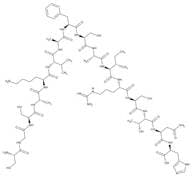
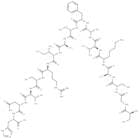
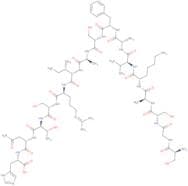
CAS 94071-26-8
:Cerebelina
Descrição:
Cerebelina, com o número CAS 94071-26-8, é um neuropeptídeo que desempenha um papel significativo no sistema nervoso central, particularmente no cerebelo. É composto por uma sequência de aminoácidos e é classificado como um fator neurotrófico, o que significa que apoia o crescimento, a sobrevivência e a diferenciação dos neurônios. Sabe-se que Cerebelina interage com receptores específicos, influenciando a plasticidade sináptica e a comunicação neuronal. Sua estrutura geralmente inclui uma série de ligações peptídicas que contribuem para sua atividade biológica. O peptídeo está envolvido em vários processos neurológicos, incluindo controle motor e funções cognitivas. Pesquisas indicaram que Cerebelina pode ter implicações em distúrbios do neurodesenvolvimento e pode ser um alvo para intervenções terapêuticas. Como substância química, é caracterizado por seu peso molecular específico, solubilidade em fluidos biológicos e estabilidade em condições fisiológicas. Compreender as propriedades e mecanismos de ação de Cerebelina é crucial para explorar suas aplicações potenciais em neurociência e medicina.
Fórmula:C6H113N23O23
InChI:InChI=1/C69H113N23O23/c1-9-33(4)52(66(112)84-42(19-15-21-76-69(73)74)58(104)88-48(30-96)64(110)92-53(37(8)97)67(113)86-44(24-49(72)98)61(107)87-45(68(114)115)23-39-25-75-31-78-39)91-56(102)36(7)80-63(109)47(29-95)89-60(106)43(22-38-16-11-10-12-17-38)85-55(101)35(6)81-65(111)51(32(2)3)90-59(105)41(18-13-14-20-70)83-54(100)34(5)79-62(108)46(28-94)82-50(99)26-77-57(103)40(71)27-93/h10-12,16-17,25,31-37,40-48,51-53,93-97H,9,13-15,18-24,26-30,70-71H2,1-8H3,(H2,72,98)(H,75,78)(H,77,103)(H,79,108)(H,80,109)(H,81,111)(H,82,99)(H,83,100)(H,84,112)(H,85,101)(H,86,113)(H,87,107)(H,88,104)(H,89,106)(H,90,105)(H,91,102)(H,92,110)(H,114,115)(H4,73,74,76)/t33-,34-,35-,36-,37?,40-,41-,42-,43-,44-,45-,46-,47-,48-,51-,52-,53-/m0/s1
SMILES:CC[C@H](C)[C@@H](C(=N[C@@H](CCCNC(=N)N)C(=N[C@@H](CO)C(=N[C@@H](C(C)O)C(=N[C@@H](CC(=N)O)C(=N[C@@H](Cc1cnc[nH]1)C(=O)O)O)O)O)O)O)N=C([C@H](C)N=C([C@H](CO)N=C([C@H](Cc1ccccc1)N=C([C@H](C)N=C([C@H](C(C)C)N=C([C@H](CCCCN)N=C([C@H](C)N=C([C@H](CO)N=C(CN=C([C@H](CO)N)O)O)O)O)O)O)O)O)O)O
Sinónimos:- H-Ser-Gly-Ser-Ala-Lys-Val-Ala-Phe-Ser-Ala-Ile-Arg-Ser-Thr-Asn-His-OH
Ordenar por
Pureza (%)
0
100
|
0
|
50
|
90
|
95
|
100
4 produtos.
Cerebellin
CAS:This Thermo Scientific Chemicals brand product was originally part of the Alfa Aesar product portfolio. Some documentation and label information may refer to the legacy brand. The original Alfa Aesar product / item code or SKU reference has not changed as a part of the brand transition to Thermo SciFórmula:C69H113N23O23Peso molecular:1632.8Cerebellin
CAS:Cerebellin: 16-amino acid peptide, from rat cerebellum, now found in human adrenal glands, mainly medullary chromaffin cells.Fórmula:C69H113N23O23Pureza:98%Cor e Forma:SolidPeso molecular:1632.78Cerebellin
CAS:Cerebellin is a protein that is found in the cerebellum. It has been shown to have a signal peptide, which is cleaved by proteases to form a mature protein. Cerebellin has receptor activity, and can bind to glutamate receptors. Cerebellin also has an effect on follicular growth and brain functions. The biological sample of cerebellin is from the Purkinje cells of the cerebellum. The chemical structure of cerebellin consists of three domains: two globular domains and one fibrous domain. It can be detected using fluorescein angiography or titration calorimetry, which measure its concentration in the body mass index or 3T3-L1 preadipocytes.Fórmula:C69H113N23O23Pureza:Min. 95%Peso molecular:1,632.78 g/molCerebellin trifluoroacetate
CAS:Please enquire for more information about Cerebellin trifluoroacetate including the price, delivery time and more detailed product information at the technical inquiry form on this page
Fórmula:C69H113N23O23•(C2HF3O2)4Pureza:Min. 95%Peso molecular:2,088.86 g/mol