CAS 942-24-5
:Metil indol-3-carboxilato
Descrição:
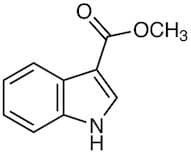
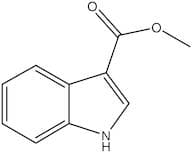
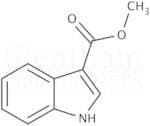
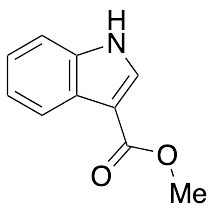
Metil indol-3-carboxilato, com o número CAS 942-24-5, é um composto orgânico que pertence à classe dos derivados do indol. Apresenta um grupo funcional de éster metílico ligado à estrutura do indol, que é um composto bicíclico consistindo em um anel de benzeno de seis membros fundido a um anel de pirrol de cinco membros que contém nitrogênio. Este composto é tipicamente caracterizado por suas propriedades aromáticas, que contribuem para sua estabilidade e reatividade. Metil indol-3-carboxilato é frequentemente utilizado em síntese orgânica e química medicinal devido às suas potenciais atividades biológicas, incluindo propriedades anti-inflamatórias e anticancerígenas. Geralmente é solúvel em solventes orgânicos como etanol e diclorometano, enquanto é menos solúvel em água. O composto pode passar por várias reações químicas, incluindo esterificação e hidrólise, tornando-se um intermediário versátil na síntese de moléculas mais complexas. Os dados de segurança devem ser consultados para manuseio, assim como com qualquer substância química, para garantir que as precauções adequadas sejam tomadas.
Fórmula:C10H9NO2
InChI:InChI=1/C10H9NO2/c1-13-10(12)8-6-11-9-5-3-2-4-7(8)9/h2-6,11H,1H3
SMILES:COC(=O)c1c[nH]c2ccccc12
Sinónimos:- 1H-Indole-3-carboxylic acid, methyl ester
- Indole-3-carboxylic acid, methyl ester
- methyl 1H-indole-3-carboxylate
- METHYL-(3-INDOLCARBOXYLATE)
- RARECHEM AH BS 0112
- Methylindole-3-Carboxylate99%
- methyl indoline-3-carboxylate
- METHYL INDOLE-3-CARBOXYLATE
- 3-Indolecarboxylic acid methyl ester
Ordenar por
Pureza (%)
0
100
|
0
|
50
|
90
|
95
|
100
13 produtos.
Methyl Indole-3-carboxylate
CAS:Fórmula:C10H9NO2Pureza:>98.0%(GC)Cor e Forma:White to Gray to Brown powder to crystalPeso molecular:175.19Methyl indole-3-carboxylate, 99%
CAS:Reactant used for preparation of nitric oxide synthesis (nNOS) inhibitors, protein kinase c alpha (PKC) inhibitors, inhibitors of the C-terminal domain of RNA polymerase II as antitumor agents, kinase insert domain receptor (KDR) inhibitors, organocatalysts for the anti-Mannich reaction, very late aFórmula:C10H9NO2Pureza:99%Cor e Forma:Powder or lumps, White to cream to dark cream to brown or purple to dark pink to pale pinkPeso molecular:175.19methyl indole-3-carboxylate
CAS:Fórmula:C10H9NO2Pureza:95.99%Cor e Forma:Brownish. SolidPeso molecular:175.0Methyl indole-3-carboxylate
CAS:Methyl indole-3-carboxylateFórmula:C10H9NO2Pureza:98%Cor e Forma: pale yellow solidPeso molecular:175.18g/molMethyl 3-indolecarboxylate
CAS:Fórmula:C10H9NO2Pureza:95%~99%Cor e Forma:PowderPeso molecular:175.187Methyl indole-3-carboxylate
CAS:Methyl indole-3-carboxylate (Methyl 3-indolecarboxylate) is a natural product isolated from Heracleum candicans.Fórmula:C10H9NO2Pureza:99.41%Cor e Forma:Light Pink PowderPeso molecular:175.18Methyl indole-3-carboxylate
CAS:Produto ControladoApplications Methyl indole-3-carboxylate is a reagent in the preaparation of oncrasin-1 derivatives which is a novel inhibitor of the C-terminal domain of RNA polymerase II.
References Wu, S., et al.: J. Med. Chem., 54, 2668 (2011);Fórmula:C10H9NO2Cor e Forma:NeatPeso molecular:175.18Indole-3-carboxylic acid methyl ester
CAS:Produto ControladoIndole-3-carboxylic acid methyl ester is a quinoline derivative that is structurally related to the well-known antibiotic, ciprofloxacin. It has been shown to be cytotoxic against a variety of bacterial strains including Pseudomonas aeruginosa and Staphylococcus aureus. The mechanism of action for this compound is not yet fully understood, but it has been shown to inhibit collagen production in cell cultures and induce neuronal death in mice. Indole-3-carboxylic acid methyl ester also possesses anti-cancer properties and inhibits fatty acid synthesis. This compound also has antifungal effects against Candida albicans and other fungi.Fórmula:C10H9NO2Pureza:Min. 98 Area-%Cor e Forma:PowderPeso molecular:175.18 g/mol