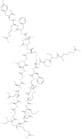
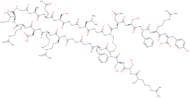
CAS 95896-08-5
:peptídeo natriurético atrial humano:*fragmento 4-28
Descrição:
O peptídeo natriurético atrial (ANP) é um hormônio produzido principalmente pelas células atriais do coração, desempenhando um papel crucial na regulação da pressão arterial e do equilíbrio de fluidos. O fragmento específico "4-28" refere-se a uma porção da molécula de ANP, que está envolvida em sua atividade biológica. Este fragmento peptídico é conhecido por seus efeitos natriuréticos, promovendo a excreção de sódio pelos rins, o que, por sua vez, ajuda a reduzir o volume sanguíneo e a pressão arterial. O número CAS 95896-08-5 identifica este fragmento específico em bancos de dados químicos, facilitando a pesquisa e aplicação em farmacologia e bioquímica. O ANP e seus fragmentos são de interesse na pesquisa cardiovascular devido às suas potenciais implicações terapêuticas em condições como hipertensão e insuficiência cardíaca. O peptídeo é tipicamente caracterizado por sua estrutura, que inclui uma sequência de aminoácidos que contribuem para sua função e interação com receptores específicos no corpo. No geral, o fragmento 4-28 do ANP é significativo para entender os mecanismos fisiológicos da regulação cardiovascular e as potenciais aplicações clínicas.
Fórmula:C112H175N39O35S3
InChI:InChI=1/C112H177N39O35S3/c1-7-56(4)88(151-98(175)65(25-17-36-127-112(122)123)139-101(178)72(43-87(164)165)144-97(174)67(32-37-189-6)140-94(171)63(23-15-34-125-110(118)119)134-84(161)45-128-82(159)44-129-92(169)69(39-58-18-10-8-11-19-58)141-106(183)79(54-188)150-104(181)77(52-155)149-103(180)75(50-153)146-90(167)62(113)22-14-33-124-109(116)117)107(184)132-46-83(160)133-57(5)89(166)137-66(30-31-80(114)157)96(173)147-74(49-152)93(170)131-47-85(162)135-68(38-55(2)3)91(168)130-48-86(163)136-78(53-187)105(182)143-71(42-81(115)158)100(177)148-76(51-154)102(179)142-70(40-59-20-12-9-13-21-59)99(176)138-64(24-16-35-126-111(120)121)95(172)145-73(108(185)186)41-60-26-28-61(156)29-27-60/h8-13,18-21,26-29,55-57,62-79,88,152-156,187-188H,7,14-17,22-25,30-54,113H2,1-6H3,(H2,114,157)(H2,115,158)(H,128,159)(H,129,169)(H,130,168)(H,131,170)(H,132,184)(H,133,160)(H,134,161)(H,135,162)(H,136,163)(H,137,166)(H,138,176)(H,139,178)(H,140,171)(H,141,183)(H,142,179)(H,143,182)(H,144,174)(H,145,172)(H,146,167)(H,147,173)(H,148,177)(H,149,180)(H,150,181)(H,151,175)(H,164,165)(H,185,186)(H4,116,117,124)(H4,118,119,125)(H4,120,121,126)(H4,122,123,127)/t56-,57-,62-,63-,64-,65-,66-,67-,68-,69-,70-,71-,72-,73-,74-,75-,76-,77-,78-,79-,88-/m0/s1
SMILES:CC[C@H](C)[C@@H](C(=NCC(=N[C@@H](C)C(=N[C@@H](CCC(=N)O)C(=N[C@@H](CO)C(=NCC(=N[C@@H](CC(C)C)C(=NCC(=N[C@@H](CS)C(=N[C@@H](CC(=N)O)C(=N[C@@H](CO)C(=N[C@@H](Cc1ccccc1)C(=N[C@@H](CCCNC(=N)N)C(=N[C@@H](Cc1ccc(cc1)O)C(=O)O)O)O)O)O)O)O)O)O)O)O)O)O)O)N=C([C@H](CCCNC(=N)N)N=C([C@H](CC(=O)O)N=C([C@H](CCSC)N=C([C@H](CCCNC(=N)N)N=C(CN=C(CN=C([C@H](Cc1ccccc1)N=C([C@H](CS)N=C([C@H](CO)N=C([C@H](CO)N=C([C@H](CCCNC(=N)N)N)O)O)O)O)O)O)O)O)O)O)O
Sinónimos:- Anaritide
- Atrial Natriuretic Factor (4-28) (human)
- H-Arg-Ser-Ser-Cys-Phe-Gly-Gly-Arg-Met-Asp-Arg-Ile-Gly-Ala-Gln-Ser-Gly-Leu-Gly-Cys-Asn-Ser-Phe-Arg-Tyr-OH (Disulfide bond)
Ordenar por
Pureza (%)
0
100
|
0
|
50
|
90
|
95
|
100
2 produtos.
Anaritide
CAS:Anaritide, a synthetic form of atrial natriuretic peptide (ANP) composed of 25 amino acids, enhances the glomerular filtration rate by dilating afferent arterioles and constricting efferent arterioles. It is utilized for studying its effects on patients with acute tubular necrosis, with a focus on improving dialysis-free survival rates.Fórmula:C112H175N39O35S3Cor e Forma:SolidPeso molecular:2724.02Atrial Natriuretic Factor (4-28) (human, bovine, porcine)
CAS:Atrial natriuretic factor (ANF) is a hormone that plays an important role in the regulation of sodium excretion and blood pressure. It binds to two different receptor sites, which are located on the cell membrane. The ANF-A receptor is found in the atria of the heart and the ANF-B receptor is found in the kidneys. ANF has been shown to increase water excretion from the kidneys and decrease blood pressure by increasing sodium excretion from the kidneys and decreasing salt retention. Atrial natriuretic factor (4-28) is a disulfide form of ANF that has a high affinity for its receptors. This agent can be labeled with a radioactive atom for use as an experimental tool for determining binding sites. Atrial natriuretic factor (4-28) can also be chemically conjugated with polymers, such as polyethylene glycol, to make it more water soluble and therefore more useful as a drug candidate.Fórmula:C112H175N39O35S3Pureza:Min. 95%Cor e Forma:SolidPeso molecular:2,724.03 g/mol